When Your Ads Work But Your Website Doesn’t: What’s Really Going On
If your ads are working, why isn’t your website converting? is one of the most common — and most frustrating — questions in digital marketing today. The short answer:
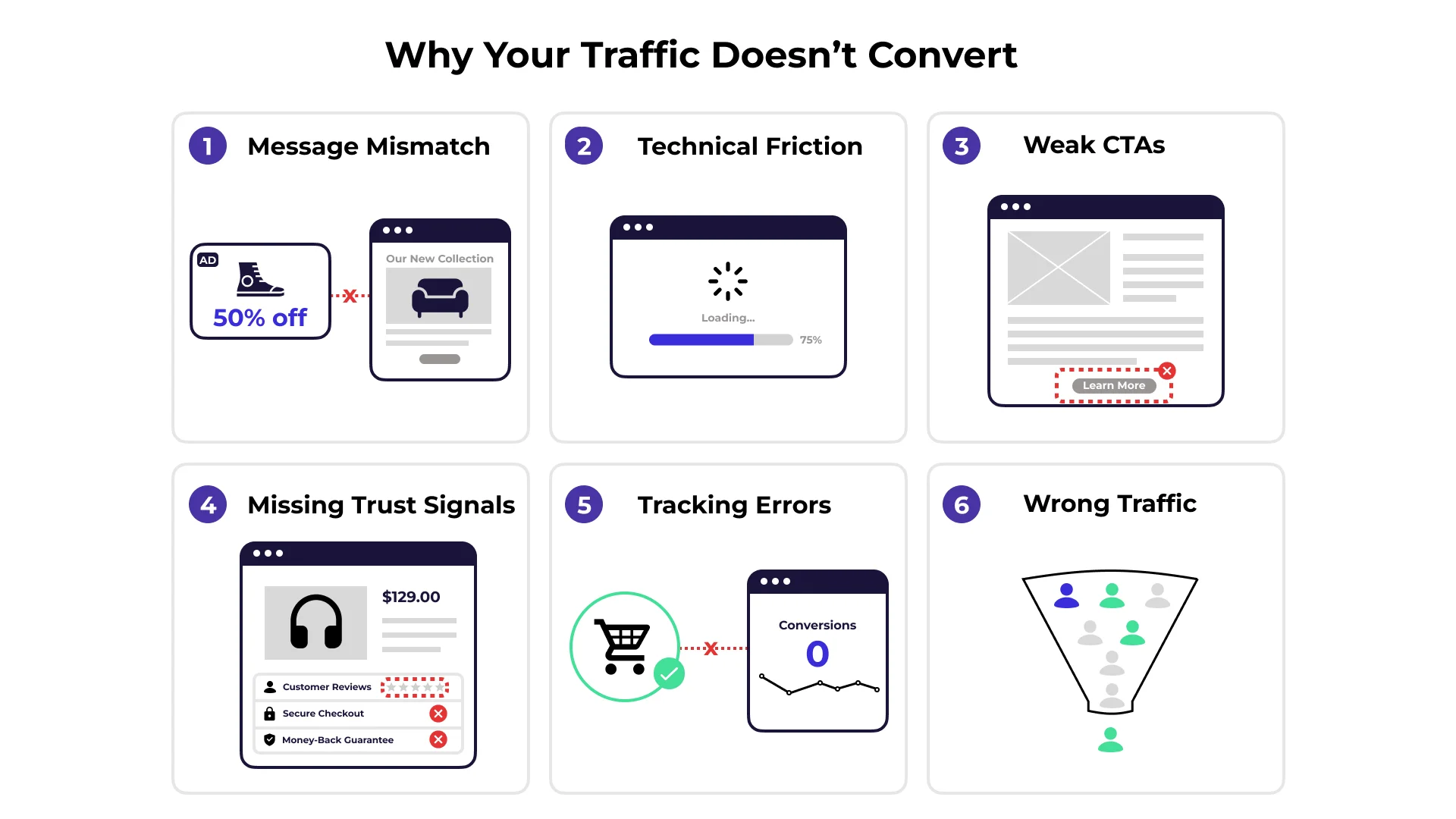
- Message mismatch — your landing page doesn’t deliver on what your ad promised
- Technical friction — slow load times or poor mobile experience drive visitors away
- Weak CTAs — vague or buried calls-to-action fail to guide users toward action
- Missing trust signals — no testimonials, guarantees, or social proof to reduce hesitation
- Tracking errors — conversions are actually happening, but aren’t being recorded correctly
- Wrong traffic — broad targeting brings clicks from users who were never going to buy
Your ads get people to the door. Your website has to close the deal. When one half of that equation breaks down, you pay for clicks that go nowhere.
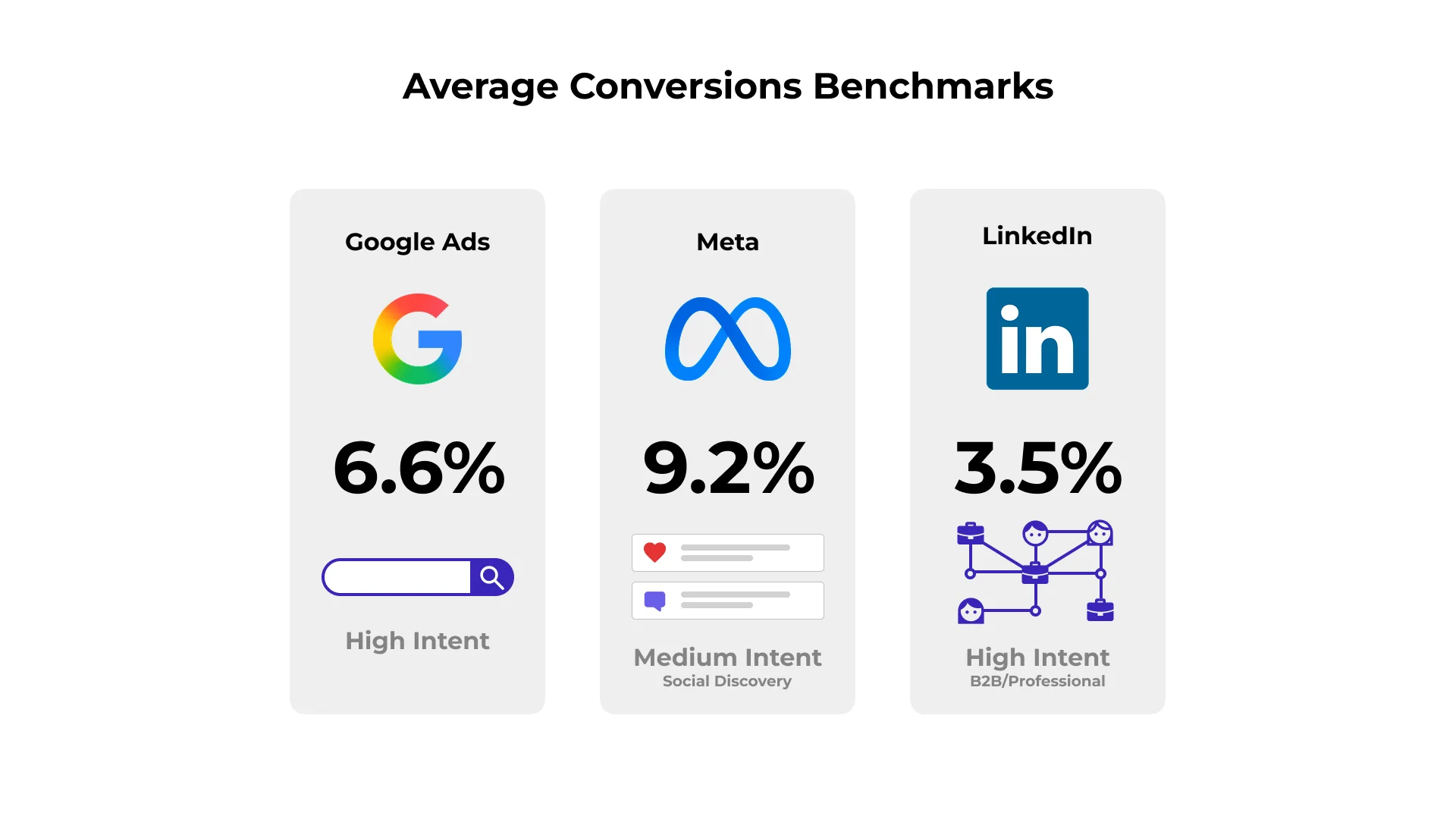
In May 2026, ad costs are higher than ever. Every unoptimized click is money left on the table. The average Google Ads conversion rate across all industries is 6.6% — if you’re well below that, your website is almost certainly the bottleneck, not your ads.
The good news? Most of these problems are fixable without pausing your campaigns or rebuilding your site from scratch.
I’m Jeffery Loquist, Vice President at SiteTuners and a conversion rate optimization specialist with over 18 years of experience aligning paid media strategy with on-site performance — including a decade managing PPC, SEO, and conversion teams for a major e-commerce brand. Throughout this guide, I’ll walk you through exactly why if your ads are working, why isn’t your website converting is a question with a diagnosable, solvable answer. Let’s find where your funnel is leaking.
The Disconnect: If Your Ads Are Working, Why Isn’t Your Website Converting?
When we look at a dashboard showing a high Click-Through Rate (CTR) but a stagnant conversion rate, we are seeing a disconnect between “promise” and “delivery.” In the digital landscape of May 2026, users have zero patience for a disjointed experience. If your ads are generating clicks, it means your targeting, creative, and offer are compelling enough to stop the scroll. You’ve won the first half of the battle.
However, if those clicks don’t turn into customers, the issue is likely the “post-click” experience. The problem usually boils down to either the traffic quality or the website’s ability to handle that traffic. If the ads are “working” by platform standards (high engagement), the platform’s algorithm thinks it’s doing a great job. But algorithms optimize for clicks unless you’ve trained them for conversions.
To find out where the ball is being dropped, you must Audit Your Landing Pages: Uncover Conversion Blockers. User expectations in 2026 are centered on immediacy and relevance. If a user clicks an ad for “Eco-friendly Roofing” and lands on a generic construction homepage, they feel a “bait-and-switch” sensation and bounce immediately.
Understanding Message Match and Ad Relevance
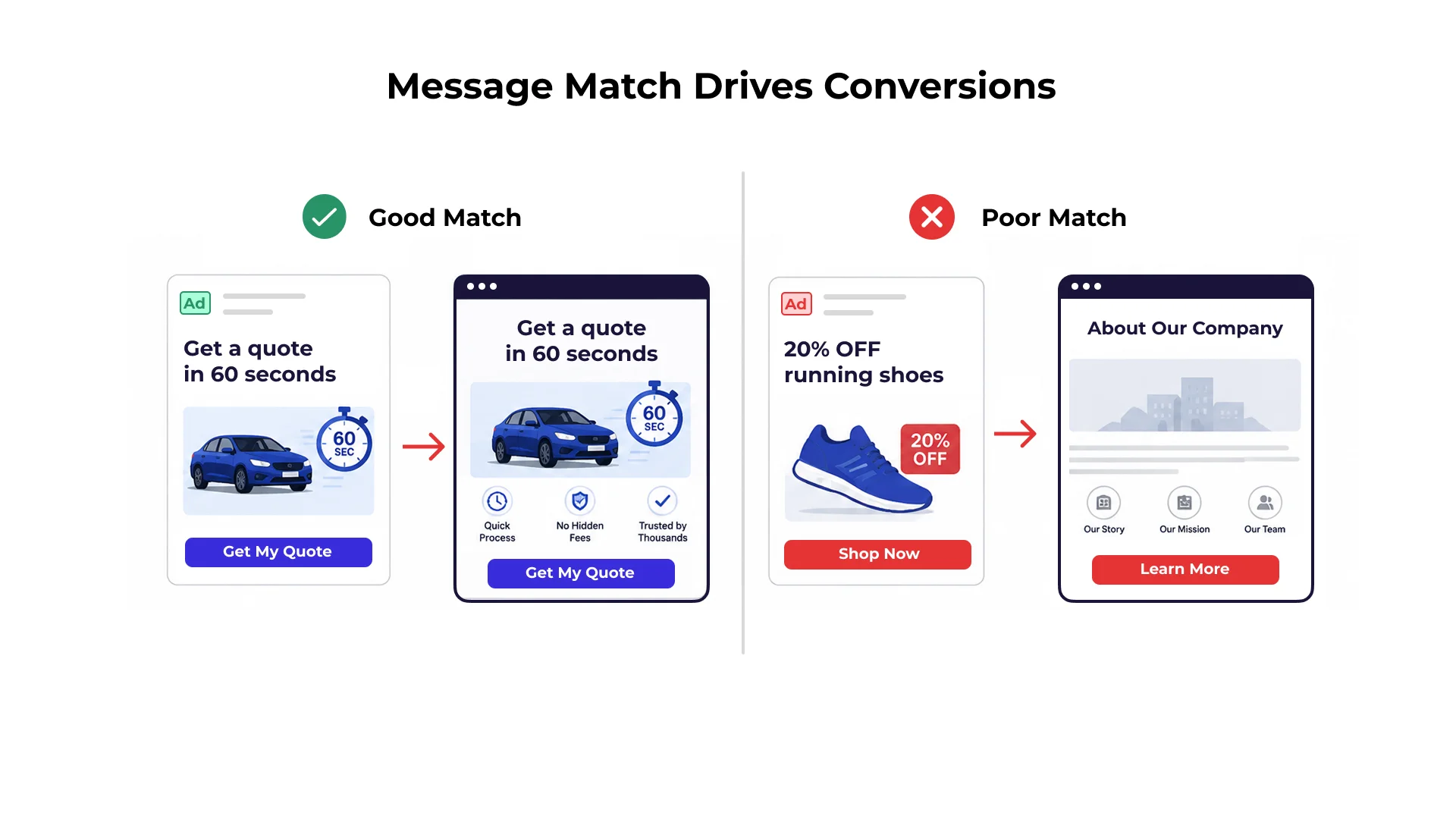
Message match is the measure of how well your landing page headline, imagery, and offer align with the ad that preceded it. This is a cornerstone of What Makes Google AdWords Campaigns Work.
We often see “narrative gaps” where the ad makes a specific brand promise (e.g., “Get a Quote in 60 Seconds”), but the landing page is a long-form “About Us” page. To maintain narrative continuity:
- Headline Alignment: The landing page headline should ideally mirror the ad’s primary hook word-for-word.
- Visual Consistency: If the ad featured a specific product image or color palette, the landing page must use the same visual language to reassure the user they are in the right place.
- Offer Reinforcement: If you promised a 20% discount in the ad, that discount should be the first thing the user sees on the page.
Why Your Website Isn’t Converting High-Intent Search Traffic
Search traffic is unique because it carries explicit intent. When someone searches for “Emergency HVAC repair near me,” they aren’t browsing; they are looking to buy. If you are paying for these high-intent clicks but seeing no leads, you likely have “conversion leaks.”
You can learn How to Spot PPC Conversion Leaks in Your Google Ad Campaigns by looking at your Search Terms report. Often, broad match keywords attract “educational” traffic rather than “commercial” traffic. For example, if you sell premium software, you don’t want to pay for clicks from people searching for “free software alternatives.”
According to 7 Reasons Your Google Ads Are Not Converting – Travis Sonder, landing page relevance is the number one killer of search ROI. If your page is too generic, it fails to answer the specific question the user asked the search engine.
5 Common Barriers Killing Your Ad-Driven Conversions
Even with a perfect message match, technical and psychological barriers can stop a conversion in its tracks. We call these “friction points.” Friction increases the cognitive load—the mental effort required to complete a task. As noted in Why Your Website Isn’t Converting (And It’s Not Just the Design), a beautiful site can still be a conversion failure if it’s difficult to use.
Technical Friction: Speed and Mobile Optimization
In 2026, 53% of mobile users will abandon a page that takes longer than 3 seconds to load. If your page takes 5 seconds, you’ve lost half your audience before they even see your logo. This is one of the most common Landing Page Mistakes: 7 Things You’re Doing Wrong on Your Landing Pages (and How to Fix Them).
With mobile-first indexing, your mobile site is your site. We often see desktop-centric designs where “thumb-friendly” navigation is ignored. If a user has to pinch and zoom to click a button, they won’t. Using tools like PageSpeed Insights is a non-negotiable step in modern CRO.
Weak Calls-to-Action and Messaging Gaps
A Call-to-Action (CTA) should be a command, not a suggestion. Vague phrases like “Learn More” or “Submit” are conversion killers. Instead, use action-oriented language that highlights the benefit, such as “Get My Free Quote” or “Start My Trial.”
For an 8 Steps to a Better Direct Response Landing Page, clarity is king. Your value proposition—the reason why someone should buy from you and not a competitor—must be visible “above the fold” (the area visible without scrolling). If a user has to hunt for the “Buy” button, you’ve already lost them. Check out our Tips to Improve Direct Response Landing Pages for more on CTA placement.
The Trust Gap: Missing Social Proof and Guarantees
Paid traffic is “cold” traffic. These visitors don’t know you, and they certainly don’t trust you yet. To bridge this gap, you need trust signals.
For instance, when looking at Why Your HVAC Website Isn’t Converting in Canada (And How to Fix It), the lack of local reviews or certification badges was a primary reason for failure. People want to see:
- Testimonials: Real stories from real people.
- Risk Reversal: Money-back guarantees or “no-obligation” consultations.
- Security Badges: Proof that their data is safe, especially on e-commerce sites.
Diagnosing and Fixing the Conversion Breakdown
Before you can fix the problem, you have to find it. We use a combination of quantitative data (the “what”) and qualitative data (the “why”).
| Platform | Avg. Conversion Rate | Intent Level |
|---|---|---|
| Google Search | 6.6% | High |
| Meta (Facebook/IG) | 9.2% | Medium (Social/Discovery) |
| 3.0% – 5.0% | High (B2B/Professional) |
Using GA4 Funnel Exploration, you can see exactly where people drop off. Is it the landing page? The cart? The checkout? Once you identify the “leaky” step, you can use heatmaps and session recordings to watch how users interact with that specific page. Do they miss the CTA? Do they get stuck on a broken form field?
A great example of this process in action is our Getting the Most Out of PPC Landing Page Tests: Coastal Insurance Solutions Case Study, where iterative testing turned a stagnant campaign into a lead-generation machine.
Why Your Website Isn’t Converting Due to Tracking Errors
Sometimes, the answer to if your ads are working, why isn’t your website converting? is simply that your data is wrong. We frequently find misconfigured pixels or Google Tag Manager (GTM) triggers that fail to fire on the confirmation page.
To ensure your 3 Ways to Make Your PPC Efforts Pay Off, verify your attribution. Are you counting “button clicks” as conversions, or actual “thank you page” loads? Data discrepancies between your ad platform and your CRM can lead you to pause winning campaigns or scale losing ones.
Prioritizing CRO Over Scaling Ad Spend
The natural instinct when sales are low is to “turn up the volume” on ads. But if your website has a 1% conversion rate, doubling your ad spend just doubles your waste.
Systematic CRO can improve conversion rates by 50-300% over 12 months. As highlighted in 10 Reasons Why Your Ads Aren’t Converting And How to Turn It Around, fixing the “leaky bucket” first makes every future ad dollar more efficient. Don’t scale until you’ve optimized.
Frequently Asked Questions about Ad Conversions
What is a good conversion rate benchmark for ad traffic in 2026?
While it varies by industry, the 2026 benchmark for Google Ads is roughly 6.6%. E-commerce on Meta often sees higher rates (around 9.2%) due to the visual nature of the platform, while B2B SaaS might consider 3-4% excellent. Always measure against your specific industry median rather than a global average.
Should I use dedicated landing pages for every ad campaign?
Yes, absolutely. A dedicated landing page allows you to remove distracting navigation menus and focus the user entirely on one action. This is a core pillar of our 8 Steps to a Better Direct Response Landing Page. It also makes A/B testing much cleaner, as you can test specific variables for specific audiences.
How long does it take to see results from website optimization?
While “quick fixes” like improving page speed can show results in days, meaningful CRO takes time. You typically need 30-60 days to reach statistical significance in A/B tests. This “learning phase” allows you to gather enough data to ensure your improvements aren’t just a fluke.
Conclusion
If you’ve been staring at your dashboard wondering, “If my ads are working, why isn’t my website converting?” you now have the roadmap to find the answer. It isn’t magic; it’s a systematic process of removing friction, building trust, and aligning your message.
At SiteTuners, we’ve been the Conversion Rate Optimization Agency of choice for over 2,100 clients since 2002. We don’t guess—we use data-driven, user-centric optimization to deliver measurable results. Whether you’re in Tampa, Florida, or operating globally across Europe, Asia, or Latin America, the principles of human psychology remain the same: people want clarity, speed, and trust.
Stop wasting your ad budget on a website that isn’t ready to convert. Scaling growth starts with fixing the foundation.
Ready to stop the leaks? Contact SiteTuners today for a conversion audit and let’s turn those clicks into customers.