Why Your Landing Page Might Be Costing You Money
A landing page conversion audit is a systematic evaluation of your landing page’s performance to identify barriers preventing visitors from taking your desired action. Here’s what it uncovers:
- Unclear messaging that confuses visitors about your offer
- Weak calls-to-action that fail to drive clicks
- Form friction causing abandonment before completion
- Design issues that distract from your conversion goal
- Trust gaps making visitors hesitate to engage
- Mobile problems losing a significant portion of your traffic
- Page speed issues increasing bounce rates
The reality is stark: businesses spend $92 on acquiring customers for every $1 spent on converting them. If your landing page isn’t converting, you’re essentially pouring marketing dollars down the drain. With the average landing page conversion rate sitting at just 2.35%, while top performers achieve 5.31% or higher, there’s often massive room for improvement.
Most landing pages fail not because of bad products or poor traffic, but because of overlooked friction points. A vague headline here, a confusing form there, slow load times on mobile—these small issues compound into a significant revenue leak.
The good news? A structured audit process can identify exactly where visitors are dropping off and why. You don’t need to guess what’s wrong or blindly follow generic “best practices” that may not apply to your specific audience.
I’m Jeffery Loquist, Vice President at SiteTuners, and I’ve spent over 18 years optimizing landing pages across e-commerce, lead generation, and paid media campaigns. Throughout my career conducting countless landing page conversion audits, I’ve seen how systematic evaluation transforms underperforming pages into revenue-generating machines. Let me show you the exact process we use to uncover and fix conversion blockers.
The Foundation: What is a Landing Page Conversion Audit and Why is it Crucial?
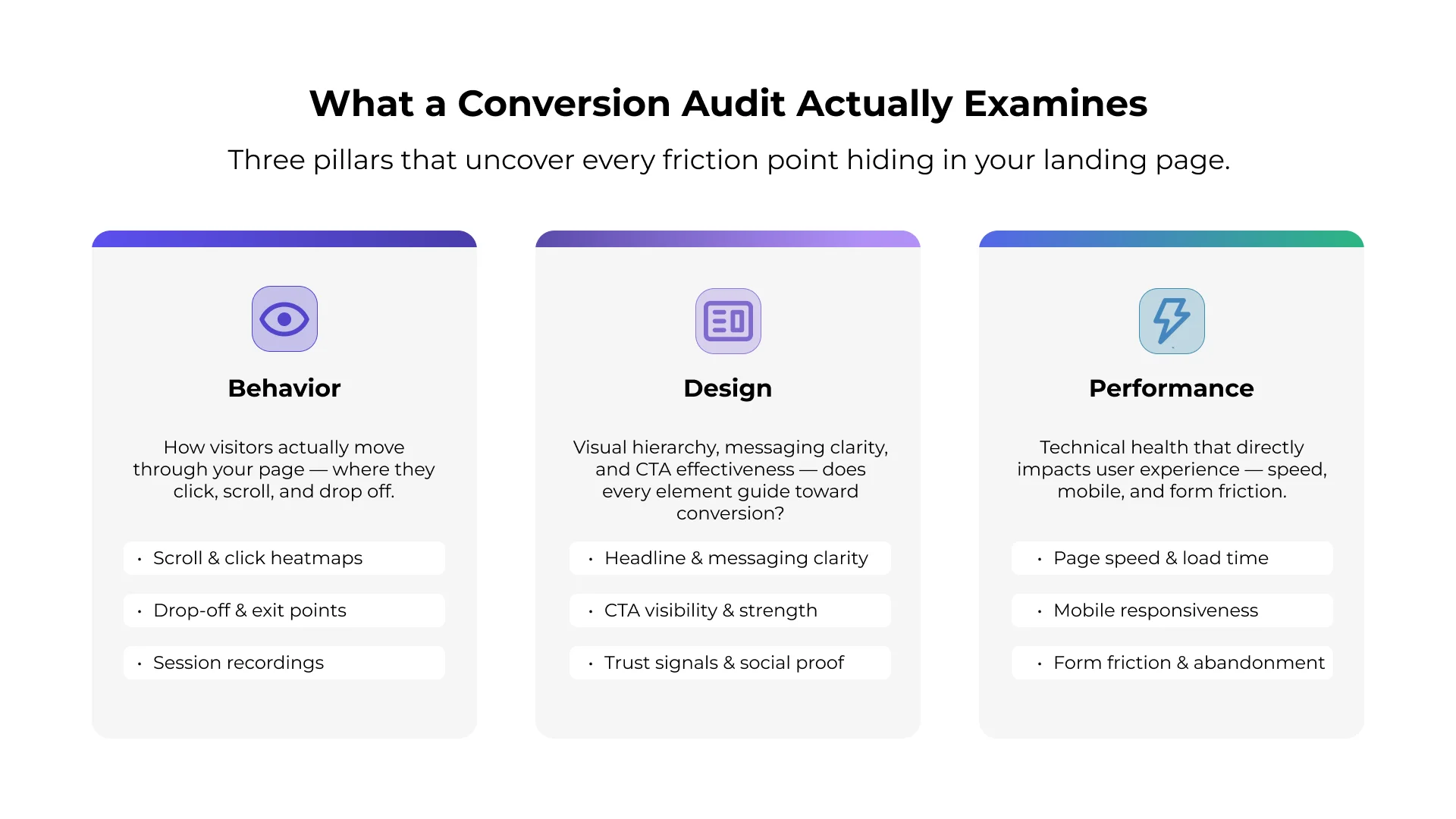
A landing page conversion audit is a comprehensive evaluation designed to scrutinize every element of a landing page to pinpoint factors hindering conversions. Think of it as a thorough health check for your conversion funnel. We’re not just looking for obvious flaws; we’re diving deep into user behavior, design choices, content effectiveness, and technical performance to identify subtle friction points that deter visitors from taking action.
Why is this audit so important? Because your landing page is often the critical moment in your marketing campaigns. It’s where your ad spend either pays off or gets wasted. A well-executed audit identifies and removes obstacles, leading to better return on investment (ROI) and lower ad costs. It transforms guesswork into data-driven decisions, ensuring every change we make is backed by evidence.
How does a landing page conversion audit differ from a general website CRO audit? While both aim to improve conversion rates, a landing page audit is far more focused. A general website CRO audit takes a broad look at an entire site, evaluating overall user engagement, lead generation across multiple pages, and the complete site structure. An e-commerce CRO audit, for instance, digs specifically into shopping experiences, product pages, and the checkout process.
However, a landing page, by its very nature, is designed with a single, specific goal in mind – whether it’s capturing a lead, making a sale, or encouraging a download. This singular focus makes landing pages incredibly sensitive to any friction or design flaws. Even minor issues can cause a significant drop-off. Our audit zeros in on this specific page, ensuring every element works in harmony towards that one conversion goal. This dedicated approach allows us to uncover precise issues that a broader website audit might overlook, ensuring that your valuable traffic isn’t wasted. For more insights on crafting effective pages, check out our 8 Essential Tips for Creating High-Converting Landing Pages.
The Impact on Your Marketing ROI
A robust landing page conversion audit directly contributes to a healthier marketing ROI. When we identify and fix conversion blockers, we don’t just get more conversions; we get better conversions. This translates into increased lead quality, as the page is optimized to attract and nurture the right audience. Consequently, your cost-per-acquisition (CPA) often decreases, meaning you spend less to acquire each new customer or lead.
Consider this: businesses might spend $92 to acquire a customer for every $1 spent on converting them. This imbalance highlights a massive opportunity for improvement. A targeted audit shifts this balance, maximizing campaign performance by ensuring that every dollar spent on traffic brings a higher return.
We’ve seen the power of this approach. For example, some businesses have reported a 29% increase in average conversion rate after implementing audit recommendations. Others have experienced a dramatic increase in leads by 325% and sales by 300%. Our own AutoWeb Case Study: How SiteTuners Implemented 7 High-Converting Landing Page Design Principles with Google to Improve Conversions and Reduce Costs showcases how our systematic approach can lead to significant cost reductions and improved performance. By optimizing your landing pages, you gain a competitive advantage, turning your ad clicks into valuable conversions rather than lost opportunities.
Key Benefits of Regular Audits
Optimizing your landing pages isn’t a one-and-done task. The digital landscape is constantly evolving, as are user behaviors, market trends, and even search engine algorithms. That’s why regular landing page conversion audits are so beneficial.
They foster continuous improvement, allowing us to adapt to shifting user expectations and refine our strategies over time. What works today might not be as effective tomorrow. By consistently evaluating and optimizing, we ensure your landing pages remain relevant and perform at their peak. This iterative process helps us stay ahead of competitors who might be resting on their laurels. Regular audits lead to sustained growth, turning your landing pages into enduring assets that consistently generate leads and sales. For more on this, explore our guide on Building Landing Pages That Convert Higher.
Your Step-by-Step Guide to a Comprehensive Landing Page Conversion Audit
Ready to roll up your sleeves and become a conversion detective? Our comprehensive landing page conversion audit process involves a blend of quantitative data analysis (numbers don’t lie!), qualitative user feedback (what are people really thinking?), and heuristic evaluation (applying expert knowledge and best practices). Here’s our step-by-step guide to uncovering those elusive conversion blockers.
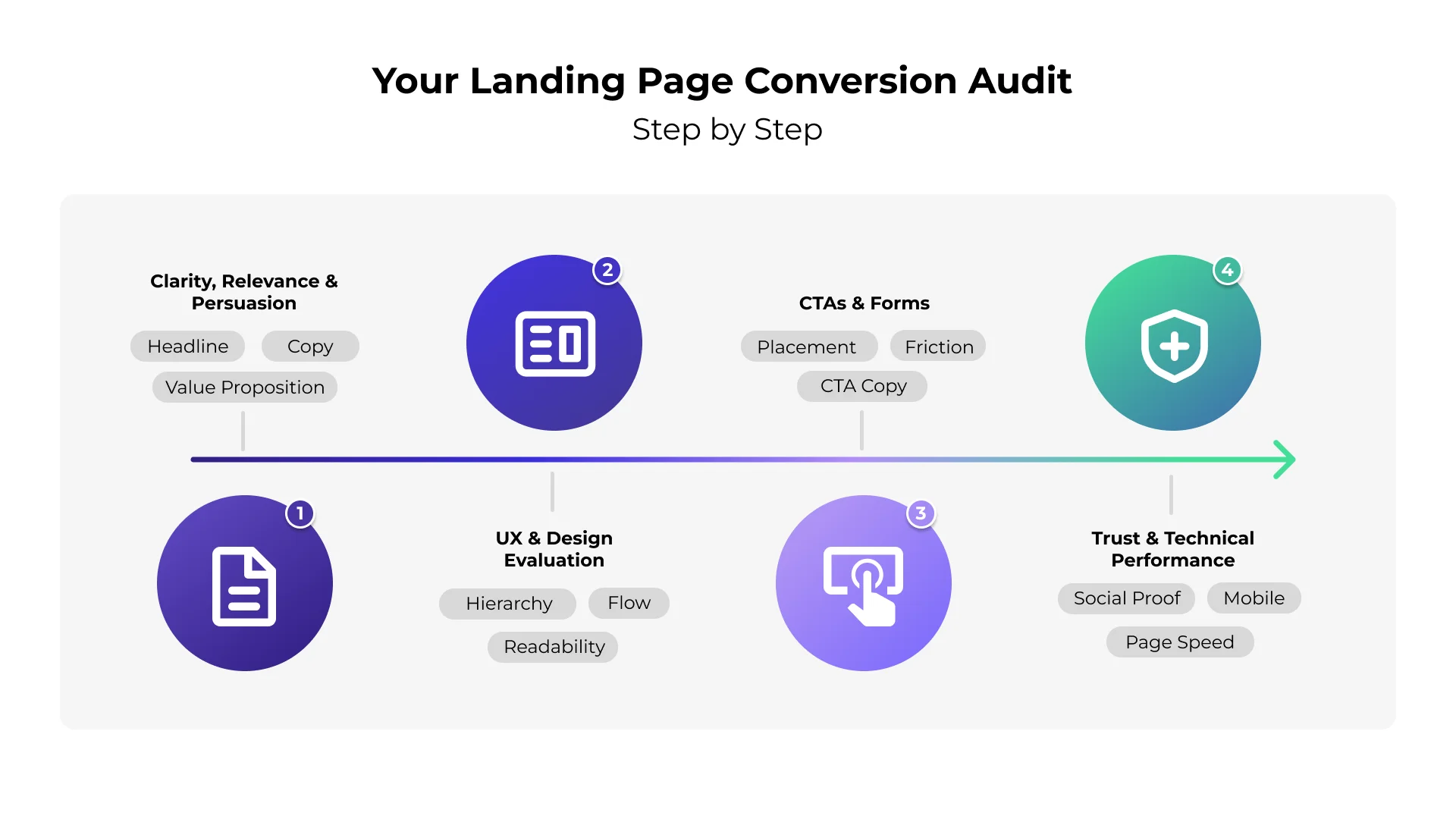
Step 1: Analyze Clarity, Relevance, and Persuasion
The first impression your landing page makes is everything. This step focuses on how effectively your message resonates with visitors.
- Headline Analysis: Your headline is arguably the most critical element. Does it match or complement the ad or search result that brought the visitor to your page? This “message matching” is crucial for a good quality score and lower cost-per-click (CPC) in paid campaigns. A clear headline should address the visitor’s intent, highlight a key benefit, and grab attention within seconds. The Flaus headline, for example, clearly explains what the product does: “the electric flosser that makes smiles accessible for everyone.”
- Value Proposition: Does your landing page clearly communicate the unique value your product or service offers? Visitors need to understand “what’s in it for them” immediately.
- Elevator Pitch Clarity: Could a stranger understand the purpose of your page in five to ten seconds? Your page message should have the clarity of a 30-second elevator pitch. If not, it’s too complicated.
- Copywriting: We scrutinize your copy for conciseness, impact, and persuasiveness. Avoid jargon and extraneous words. As conversion experts, we often advise “Kruging” your copy – cutting it in half, then cutting what’s left in half again. This ensures maximum clarity and keeps the page short and sweet.
- Pain Points: Does your content directly address the visitor’s key pain points or needs? Effective copy acknowledges their problems and positions your solution as the answer.
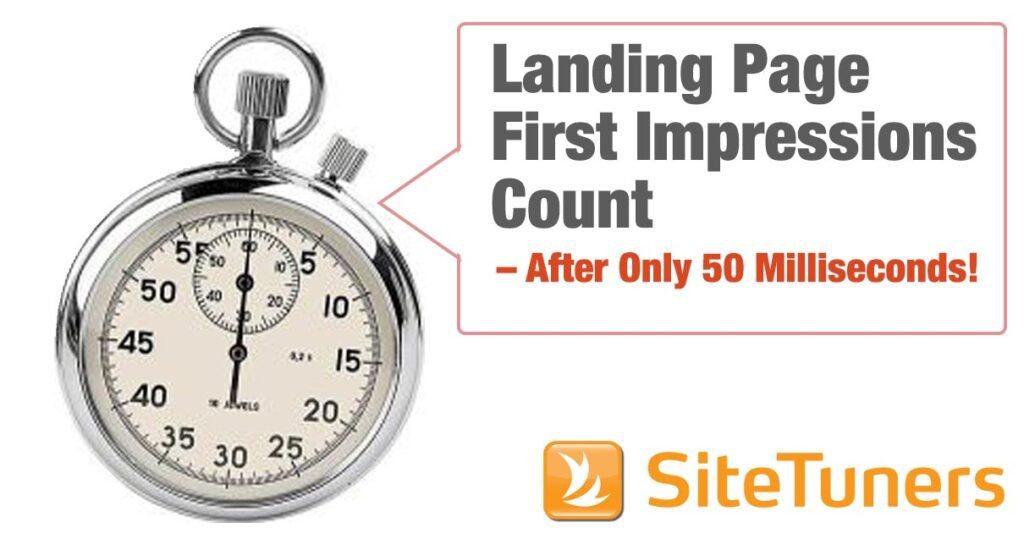
Landing Page First Impressions Count. If your message isn’t clear and relevant from the get-go, visitors will bounce faster than a rubber ball.
Step 2: Evaluate User Experience (UX) and Design
A beautiful page is nice, but a functional, intuitive page is a conversion machine. This step dives into how users interact with your page.
- Visual Hierarchy: Does the design clearly guide the visitor’s eye towards the most important elements, like your headline and call-to-action (CTA)? We look for clear visual pathways that direct attention.
- White Space: Is there enough breathing room around your content? Ample white space improves readability and helps focus the user’s attention. Take a look at Sunday’s landing page example to see how a clean design with ample white space can create a pleasant and effective user experience.
- Readability: We check font choices, sizes, and color contrast to ensure your text is easy to read for all users, including those with visual impairments.
- Navigation Flow: Landing pages should have a clear structure and a smooth navigation path towards the conversion goal. We look for minimal distractions. This often means removing extraneous links, like global navigation menus, which can create “page leaks” and pull visitors away from your primary objective.
- Distraction Removal: Are there annoying pop-ups, excessive links, or cluttered elements that compete for attention? We aim for a clean, uncluttered design that supports the primary goal of the landing page.
Heatmaps, like the one shown, are invaluable here. They visually represent where users click, scroll, and spend their time, helping us identify areas of confusion or neglect. Understanding Landing Page Layout Principles is key to optimizing this aspect.
Step 3: Scrutinize Calls-to-Action (CTAs) and Forms
The CTA and lead generation form are where the rubber meets the road. This is where visitors either convert or abandon.
- CTA Visibility and Design: Is your CTA button prominently visible and easy to spot? Does it stand out from the rest of the design, perhaps with a contrasting color? We ensure it’s large enough to be easily clicked, especially on mobile devices.
- Action-Oriented Copy: The text on your CTA should be clear, action-oriented, and specific about what happens next. Instead of a generic “Submit,” a CTA like “View Pricing Plans” (as seen on Beehiiv) or “Create an Email for Free” (like Sidekick) tells visitors exactly what to expect. It should also communicate the benefit or outcome of clicking.
- Strategic Placement: CTAs should be in the hero section and strategically placed in multiple locations throughout longer pages. Directional cues (like graphical arrows or eye-tracking elements) can guide users to your CTA.
- Form Length and Fields: The length of your form should align with the value of your offer. If you’re asking for a simple newsletter signup, a form with just an email field (like MODL) is ideal. For a free product demo (like Rattle) or a free trial (like Groove, which asks for only three fields), a slightly longer form might be acceptable, but only essential fields should be included.
- Friction Reduction: We audit forms for clarity of labels, logical order, mobile optimization, and clear error messages. Are optional fields clearly marked? Are there trust signals (like a privacy policy link) near the form to alleviate anxiety? We want to minimize any friction that might cause abandonment.
For more detailed insights on improving forms and CTAs, check out our 5 Lead Gen Landing Page Design Tips to Improve Conversion and our article The CRO Playbook: Mastering Web Conversion for Maximum Impact.
Step 4: Assess Trust, Credibility, and Technical Performance
Visitors need to trust you before they convert. And if your page is slow or broken, they won’t even get that far.
- Trust Signals and Credibility: We evaluate the presence and prominence of trust-building elements. Are security badges visible? Are customer testimonials prominently displayed, with specific details (name, company, photo) to increase credibility? Social proof, such as relevant reviews, ratings, case studies, partner logos, or even customer counts (like Vandham’s 5 million+ customers), significantly boosts confidence. User-generated content, such as the videos featured by Genius Litter showcasing happy cats, can be incredibly persuasive.
- Technical Performance:
- Page Speed: This is non-negotiable. A page loading speed under 3 seconds is crucial for good user experience and conversion rates. We use tools like Google PageSpeed Insights to identify elements slowing down your site and recommend optimizations.
- Mobile Responsiveness: With a significant portion of traffic coming from mobile devices, your landing page must be perfectly optimized for all screen sizes. We check for clear text, easy-to-tap buttons, and appropriate layouts on mobile. A lack of mobile optimization is a common mistake that can decimate your conversion rates.
From Audit to Action: Tools, Testing, and Optimization
Once we’ve conducted the comprehensive landing page conversion audit, the real work begins: translating insights into actionable optimization strategies. We prioritize findings based on potential impact and ease of implementation, creating a clear roadmap for improvements. This involves implementing changes, measuring their impact, and continuously iterating for better results.
We also analyze the customer journey and navigation flow. By mapping common navigation routes using Google Analytics and looking for high drop-off points, we can uncover specific obstacles like confusing navigation or a lack of trust signals that prevent conversions. Funnel analysis helps us understand where users abandon the process and target our fixes effectively.
The Essential Toolkit for Your Landing Page Conversion Audit
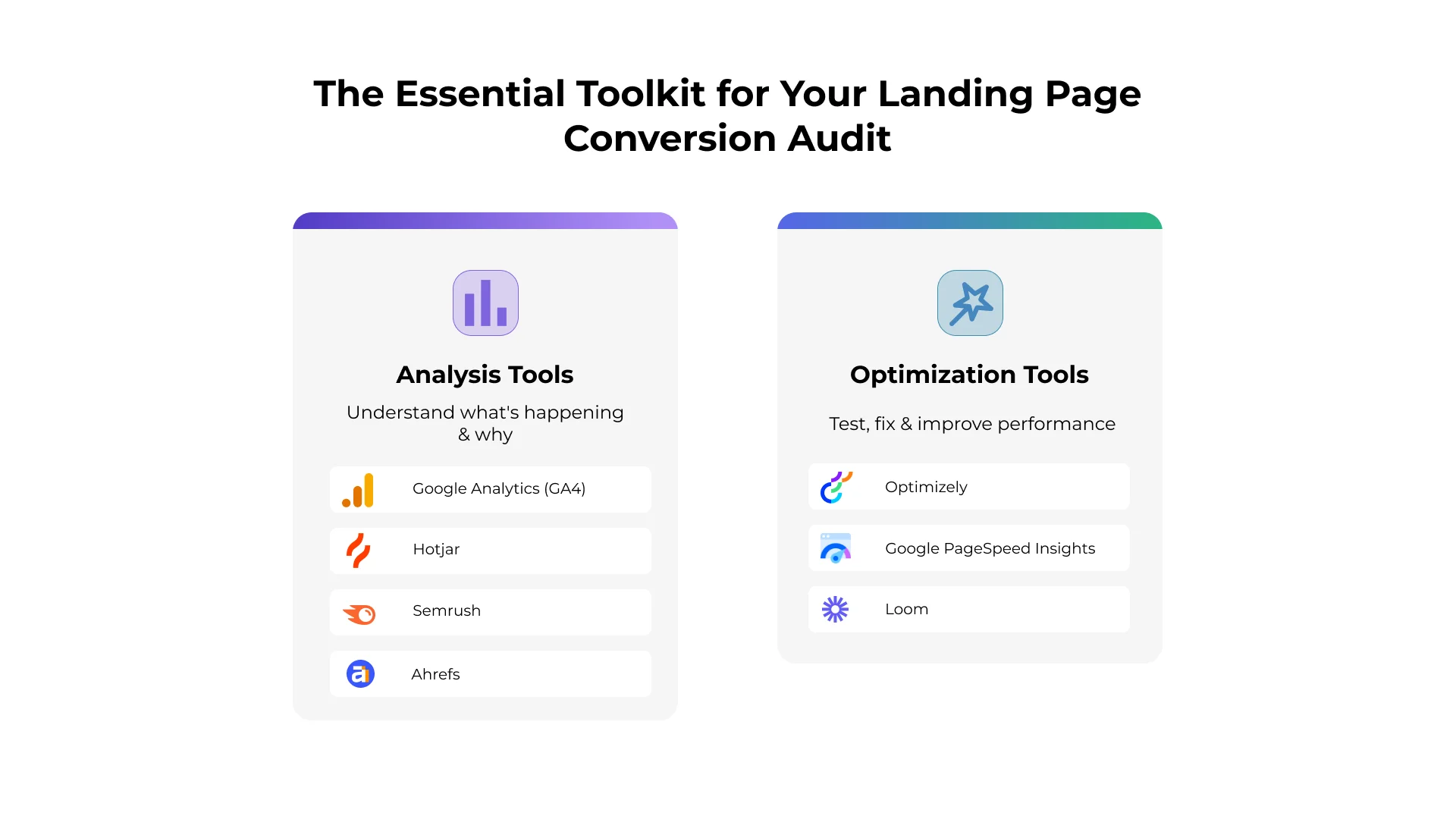
To conduct a thorough landing page conversion audit, we rely on a suite of powerful tools:
- Analytics Tools: Google Analytics (GA4) is fundamental for tracking page performance, identifying traffic sources, bounce rates, time on page, and goal completions. We ensure event tracking and goals (like form submissions or CTA clicks) are properly configured.
- User Behavior Tools: Heatmaps and session recordings (from tools like Hotjar) provide invaluable qualitative data, showing us exactly where users click, scroll, hesitate, or abandon the page.
- A/B Testing Platforms: Tools like Optimizely are essential for running experiments to validate our hypotheses and measure the impact of changes.
- Page Speed Tools: Google PageSpeed Insights helps us diagnose and fix speed issues.
- Other Specialized Tools: We also use tools like Semrush or Ahrefs for keyword analysis, and SimilarWeb for competitor analysis to benchmark performance and identify industry strategies. For creating quick video demos or screencasts, tools like Jing can be effective.
Developing Your Hypothesis and Integrating A/B Testing
A landing page conversion audit is not just about finding problems; it’s about finding solutions and proving their effectiveness. This is where A/B testing comes in.
- Forming a Hypothesis: Based on our audit findings, we develop clear, testable hypotheses. For example: “Changing the CTA button color from blue to orange will increase clicks by 15% because orange creates more contrast.”
- A/B Testing Process: We then design and run A/B tests to compare variations of specific web elements. This allows us to make data-driven decisions rather than relying on gut feelings. We ensure tests run long enough to generate statistically significant results.
- Learning from Tests: Whether a test “wins” or “loses,” we gain valuable insights into user preferences and behavior patterns. We then apply the winning variants to improve site performance and continuously refine our understanding of what works for your audience. Our Getting the Most Out of PPC Landing Page Tests: Coastal Insurance Solutions Case Study demonstrates how rigorous A/B testing can lead to substantial improvements. For more examples and to test your own CRO intuition, you can explore A/B testing examples on GuessTheTest.
Frequently Asked Questions about Landing Page Audits
How much does a professional landing page audit cost?
The cost of a professional landing page conversion audit can vary significantly based on the complexity and scale of your website and marketing efforts. For small to medium-sized business websites, a basic CRO audit might range from $1,000 to $5,000. Larger business websites can expect costs between $10,000 to $25,000. For enterprise-level websites with extensive traffic and numerous landing pages, the cost may exceed $50,000.
E-commerce CRO audits, which dig deeper into shopping cart abandonment, product page layouts, and checkout optimization, typically start around $15,000 and can rise to $30,000 or more for large platforms. The investment, however, often yields a significant ROI, with many businesses reporting substantial increases in conversion rates and revenue.
What are the most common mistakes to avoid in a landing page conversion audit?
When conducting a landing page conversion audit, it’s easy to fall into common traps that can derail your efforts. Here are some critical mistakes we see and how to avoid them:
- Ignoring Mobile Users: Focusing only on desktop performance is a huge oversight. With the majority of internet traffic now mobile, neglecting mobile responsiveness and user experience can lose a significant portion of your audience.
- Neglecting User Feedback: Quantitative data tells you what is happening, but user feedback (surveys, session recordings, usability tests) tells you why. Don’t ignore the voices of your actual visitors.
- Focusing Only on High-Traffic Pages: While high-traffic pages offer significant optimization potential, sometimes lower-traffic pages with specific, high-value offers can have hidden conversion blockers that are easier and more impactful to fix.
- Not Considering the Full User Journey: A landing page is rarely an isolated event. It’s part of a larger customer journey. Consider how users arrive, what they expect, and what happens after they convert.
- Making Assumptions Without Data: Never assume you know why something isn’t converting. Always back your hypotheses with data, whether from analytics, heatmaps, or A/B tests.
- Lacking a Testing Plan: An audit provides insights, but without a clear plan for A/B testing and implementing changes, those insights remain just that – insights.
For a deeper dive into common pitfalls, check out our insights on Landing Page Mistakes: 7 Things You’re Doing Wrong on Your Landing Pages and How to Fix Them.
How often should I perform a landing page audit?
The digital world is dynamic, so optimizing your landing pages isn’t a one-time event; it’s a continuous process. We recommend performing a landing page conversion audit regularly, ideally:
- Quarterly or Semi-Annually: This ensures ongoing maintenance and keeps your pages aligned with current user behaviors and market trends.
- After Significant Website Changes: Any major redesigns, platform migrations, or content overhauls warrant an immediate audit to catch new friction points.
- Before Launching Major Campaigns: Especially for high-budget paid advertising campaigns, an audit ensures your landing pages are primed to convert, maximizing your ad spend.
- When Performance Drops: If you notice a sudden or gradual decline in conversion rates, bounce rates, or lead quality, it’s a clear signal that an audit is needed to diagnose the problem.
Regular audits are crucial for adapting to user behavior, staying ahead of competitors, and ensuring sustained growth for your marketing efforts.
Conclusion: Start Uncovering Your Conversion Blockers Today
A landing page conversion audit is more than just a checklist; it’s a strategic imperative for any business serious about maximizing its online performance. It empowers you to move beyond guesswork, systematically identify conversion blockers, and implement data-driven improvements that deliver tangible results. By embracing a continuous improvement mindset, your landing pages can transform from underperforming assets into powerful revenue generators.
At SiteTuners, we’ve been helping businesses in the United States, Canada, Europe, Asia Pacific, and Latin America increase sales and leads since 2002. Our expertise in Conversion Rate Optimization (CRO) is backed by over 2,100 satisfied clients and a proven focus on user-centric optimization. We specialize in uncovering those hidden friction points that are costing you conversions and turning them into opportunities for growth.
Don’t let your valuable traffic slip away. Take control of your conversion rates and open up the full potential of your marketing campaigns.
Ready to take the next step? Get a professional CRO audit from a leading optimization agency and start turning more visitors into customers today.