
Why Your Website Needs a Strategic Optimization Plan in 2026
Your 2026 Website Optimization Checklist addresses a critical reality: most business websites are losing leads and revenue. Issues like slow loading speeds, poor mobile experiences, or confusing content cause visitors to abandon your site in seconds, even if the problems are invisible to you.
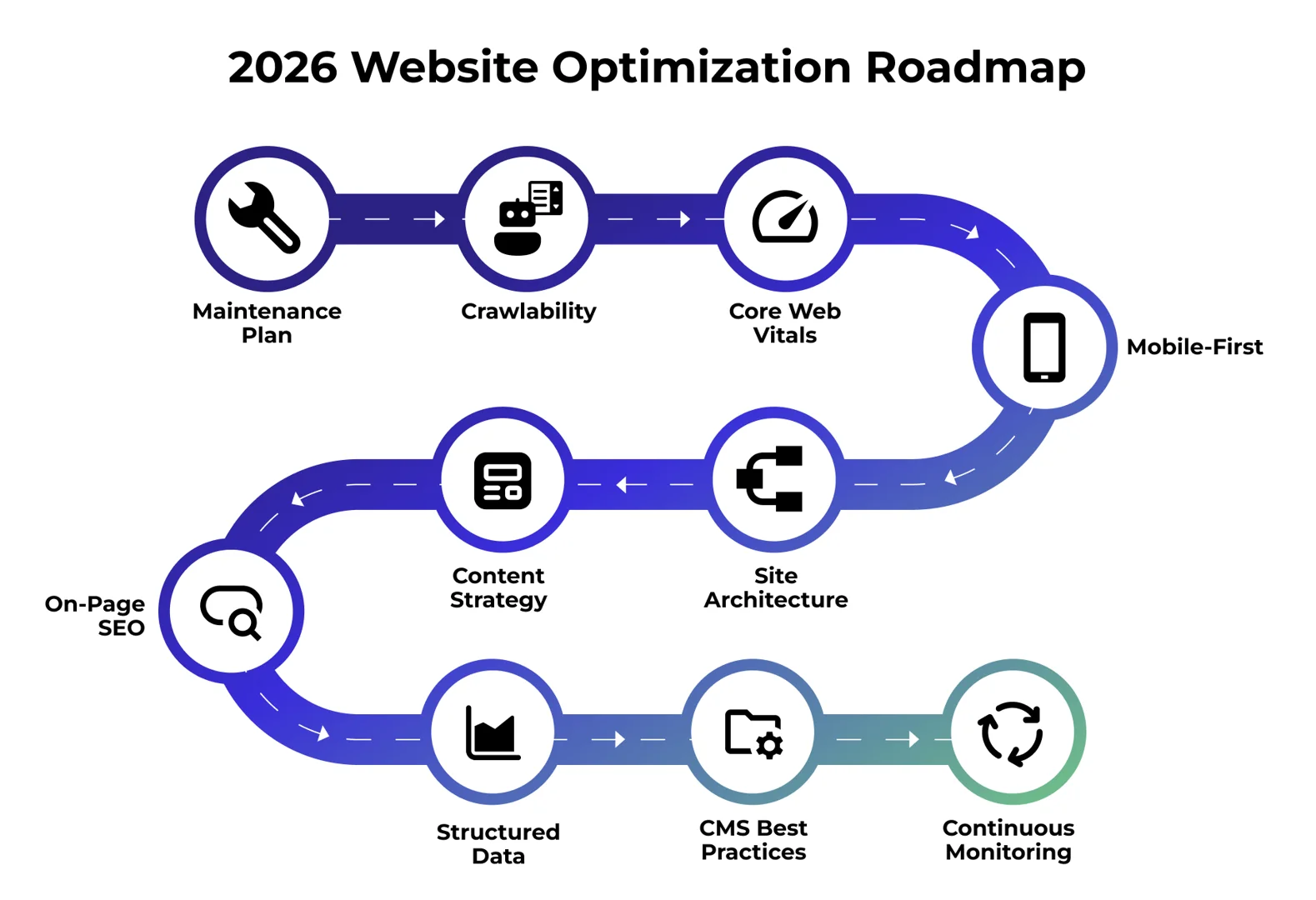
Here are the 10 essential steps to optimize your website in 2026:
- Establish a Proactive Maintenance Plan – Schedule weekly, monthly, quarterly, and annual tasks to keep your site secure, fast, and search-ready
- Optimize Crawlability & Indexation – Ensure search engines and AI crawlers can find and understand your content
- Boost Core Web Vitals – Target LCP under 2.5s, INP under 200ms, and CLS below 0.1 for optimal performance
- Prioritize Mobile-First Experience – Optimize for the 60%+ of users accessing your site from mobile devices
- Refine Site Architecture – Build logical structures with clear internal linking and shallow crawl depth
- Evolve Your Content Strategy – Focus on comprehensive topic coverage and search intent rather than just keywords
- Optimize On-Page Elements – Perfect your title tags, meta descriptions, headings, and image alt text
- Implement Structured Data – Use schema markup to help search engines and AI understand your content
- Apply CMS-Specific Best Practices – Leverage platform features for SEO-friendly URLs, redirects, and sitemaps
- Establish Continuous Monitoring – Track performance with Google Search Console, Analytics, and regular technical audits
The digital landscape is evolving. Google’s algorithms change constantly, and AI-powered search (like ChatGPT and Google’s SGE) now favors trusted, well-structured sources. With an average of 33% of website traffic coming from organic search, optimization is essential for survival.
The challenge is clear: 53% of users abandon sites that take longer than 3 seconds to load, and a one-second delay can cut conversions by 20%. Mobile generates over 60% of web traffic, yet many sites fail mobile-first standards. With AI-driven zero-click searches on the rise, the stakes are higher than ever.
The good news? Most website optimization issues are fixable without needing to be a developer. This checklist addresses the critical performance factors that determine whether visitors stay or leave, whether search engines surface your content, and whether your site converts traffic into revenue.
As Jeff Loquist, Vice President at SiteTuners, I’ve used this checklist approach for over 18 years to help businesses transform underperforming websites. My background in e-commerce, paid media, SEO, and CRO provides a complete view of the user journey, driving measurable revenue growth through technical and strategic improvements.
Step 1-2: Establish Your Foundation with a Proactive Maintenance Plan
Think of your website as a high-performance vehicle: it needs consistent maintenance to stay fast, secure, and search-ready. A proactive maintenance plan is core to long-term success, preventing security vulnerabilities, slow load times, and poor SEO rankings that harm the user experience.
The key is shifting from a reactive to a proactive strategy, turning maintenance into an investment, not an emergency expense. A structured weekly, monthly, quarterly, and annual schedule ensures long-term performance, compliance, and user trust.
Weekly & Monthly Maintenance Tasks
Weekly and monthly tasks form the backbone of a healthy site, addressing immediate concerns and preventing small issues from escalating.
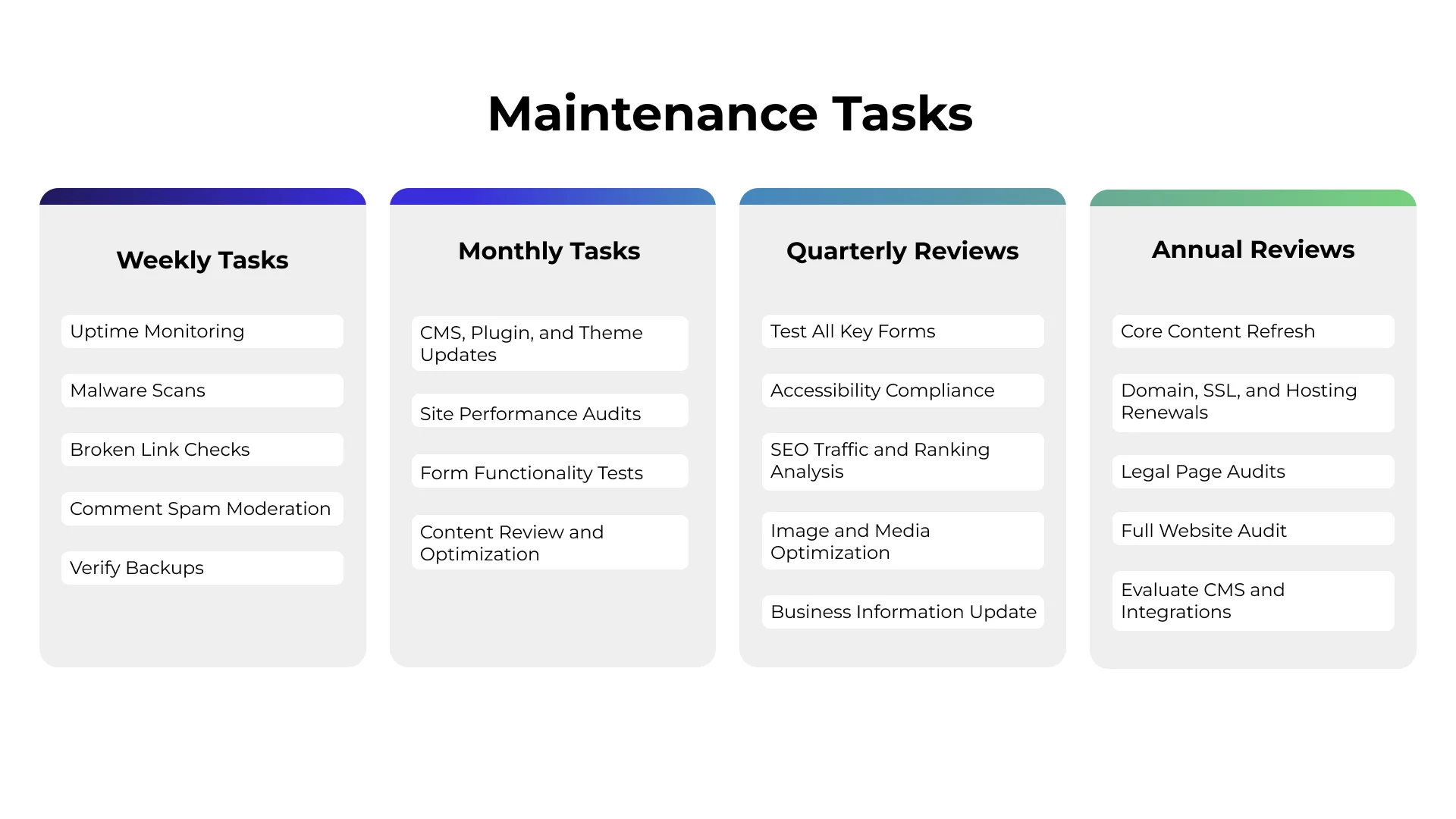
Weekly Tasks:
- Uptime Monitoring: We use tools like UptimeRobot to monitor site availability, which is crucial for user experience and SEO.
- Malware Scans: We run regular scans with tools like Sucuri to detect and eliminate threats before they cause damage.
- Broken Link Checks: We use tools like Ahrefs to find and fix broken links, which frustrate users and waste crawl budget.
- Comment Spam Moderation: We moderate comments to maintain a professional image.
- Verify Backups: We verify that automatic backups are working, ensuring quick recovery. Tools like BlogVault can help manage this.
Monthly Tasks:
- CMS, Plugin, and Theme Updates: Update your CMS core, plugins, and themes every month to reduce security risks and avoid compatibility problems.
- Site Performance Audits: Run a monthly audit with Google PageSpeed Insights to spot and fix speed issues before they hurt user experience.
- Form Functionality Tests: Test your most important forms each month to make sure leads, inquiries, and sign-ups are coming through properly.
- Content Review and Optimization: Refresh or improve content monthly to keep it accurate and useful. Review your sitemap and robots.txt regularly to make sure search engines can crawl the right pages.
Quarterly & Annual Strategic Reviews
Quarterly and annual reviews align our website optimization with broader business goals.
Quarterly Reviews:
- Test All Key Forms: A thorough test of all forms ensures they’re functioning perfectly for conversions.
- Accessibility Compliance (WCAG): We review our site against WCAG standards to ensure it’s usable by everyone, as many jurisdictions require WCAG 2.1 Level AA compliance.
- SEO Traffic and Ranking Analysis: We analyze search rankings and traffic to identify trends and adapt our strategy to algorithm changes.
- Image and Media Optimization: We compress or replace outdated media to maintain site performance.
- Business Information Update: We verify and update business information (hours, services) for accuracy on our site and in local listings.
Annual Reviews:
- Core Content Refresh: We refresh core pages (“About,” “Services”) to ensure they are current and demonstrate E-E-A-T (Experience, Expertise, Authoritativeness, and Trustworthiness).
- Domain, SSL, and Hosting Renewals: We confirm renewals to prevent service interruptions. An expired SSL certificate can create security warnings that deter visitors.
- Legal Page Audits: We audit our Privacy Policy and Terms of Service for compliance with current regulations.
- Full Website Audit: A comprehensive audit helps identify underlying issues and prepare our site for future needs, a crucial step in Your 2026 Website Optimization Checklist.
- Evaluate CMS and Integrations: We assess if our CMS and integrations still meet our needs and are scalable.
Step 3-6: Master Your 2026 Website Optimization Checklist for Technical SEO
Technical SEO is the foundation of online visibility. In 2026, with the rise of AI and zero-click searches, a technically sound website is critical. Speed, stability, and structure are prerequisites, as search engines and AI platforms demand them. Without a solid technical base, valuable content may fail to rank or be excluded from AI overviews.
The biggest SEO challenges in 2026 are changing algorithms, AI search, and intense competition. To adapt, we must focus on the pillars of technical SEO: crawlability, performance, mobile-first design, and site architecture.
Step 3: Optimize Crawlability & Indexation
Crawlability and indexation ensure search engines and AI crawlers can efficiently find and process our content.
- XML Sitemaps: An optimized XML sitemap acts as a roadmap for search engines. We ensure it includes only relevant, indexable pages and submit it to Google Search Console and Bing Webmaster Tools.
- Robots.txt: This file guides crawlers on what to access. We refine it to block low-value pages and test changes with Google’s Robots Testing Tool. The emerging
LLMs.txtfile serves a similar purpose for AI crawlers. - Canonical Tags: We use canonical tags to identify the preferred version of a page, consolidating ranking signals and preventing duplicate content issues.
- Redirect Chains: Long redirect chains slow down loading and dilute link equity. We fix them by implementing direct 301 redirects.
- Crawl Budget: We optimize our crawl budget by using log file analysis to understand bot patterns and blocking low-value pages so crawlers focus on high-value content.
Step 4: Boost Site Performance & Core Web Vitals
Speed and stability are paramount for UX and SEO. Google, Bing, and AI search favor fast sites, making Core Web Vitals key performance signals. Our goal is to meet or exceed these metrics:
- Largest Contentful Paint (LCP): Measures loading performance. We aim for under 2.5 seconds by optimizing server response times, using next-gen image formats, and minimizing render-blocking resources.
- Interaction to Next Paint (INP): Measures interactivity. We target under 200ms by optimizing JavaScript execution and reducing third-party scripts.
- Cumulative Layout Shift (CLS): Measures visual stability. We aim for below 0.1 by setting explicit dimensions for images and reserving space for dynamic content.
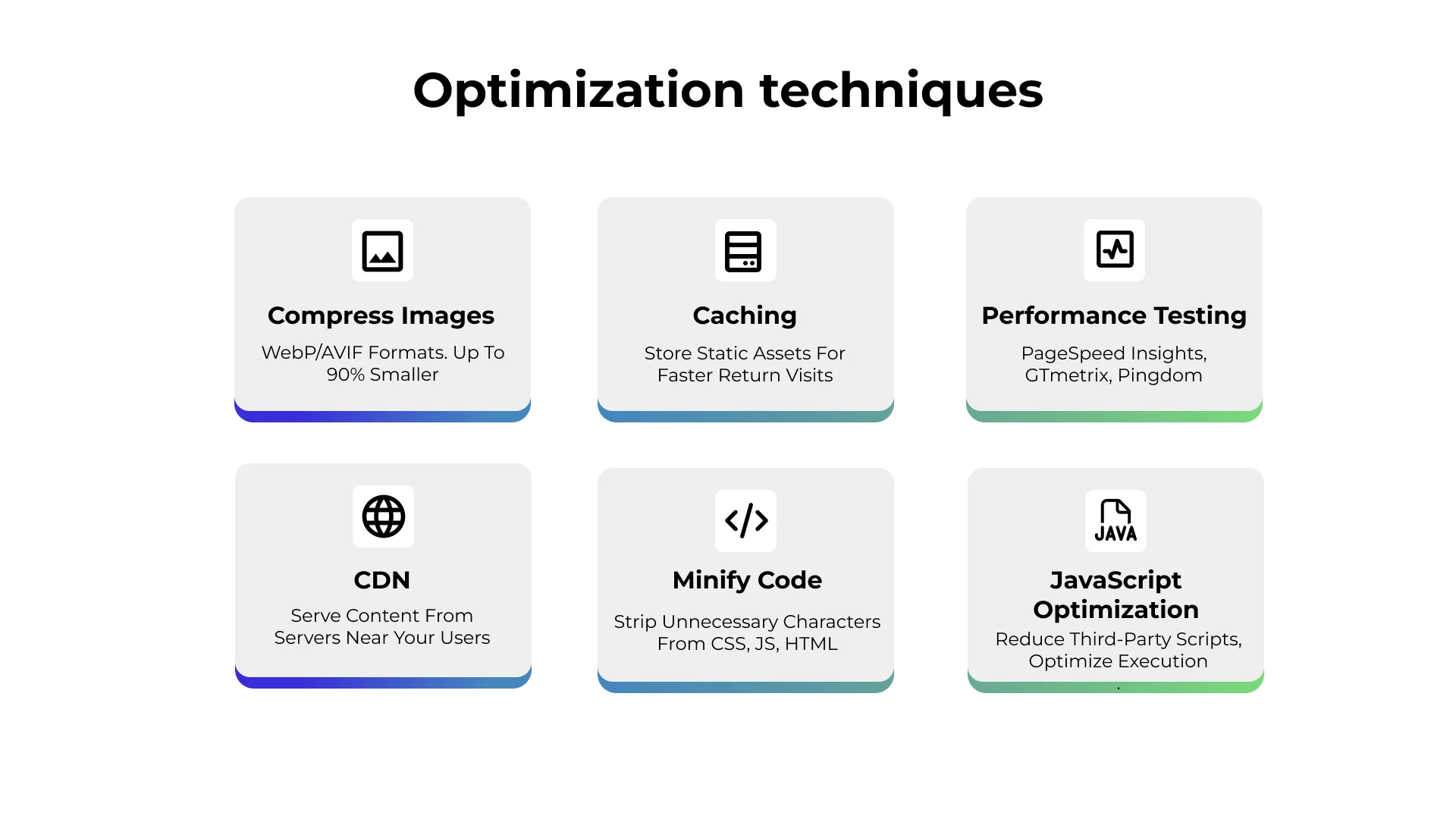
To achieve these targets, we:
- Compress Images: We use tools like TinyPNG and modern formats like WebP or AVIF to shrink image file sizes by up to 90% without losing quality.
- Caching: Implementing browser and server-side caching saves static assets on users’ devices, making return visits and server response times faster.
- Content Delivery Network (CDN): A CDN delivers content faster to users by caching our site on servers worldwide.
- Minify Code: Minifying CSS, JavaScript, and HTML removes unnecessary characters to create smaller, faster-loading files.
- Performance Testing Tools: We regularly check site speed with Google PageSpeed Insights, GTmetrix, and Pingdom Tools.
Step 5: Prioritize Mobile-First & Multi-Device Experience
Mobile-first indexing is the standard, with over 60% of searches on mobile. Since AI results often use mobile-first formats, poor mobile performance can hurt visibility. The goal is a site optimized for all device experiences.
- Responsive Design: Our website uses fluid grids and flexible images to adapt smoothly across different devices.
- Content Parity: We ensure core content, structured data, and metadata are consistent between mobile and desktop versions, as Google primarily uses the mobile version for ranking.
- Touch Targets: On mobile, we ensure buttons and links are large enough (at least 44×44 pixels) to be tap-friendly.
- Mobile Page Speed: We monitor Core Web Vitals specifically for mobile, optimizing elements to reduce payload sizes.
- Mobile Usability Testing: We manually test our site on various mobile devices to ensure an optimal user experience, using tools like Google’s Mobile-Friendly Test for quick checks.
Step 6: Refine Site Architecture & Internal Linking
A logical site architecture helps users and bots find content quickly. Organizing content into topic clusters with strong internal links reinforces topical authority, which is critical for AI search. A messy structure can hide your best pages from generative results.
- Logical Site Structure: We design a flat hierarchy where most content is no more than 3-4 clicks from the homepage, making important pages easily accessible.
- Topic Clusters: We organize content into thematic clusters, with a central “pillar page” linking to related “cluster content” to signal comprehensive coverage.
- Internal Linking Strategy: We build contextual internal links with descriptive anchor text to distribute “link equity” and guide crawlers.
- Breadcrumbs: We implement breadcrumbs with schema markup to help users and crawlers understand our site’s hierarchy.
- Crawl Depth: We aim for a shallow crawl depth and fix broken internal links to ensure valuable pages are easily found.
- User Navigation: Clear menus and intuitive category structures are designed for user-friendliness, which indirectly benefits SEO.
Step 7-8: Adapt Content & On-Page SEO for the AI Era
The SEO landscape is evolving with the rise of AI and zero-click searches. Google’s shift from “strings to things” is now amplified by generative results. Our content strategy must adapt by focusing on comprehensive topic coverage, user intent, and demonstrating E-E-A-T.
Step 7: Evolve Your Keyword & Content Strategy
In a world of zero-click searches, getting a user to click through is more valuable than ever. Our keyword and content strategy must be smarter.
- Keyword Research for Intent: We analyze search intent (informational, commercial, etc.) to create content that matches user needs, using tools like Google Keyword Planner to find relevant keywords.
- Long-Tail Keywords: We target long-tail keywords (3+ words) which, despite lower search volume, often have higher conversion potential and are less competitive.
- Competitor Analysis & Content Gaps: We perform keyword gap analysis to find topics our competitors cover poorly, helping us create superior content that addresses user needs.
- Content Excellence Strategies (10x Content): We aim to create “10x content” that is far better than the top result. This means it’s comprehensive, original (using first-party data or case studies), and valuable. Original insights are more likely to be cited by AI.
- Topics vs. Keywords: We build topical authority with comprehensive content clusters, signaling to search engines and AI that we are an authoritative source on a subject.
- E-E-A-T (Experience, Expertise, Authoritativeness, Trustworthiness): We demonstrate E-E-A-T by highlighting team experience, providing expert insights, and citing sources to build trust, a critical factor for Google.
Step 8: Leverage Structured Data & On-Page Elements for Your 2026 Website Optimization Checklist
On-page SEO boosts relevance and user experience to improve rankings. In 2026, it’s also about helping AI understand our content.
- Title Tags: We write unique, concise titles (under 60 characters) that include the primary keyword and encourage clicks.
- Meta Descriptions: These brief descriptions (up to 155 characters) include keywords and a clear call-to-action (CTA) to boost click-through rates (CTR).
- Heading Hierarchy: A logical H1, H2, and H3 structure improves readability and organizes content for users and search engines. Each page has one H1 that includes the target keyword.
- Image Alt Text: All images have descriptive alt text to help search engines understand them and to assist visually impaired users. We also compress images and use descriptive filenames.
- Schema Markup: Structured data is a critical technical SEO lever. It helps crawlers understand content context, enabling rich results and inclusion in AI overviews. Without it, content can be overlooked. We use tools like Google’s Structured Data Markup Helper to implement schema (e.g., Article, Product, FAQPage) and validate it with the Rich Results Test.
Step 9-10: Implement Platform-Specific & Ongoing Optimization
Initial optimization requires continuous attention. In 2026, this means applying general SEO best practices, leveraging our CMS’s capabilities, and establishing a rigorous monitoring process.
Step 9: Apply SEO Best Practices for Your CMS
While SEO principles are universal, implementation varies by CMS. For example, a platform like Webflow offers robust built-in SEO capabilities.
- Clear Navigation and Structure: Build your site architecture on purpose, not by accident. In any CMS, clear menus, logical categories, and well-organized pages make it easier for people to navigate and easier for search engines to crawl.
- Semantic HTML5: Use semantic HTML5 tags like
, andto give pages clearer structure. This helps accessibility tools and gives search engines better context. - Intuitive URL Structures: Keep URLs short, readable, and descriptive. Good CMS settings make it easy to create clean slugs with relevant words and hyphens instead of messy parameters.
- 301 Redirects: When a page moves or a URL changes, set up a 301 redirect in your CMS. That preserves link equity, avoids unnecessary 404 errors, and creates a smoother user experience.
- Auto-Generated Sitemaps: Most modern CMS platforms can generate an XML sitemap automatically. Make sure it is turned on, accurate, and submitted so important pages are easier to discover.
- Robots.txt Configuration: Configure your robots.txt file carefully to guide crawlers toward useful content and away from low-value or non-public pages. This helps keep crawl activity focused where it matters most.
- Canonical URLs and Duplicate Content: Use your CMS to add canonical tags where needed, especially on similar pages, filtered URLs, or paginated content. Canonicals help search engines understand which version should be treated as primary.
- Optimized On-Page Elements: Your CMS should make it easy to update title tags, meta descriptions, heading structure, and image alt text. These basics still matter because they improve both visibility and usability.
Step 10: Establish Continuous Monitoring & Auditing for Your 2026 Website Optimization Checklist
SEO is an ongoing process, not a one-time fix. Constant search engine changes require proper monitoring to track fixes and identify new issues.
- Fundamental SEO Tools Setup:
- Google Search Console (GSC): This free tool is indispensable for monitoring search traffic, indexing issues, Core Web Vitals, and overall performance in Google Search.
- Google Analytics 4 (GA4): GA4 is essential for measuring performance from traffic to conversions, helping us understand user behavior and track the impact of our SEO efforts.
- Bing Webmaster Tools: We use this for similar performance insights on Bing, which still holds a significant market share.
- Regular Audits: We run a full technical SEO audit at least twice a year to account for traditional search and emerging AI models.
- Performance Tracking & Alerting: We use custom dashboards to report on technical KPIs (LCP, INP, CLS) and set up alerts for performance regressions or crawl errors to catch issues early.
- Goal Setting: We set and monitor continuous SEO goals to ensure our efforts align with business objectives, turning our checklist into a proactive strategy.
Frequently Asked Questions about Website Optimization
Why is SEO so difficult in 2026?
SEO in 2026 is particularly challenging due to:
- Ever-changing Google Algorithms: Major updates roll out every few months, and systems update daily, requiring constant adaptation as rankings fluctuate.
- AI and Zero-Click Search: AI summaries reduce direct traffic by answering queries in the search results. Optimization requires understanding how AI summarizes and attributes information.
- Intense Market Competition: Ranking competition is fierce, requiring superior content and technical excellence to stand out.
- Long-Term Investment: SEO is a long-term commitment, with results often taking 6-12 months to materialize, which can make stakeholder buy-in challenging.
- Evolving User Behavior: Users expect fast, mobile-friendly, and relevant experiences, requiring constant refinement of our strategy.
What are the core components of a website maintenance plan?
A comprehensive website maintenance plan includes:
- Security Scans: Regular malware and vulnerability checks to protect against threats.
- Backups: Automatic and verified backups with secure off-site storage for quick recovery.
- Performance Checks: Ongoing monitoring and optimization for site speed and Core Web Vitals.
- Software Updates: Regular updates for the CMS, plugins, and themes to prevent security and compatibility issues.
- Content Review: Monthly content optimization, broken link checks, and quarterly content audits to ensure relevance and quality.
- SEO Monitoring: Tracking rankings, traffic, and indexation through tools like Google Search Console.
- Legal & Compliance Audits: Annual reviews of legal pages and accessibility compliance.
How do I adapt my SEO for AI and zero-click searches?
To adapt SEO for AI and zero-click searches:
- Create High-Value Content: Focus on comprehensive, original content that deeply answers user queries. Unique insights (e.g., first-party data) increase the chance of being cited by AI.
- Target Long-Tail Keywords & Intent: Optimize for specific queries that either AI will summarize or that will encourage users to click through for more detail.
- Leverage Structured Data: Implement schema markup to help AI understand content contextually, making it easier to feature in summaries and rich results.
- Focus on User Experience: A fast, mobile-friendly, and easy-to-steer site is crucial for users who click through from AI-generated results.
- Build Brand Authority & E-E-A-T: Demonstrate Experience, Expertise, Authoritativeness, and Trustworthiness. AI is more likely to cite sources with strong topical authority.
Conclusion: Turn Your Checklist into a Competitive Advantage
Your 2026 Website Optimization Checklist is more than just a list of tasks; it’s a strategic roadmap for sustained digital success. In a rapidly evolving landscape driven by AI and fierce competition, a proactive, user-centric approach to website optimization is no longer optional—it’s essential.
By consistently focusing on technical health, content quality, and a seamless user experience, we can ensure our website remains secure, fast, and highly visible. This ongoing process yields measurable results, from improved search rankings and increased organic traffic to higher conversion rates and ultimately, greater profitability.
We understand that navigating this complex landscape can be daunting. That’s why we at SiteTuners specialize in identifying and fixing website conversion barriers, turning your underperforming website into a lead-generating machine. Our expertise in user-centric optimization, backed by measurable results since 2002 and over 2,100 satisfied clients, ensures your website not only attracts visitors but converts them into loyal customers.