Why the PPC vs CRO Debate Matters for Your Bottom Line
PPC vs CRO are two of the most important levers in digital marketing — and most businesses are only pulling one of them.
Here’s the short answer:
| PPC (Pay-Per-Click) | CRO (Conversion Rate Optimization) | |
|---|---|---|
| What it does | Drives paid traffic to your site | Turns more of that traffic into customers |
| Speed | Immediate results | Takes 4–12 weeks for meaningful data |
| Cost model | You pay per click, win or lose | One-time or ongoing optimization investment |
| Risk | Budget drains if traffic doesn’t convert | Requires enough traffic volume to test |
| Best use | Filling the funnel | Fixing the leaks in the funnel |
| Bottom line | More visitors | More revenue from existing visitors |
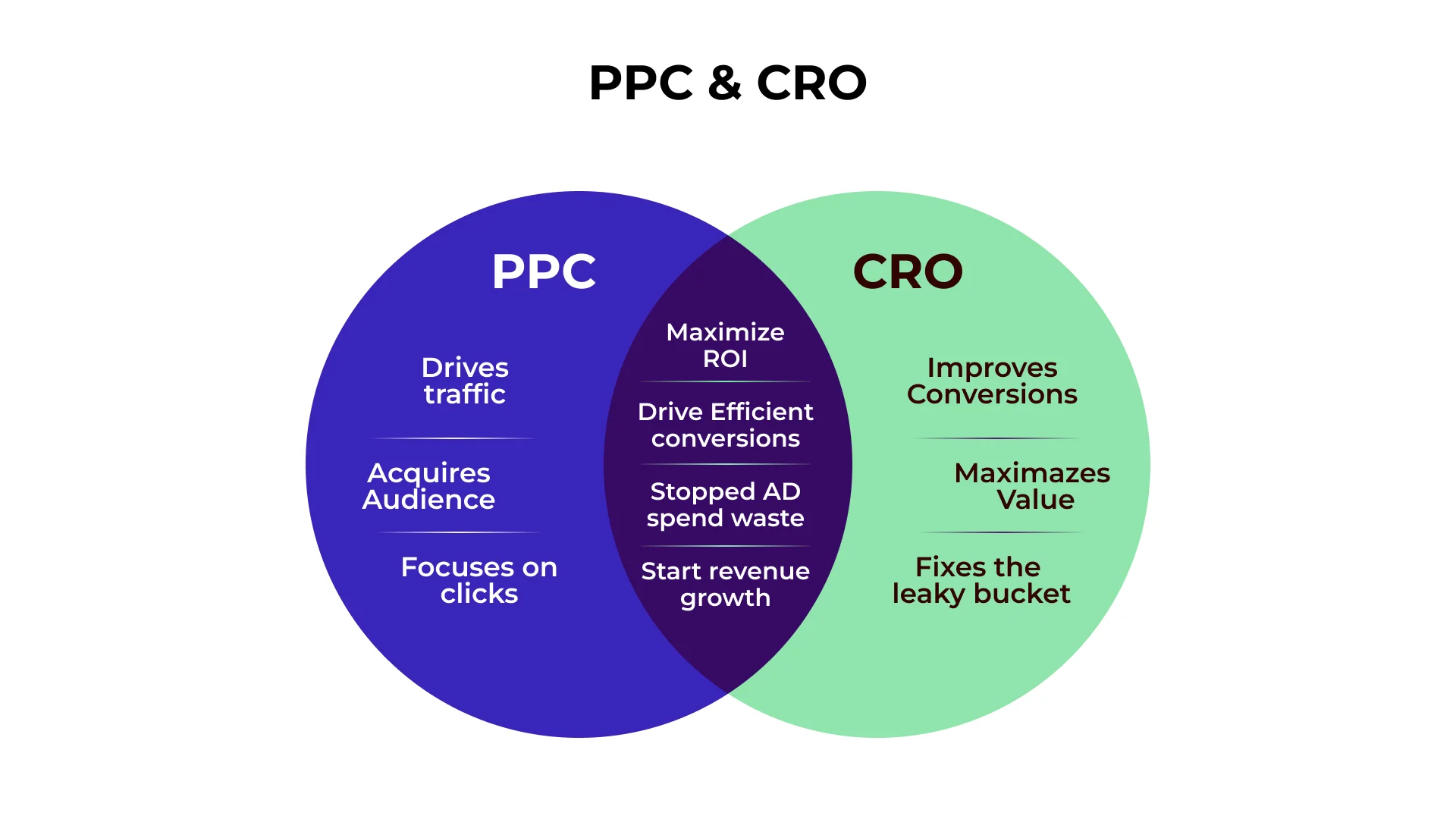
The bottom line: PPC and CRO are not competitors. PPC brings the audience. CRO makes sure you don’t waste them.
Most businesses pour money into paid ads and wonder why the returns keep shrinking. The answer is usually not the ads. It’s what happens after the click.
The numbers are striking. The average paid search account wastes 76% of its budget on the wrong search terms. And most sites lose 60–70% of paid traffic to conversion problems that are entirely fixable. That’s not a traffic problem. That’s a leaky bucket.
This guide walks through exactly how PPC and CRO work, where each one fits, and how to use them together to stop wasting ad spend and start growing revenue.
I’m Jeffery Loquist, VP at SiteTuners, with over 18 years of hands-on experience managing both paid media and conversion optimization — giving me a rare, dual-lens view of the PPC vs CRO relationship that most specialists simply don’t have. That background shapes everything in this guide.
PPC vs CRO terms to learn:
- CRO case studies
- how to increase conversion rate
- digital marketing optimization
The Fundamental Differences: PPC vs CRO
When we look at the landscape of digital marketing in 2026, it is easy to get distracted by flashy new platforms. However, the core of your growth still relies on two pillars: how you get people to your site (Acquisition) and what you do with them once they arrive (Experience).
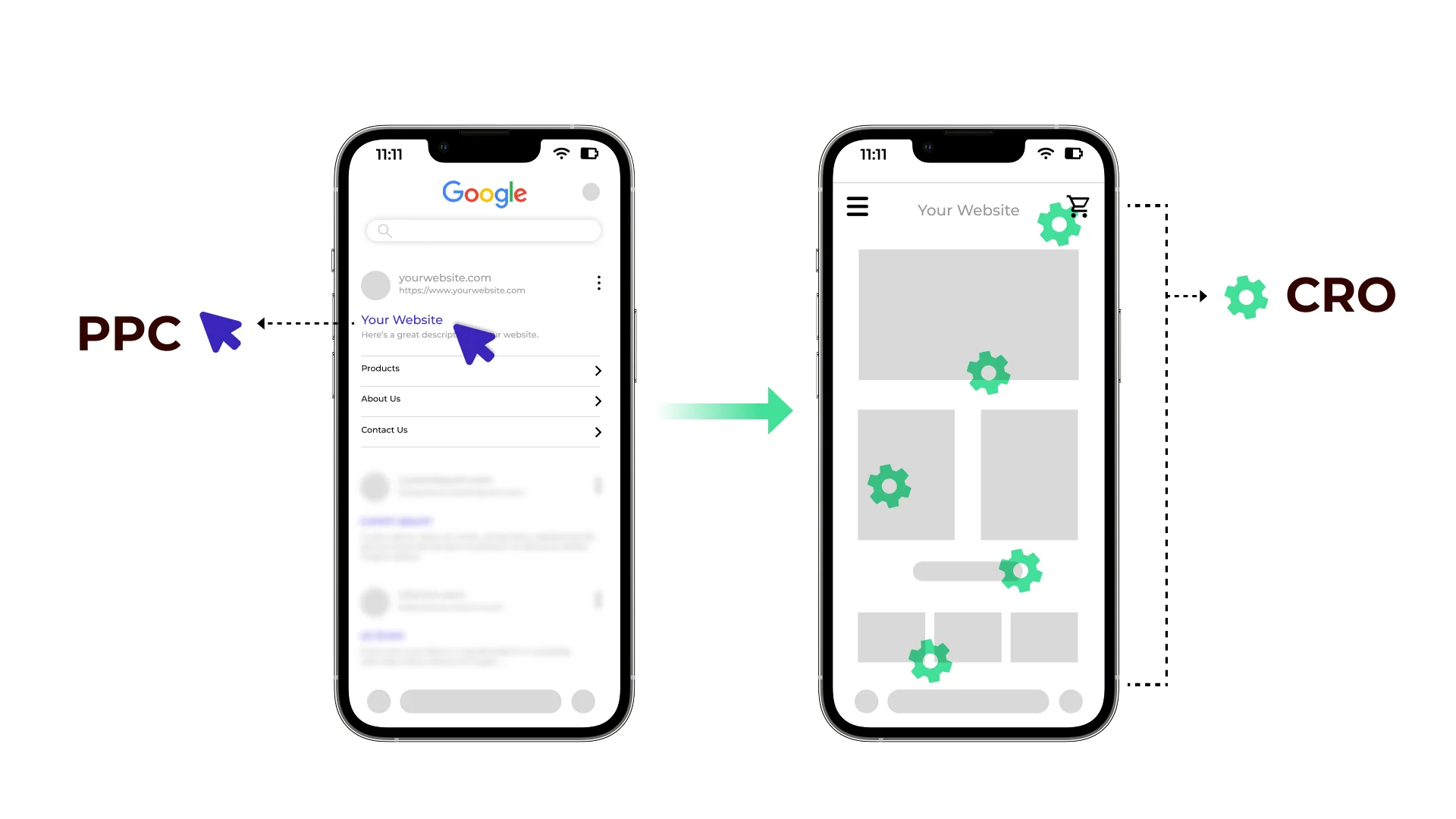
PPC (Pay-Per-Click) is essentially renting traffic. Whether you are using Google Ads, Meta, or LinkedIn, you are paying for the privilege of appearing in front of a targeted audience. It is fast, highly controllable, and provides immediate visibility. But the moment you stop paying, the traffic disappears.
CRO (Conversion Rate Optimization) is about owning the efficiency of your site. It is the scientific process of identifying barriers that prevent visitors from taking action—whether that is buying a product, signing up for a newsletter, or requesting a quote. Unlike PPC, CRO is a compounding asset. Once you improve your conversion rate from 2% to 3%, that improvement stays with you, making every future visitor (paid or organic) more valuable.
PPC vs CRO: At-a-Glance Comparison
| Feature | PPC Advertising | Conversion Rate Optimization |
|---|---|---|
| Primary Goal | Traffic Volume & Reach | User Intent & Goal Completion |
| Metric Focus | CPC, CTR, Impressions | Conversion Rate, Average Order Value, Lifetime Value |
| Cost Structure | Variable (Spend more, get more) | Fixed/Project-based (One-time effort, ongoing gain) |
| Sustainability | Low (Stops when budget ends) | High (Permanent site improvement) |
| Profit Margin | Lower (High variable costs) | Higher (Fixed costs, scaled revenue) |
Common Pitfalls in PPC vs CRO Integration
One of the biggest mistakes we see at SiteTuners is treating these two departments as silos. When the PPC team doesn’t talk to the CRO team, the “leaky bucket” becomes a flood.
- The 76% Waste Problem: Research shows the average paid search account wastes 76% of its budget on irrelevant search terms. This isn’t just a targeting issue; it’s an intent issue. If you’re paying for “best running shoes” but your landing page only shows “hiking boots,” you’ve paid for a bounce.
- Message Mismatch: If your ad promises a “50% Discount” but the landing page mentions “Up to 20%,” you lose trust instantly. This mismatch is a primary driver of high bounce rates.
- Conversion Leaks: Even with perfect ads, a complex checkout or a slow-loading page will kill your ROI. You can learn how to spot ppc conversion leaks in your google ad campaigns by looking for sharp drops in your funnel analytics.
Measuring Success: Key Metrics for PPC vs CRO
To bridge the gap between PPC vs CRO, you need a unified dashboard. Relying solely on “Cost Per Click” (CPC) is a dangerous vanity metric. If a click costs $1.00 but never converts, it’s more expensive than a $5.00 click that converts 50% of the time.
Key metrics we track include:
- Cost Per Acquisition (CPA): The total cost to get one customer. This is the ultimate “truth” metric for both teams.
- Return on Ad Spend (ROAS): How much revenue you generate for every dollar spent on ads.
- Statistical Significance: In CRO, we don’t guess. We use A/B testing to ensure that a 10% lift in conversions isn’t just a fluke.
- Conversion Latency: The time it takes from the first click to the final conversion. In 2026, many customer journeys are multi-touch, and understanding this window is vital for CRO for PPC: Key areas to optimize beyond landing pages.
Why PPC and CRO are Better Together
Think of your marketing strategy as a relay race. PPC is the first runner—they are fast, they have the baton, and they are eating up the track. But if the handoff to the second runner (CRO) is fumbled, the race is over.
When you combine PPC vs CRO, you create a “Synergy Loop.” Higher conversion rates lead to a better Quality Score in Google Ads. A better Quality Score lowers your CPC. Lower CPCs mean you can buy more traffic for the same budget. It is a virtuous cycle that allows you to dominate your competitors.
The Power of the Synergy Loop
- Ad Relevance: When your landing page is optimized for the specific keywords in your ad, search engines reward you with lower costs.
- Remarketing Lists for Search Ads (RLSA): CRO data helps you identify users who almost converted. By using RLSA, you can bid more aggressively on these “warm” leads, often doubling your conversion rates.
- Real-World Results: We’ve seen a simplified signup process increase trial signups by 31%, raising the overall conversion rate from 2.3% to over 3%. You can explore 3 ways to make your ppc efforts pay off to see how these small tweaks lead to massive gains.
_compressed.webp?alt=media&token=f3e2afb1-cfa6-4d71-9c98-530b2be2bcaf "Ad, rlsa, real world results")
Optimizing the Post-Click Experience
The moment a user clicks your ad, the “PPC” job is done and the “CRO” job begins. In the split second it takes for your page to load, the user is looking for three things:
- Am I in the right place? (Consistency)
- Can I trust this site? (Credibility)
- What do I do next? (Clarity)
To win, your landing page must feature a clear Unique Selling Proposition (USP) and prominent Trust Signals like testimonials or security badges. In May 2026, mobile responsiveness is no longer optional; it is the baseline. Most of your paid traffic is likely coming from mobile devices, and if your checkout process is clunky on a smartphone, you are effectively throwing money away. Check out our tips to improve direct response landing pages for a checklist on how to tighten this experience.
Leveraging Audience Intent and Skepticism
We live in an era of high skepticism. As of 2026, roughly 84% of millennials are skeptical of traditional online advertising, and 54% of people overall say they don’t trust sponsored ads. They’ve become “immune” to the hard sell.
This is where CRO becomes your secret weapon. Instead of yelling louder with a bigger ad budget, you use CRO to build authority and answer the user’s intent.
- Search Intent: A user searching for “how to fix a leaky faucet” has different intent than someone searching for “plumber near me.” CRO allows you to tailor the experience to that specific stage of the journey.
- The Email Alternative: With rising ad costs, many businesses are looking at “Email CRO.” By the end of 2025, there were an estimated 4.5 billion active email users. Capturing an email address via a well-optimized lead magnet is often more cost-effective than trying to force an immediate sale. If you’re wondering Email CRO or PPC? Which Is More Important to Focus on?, the answer is usually both—use PPC to capture the lead, and CRO to optimize the conversion path.
The Financial Impact: ROI and the Power Law of CRO
Let’s talk numbers. Many CEOs view CRO as a “nice-to-have” design project. In reality, it is a financial lever that is more powerful than almost any other marketing activity. This is due to something we call Profit Sensitivity.
Because your ad spend, rent, and payroll are largely fixed costs, every incremental increase in conversion rate flows almost entirely to your bottom line.
The Multiplier Effect on Net Profit
Consider this scenario: You spend $50,000 a month on ads and generate $100,000 in revenue. After ad spend and other costs, your profit might be $10,000.
If you use CRO to double your conversion rate, your revenue jumps to $200,000. But your ad spend stayed at $50,000! Your profit doesn’t just double; it can increase by 7x or more because you’ve reached a “break-even” point where every new dollar is pure margin.
This creates what we call a high Allowable Cost Per Sale. If your site converts twice as well as your competitor’s site, you can afford to pay twice as much for a click and still be more profitable. This is how you achieve market dominance. A great example of this is the autoweb case study how sitetuners implemented 7 high converting landing page design principles with google to improve conversions and reduce costs.
Reinvesting Savings for Market Dominance
When your CRO is firing on all cylinders, you aren’t just saving money—you’re gaining a weapon.
- Market Clearing CPC: Every industry has a “sweet spot” for bidding. If your conversion rate is low, you are forced to bid low, which means you only get the “scrap” traffic.
- Aggressive Bidding: With high conversion rates, you can move into the “Market Clearing” bid range, capturing the highest-quality traffic that was previously too expensive.
- Scaling Budgets: Optimization gives you the confidence to scale. Instead of wondering if a $100,000 budget will work, you have the data to prove it will. You can see this in action in our getting the most out of ppc landing page tests coastal insurance solutions case study.
Frequently Asked Questions about PPC vs CRO
Should I prioritize PPC or CRO if I have a limited budget?
If your traffic is currently “bad” (irrelevant, low-intent), start by optimizing your PPC. No amount of CRO can fix a visitor who has zero interest in what you sell. However, once you have a steady stream of relevant traffic, CRO should become your priority.
We generally recommend a $5,000 monthly threshold. If you are spending less than that on ads, you might not have enough conversion volume to run statistically significant A/B tests. In that case, focus on “Best Practice” CRO—fixing obvious usability issues—until your volume grows.
How long does it take to see results from a combined strategy?
PPC results are instant—you’ll see clicks within minutes. CRO is a slower, more deliberate process. It typically takes 4–12 weeks to gather enough data for a meaningful test. However, once those results are implemented, the ROI is permanent. Think of PPC as a sprint and CRO as the training that makes the sprinter faster every single day.
Can CRO fix a campaign with poor traffic quality?
No. This is a common myth. If you are buying clicks from people looking for “free pizza” when you sell “cloud software,” your conversion rate will be 0% no matter how pretty your landing page is.
In fact, irrelevant traffic creates a Dilution Effect. It skews your data, making it look like your site is failing when the real problem is the traffic source. You must ensure an Intent Match by using negative keywords and tight audience targeting before you can trust your CRO data.
Conclusion
The debate of PPC vs CRO is a false choice. In the competitive landscape of May 2026, you cannot afford to have one without the other.
PPC is your engine—it provides the power and the speed to reach your audience. CRO is your steering and aerodynamics—it ensures that every ounce of power is used efficiently to reach the finish line.
At SiteTuners, we’ve spent over two decades helping businesses move past the “leaky bucket” stage. By focusing on user-centric optimization and measurable results, we turn paid traffic into a predictable engine for growth. Don’t let another 76% of your ad budget vanish into the void. Start treating your traffic with the respect it deserves by optimizing the experience they find when they arrive.
Ready to stop guessing and start converting? More info about conversion rate optimization services