Why Your Website Isn’t Turning Visitors Into Customers
Most websites convert just 2–3% of their visitors — meaning 97 cents of every traffic dollar you spend walks out the door. Across 2,100 client engagements since 2002, SiteTuners has helped businesses achieve an average of 277.5% conversion growth, generating over $1 billion in cumulative revenue lift. This guide distills those real-world results into 7 actionable methods you can apply today — no guesswork, no generic checklists.
Quick Answer: Top Ways to Increase Conversion Rate
- Speed up your site – Pages loading in 1 second convert 2.5x higher than those loading in 5 seconds.
- Simplify your forms – Expedia increased profits by $12 million by removing one form field.
- Add social proof – Customer reviews can increase conversions by up to 270%.
- Optimize for mobile – Nearly 60% of web traffic comes from mobile devices.
- Use clear CTAs – Personalized calls-to-action convert 202% better than generic ones.
- Offer guest checkout – Forcing account creation is a major conversion killer.
- Show trust signals – Security badges and guarantees reduce purchase anxiety.
- Fix cart abandonment – 70% of shopping carts are abandoned before checkout.
Consider this: 1,000 monthly visitors at a 3% conversion rate equals 30 customers. Increasing that rate to just 4.5% yields 45 customers—a 50% sales increase from the same traffic.
The key is to remove friction, build trust, and clarify the path to purchase. It’s not about manipulation; it’s about creating a better user experience that helps visitors get what they came for.
_compressed.png?alt=media&token=0adf8e21-9132-49f3-ad31-1a1a13cfedca "user-inserted")
What is Conversion Rate Optimization (CRO) and Why Does It Matter?
Let’s start with the basics. Your conversion rate is the percentage of website visitors who complete a desired action, like buying a product or signing up for a newsletter. The math is simple: (Conversions / Total Visitors) x 100.
Conversion Rate Optimization (CRO) is the process of systematically improving your website to turn more of those visitors into customers. Instead of spending more to drive more traffic to your site, you’re squeezing more value from the visitors you already have.
For example, if your site converts at 2% and generates $50,000 monthly, a small bump to 2.5% increases revenue to $62,500. That’s an extra $150,000 per year from the same traffic, with no additional ad spend. This is why how to increase conversion rate is a critical question for growing businesses.
Every percentage point improvement means increased ROI from your existing marketing. Your customer acquisition costs drop, your advertising dollars work harder, and your business grows faster.
CRO also provides better customer insights. By testing different headlines, layouts, or checkout processes, you learn what resonates with your audience. You find which messages build trust, which features matter most, and where people get confused. This understanding helps improve your user experience, product offerings, and marketing messages.
CRO is a continuous cycle: collect data, analyze behavior, form a hypothesis, test your idea, and implement what works. This process, shown in the infographic above, ensures constant improvement. Maximizing existing traffic is almost always more cost-effective than constantly chasing new visitors.
Small improvements compound over time. A business that improves its 2% conversion rate by just 0.5% each quarter would double its revenue from the same traffic by year’s end. CRO helps you work smarter, turning your website into a sales machine that improves with every test.
Foundation First: Optimize Your Website’s Core Experience
Before crafting persuasive headlines, you must ensure your website’s foundation is solid. The technical and structural elements we’re about to cover are essential for how to increase conversion rate. If your site is slow, confusing, or broken on mobile, visitors will leave before seeing your offer.
Improve Website Navigation and Structure
Your navigation should guide visitors effortlessly. If they can’t find what they need in seconds, they’ll leave. Start with easy-to-use menus with a logical hierarchy. For example, an apparel store might have top menus like “Women” and “Men,” with subcategories like “Dresses” and “Shoes.”
Since many visitors head straight to the search bar, ensure your search bar functionality is smart, with predictive text and tolerance for misspellings. Also, use breadcrumbs—navigational trails that show users their location on your site, making it easy to backtrack.
_compressed.png?alt=media&token=0a94aa9f-921f-40a1-9029-8541fa3b3e4d "Clean and simple website navigation menu - how to increase conversion rate")
Boost Your Page Load Speed
Page speed is a silent conversion killer. Patience is rare online; users are 32% more likely to bounce if a page takes three seconds to load, and that jumps to 106% at six seconds. Every second of load time can cause a significant drop in conversions.
Conversely, for every second faster your site loads, conversion rates can improve by 17%. At SiteTuners, we follow a simple rule: your page load time should be less than four seconds. To get there, use tactics like lazy loading for images, image compression to reduce file sizes, and caching to speed up return visits. Use Google PageSpeed Insights to analyze your site and get a clear action plan.
_compressed.png?alt=media&token=81db332d-1677-49de-bad4-c6c410c4cc43 "Google PageSpeed Insights report showing a fast score - how to increase conversion rate")
Master the Mobile Experience
With nearly 60% of web page views worldwide happening on mobile devices, a poor mobile experience means turning away over half your potential customers. Mobile optimization is critical.
Responsive design, which automatically adapts your site to different screen sizes, is the foundation. But it’s just the start. You also need thumb-friendly elements with large, easy-to-tap buttons with ample space to prevent accidental clicks. Your desktop navigation should collapse into a simplified mobile navigation, like a hamburger menu.
Speed is even more critical on mobile, as users are less patient. Furthermore, Google’s mobile-first indexing means your mobile site’s performance affects your search rankings. Your mobile experience must be as good as, if not better than, your desktop experience.
Build Unshakeable Trust and Eliminate Purchase Anxiety
A fast, organized website is a great start, but it won’t convince someone to share their credit card details. This section covers the psychological elements that make visitors feel safe and confident enough to convert. Your visitors are looking for reviews and security badges, just as you would on an unfamiliar site.
Leverage the Power of Social Proof
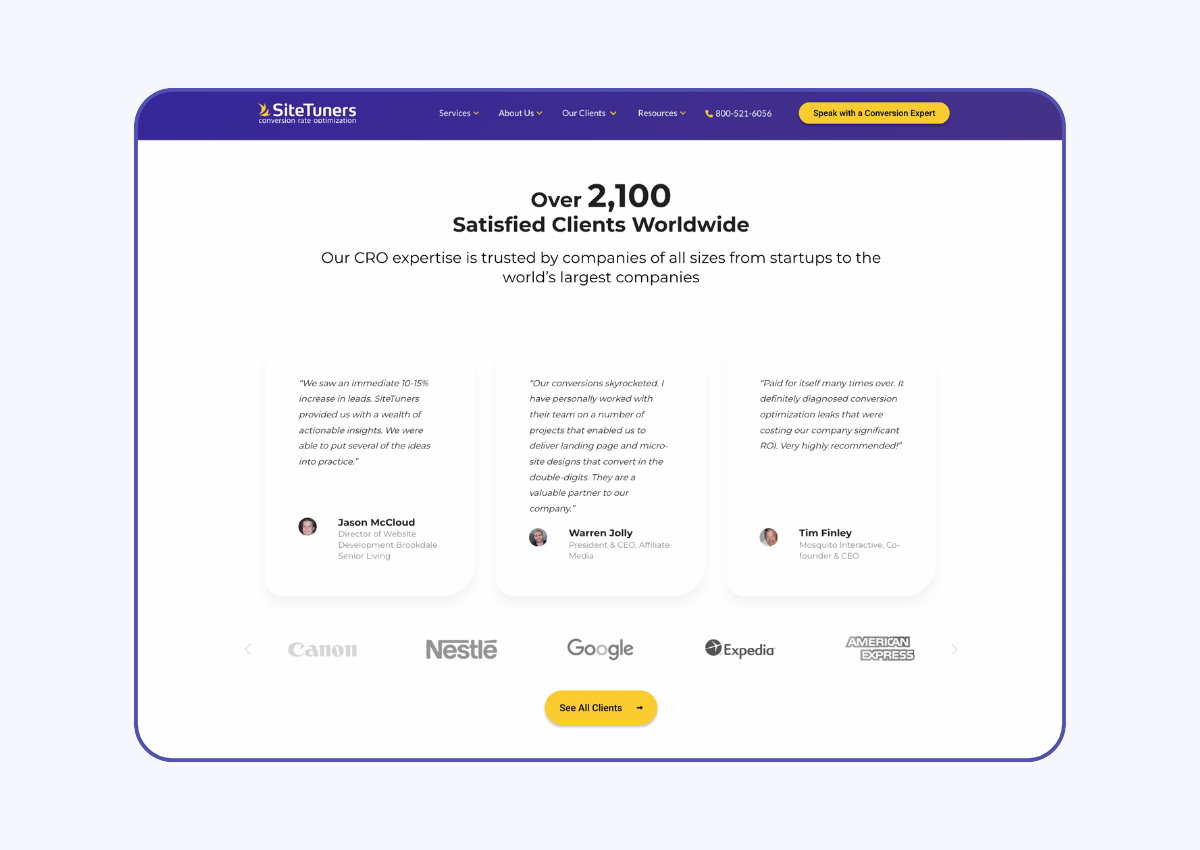
Skeptical modern consumers want reassurance before buying. Social proof – evidence that others trust your products – is incredibly persuasive. In fact, customer reviews can increase conversions by up to 270%, as most users rely on them to evaluate products.
Display customer reviews and star ratings prominently on product pages. Testimonials with a photo and full name are also powerful, capable of increasing conversions by 34%. Place them on your homepage, landing pages, and near checkout buttons. User-generated content, like photos of real customers, adds a layer of authenticity. For complex products, detailed case studies can provide the final nudge.
Display Clear Security and Privacy Signals
Visitors need to feel secure before entering payment information. Trust signals reassure them their data is safe. Start with an SSL certificate, which provides the “https://” and padlock icon in the URL, encrypting user data. Without it, browsers will warn visitors your site isn’t secure.
Display secure payment logos and credit card icons (Visa, Mastercard, PayPal) near your checkout button to show that trusted companies vet your process. Make your privacy policy accessible and clear about how you protect user data. Money-back guarantees reduce perceived risk, and easily accessible contact information shows that a real person is available to help if something goes wrong.
Be Transparent with Costs and Policies
Hidden fees at checkout are a top reason for cart abandonment. Over 60% of shoppers have left a cart due to unexpected costs. Be transparent with upfront pricing, including all taxes and shipping fees.
Since many shoppers expect free shipping, consider offering it. If you can’t, state the costs clearly and early. A great strategy is to offer free shipping above a certain order value, which can reduce abandonment and increase average order size.
Your returns policy and terms of service should be easy to find and understand. Transparency isn’t just good ethics; it’s good business.
How to Increase Conversion Rate with Smart Persuasion and Design
You’ve built a solid, trustworthy foundation. Now it’s time to guide visitors toward conversion with smart design and persuasive messaging that feels helpful, not pushy.
Create High-Impact Landing Pages
A common mistake is sending ad traffic to a generic homepage. This breaks message matching – the promise made in your ad. If your ad promotes “50% off summer dresses,” the landing page should be about that specific sale.
Dedicated landing pages are like focused conversations. A high-impact landing page has a clear value proposition, uses high-quality imagery, and eliminates distractions by removing unnecessary navigation. Most importantly, every landing page should have a single, focused goal. When you ask visitors to do everything, they often do nothing.
How to increase conversion rate with compelling CTAs
Your Call-to-Action (CTA) is the bridge between interest and action. A weak CTA can ruin your efforts. The best CTAs use action-oriented language that tells visitors what happens next. “Get Your Free Quote” is much better than a vague “Submit.”
Your CTA button should stand out with contrasting colors. It should be placed where visitors naturally look, such as above the fold. The real game-changer, however, is personalization. Studies show personalized calls-to-action can convert over 200% better than generic ones. “Welcome back! Complete your order” is far more effective than a generic “Shop now.”
Always A/B test your CTAs – try different colors, copy, and placements to see what works for your audience. Effective phrases include “Get Started Today,” “Shop Now,” “Download Your Free Guide,” and “Claim Your Discount.”
Personalize the User Experience
Treating every visitor the same is a missed opportunity. Personalization makes each visitor feel like your site was built just for them, and 81% of customers prefer it. When done right, personalization makes your site more relevant and dramatically improves how to increase conversion rate.
Use dynamic content that changes based on who is visiting. For example, show location-based offers or product recommendations based on browsing history. For returning visitors, a simple greeting by name or a reminder of items in their cart can be very effective.
The goal isn’t to be invasive but to show customers you understand their needs and can help them find what they’re looking for faster. It’s about being a thoughtful host, not a pushy salesperson.
The Final Hurdle: Perfecting the Checkout and Forms
You’ve attracted visitors, built trust, and persuaded them. Now comes the moment of truth: the checkout. This is where many businesses lose the sale they’ve worked so hard to earn. Don’t put unnecessary obstacles in front of visitors who are just steps from the finish line.
How to increase conversion rate by simplifying forms
Long forms are a major conversion killer, with over a quarter of users abandoning them. Every field is another hurdle. The classic example is Expedia, which famously increased profits by millions simply by removing a single, optional field from their checkout form. That’s the power of simplification.
Ruthlessly cut unnecessary form fields. Only ask for information you absolutely need. Offer guest checkout as a non-negotiable feature; forcing account creation is a top reason for abandonment. You can always invite customers to create an account after their purchase.
Make the experience smoother with address autocomplete and provide clear, helpful error messages. “Please include an @ symbol” is far better than a vague “Invalid email.”
Offer Flexible Payment and Shipping Options
Offering multiple payment options caters to diverse customer preferences. Digital wallets like Apple Pay and Google Pay are game-changers for mobile shoppers, offering a fast, one-click checkout. In fact, some merchants see nearly double the mobile checkout-to-order rate when using integrated digital wallets.
For higher-priced items, Buy Now, Pay Later (BNPL) services like Klarna or Afterpay can make purchases feel more manageable by splitting them into smaller payments. And don’t forget shipping. Many shoppers won’t buy from a retailer without free shipping. If you can’t offer it on all orders, set a free shipping threshold (e.g., “on orders over $50”) to reduce cart abandonment and increase average order value.
Recapture Abandoned Carts
Industry data shows that around 70% of online shopping carts are abandoned. These aren’t cold leads; they are highly interested prospects who just need a nudge to complete their purchase.
Automated email reminders are your first line of defense. Send an email within an hour of abandonment with product images and a clear call to action. Exit-intent popups can catch visitors as they’re about to leave, offering an incentive like a 10% discount to encourage them to stay. Finally, use retargeting ads to follow users across the web, reminding them of the products they left behind. These ads are highly effective because they target users already familiar with your brand.
Frequently Asked Questions about Increasing Conversion Rates
What is a good conversion rate?
What’s a “good” conversion rate varies by industry, traffic source, and product. While average conversion rates are typically 2-4%, top performers can exceed 8%. The key is to focus on continuous improvement rather than a single benchmark. A rate that’s better than last month’s is a good rate.
What are the first steps to start optimizing conversion rates?
Begin with data, not guesses. Use analytics to find high-traffic, high-exit pages where small improvements can have a big impact. Next, analyze user behavior with heatmaps and session recordings to see where users struggle. Form a hypothesis based on this data and start with A/B testing one element at a time, like a headline or CTA, to know exactly what’s making a difference.
How long does it take to see results from CRO?
It depends. Some quick wins, like fixing a broken form, can show results in days. Larger tests may take weeks to gather statistically significant data, especially on lower-traffic sites. Patience is crucial, as ending a test too early can lead to wrong conclusions. CRO is an ongoing process, not a one-time fix. The most successful businesses integrate it into their regular operations, compounding small improvements over time.
Start Boosting Your Conversions Today
You now have a roadmap on how to increase conversion rate, from laying a solid technical foundation and earning trust to crafting persuasive design and streamlining your checkout process.
CRO is a continuous cycle of testing and learning. You collect data, analyze what’s working, form hypotheses, test changes, and implement the winners. The best part is that small changes compound over time.
Remember the impact of small changes: a one-second speed improvement can boost conversions, and adding customer reviews can increase them significantly. These are strategic, focused improvements that deliver real results. You don’t need more traffic to grow your revenue; you can make more from the visitors you already have.
Figuring out where to start can be overwhelming. That’s where we come in. At SiteTuners, we’ve been helping businesses identify and fix their conversion barriers since 2002. With over 2,100 satisfied clients, our process is based on data and testing, not guesswork. We focus on delivering measurable growth for your business.
For expert help in identifying and fixing your website’s conversion barriers, explore our conversion rate optimization agency services. Let’s turn those missed opportunities into real revenue – together.