B2B Conversion Optimization Strategies That Move Pipeline Forward
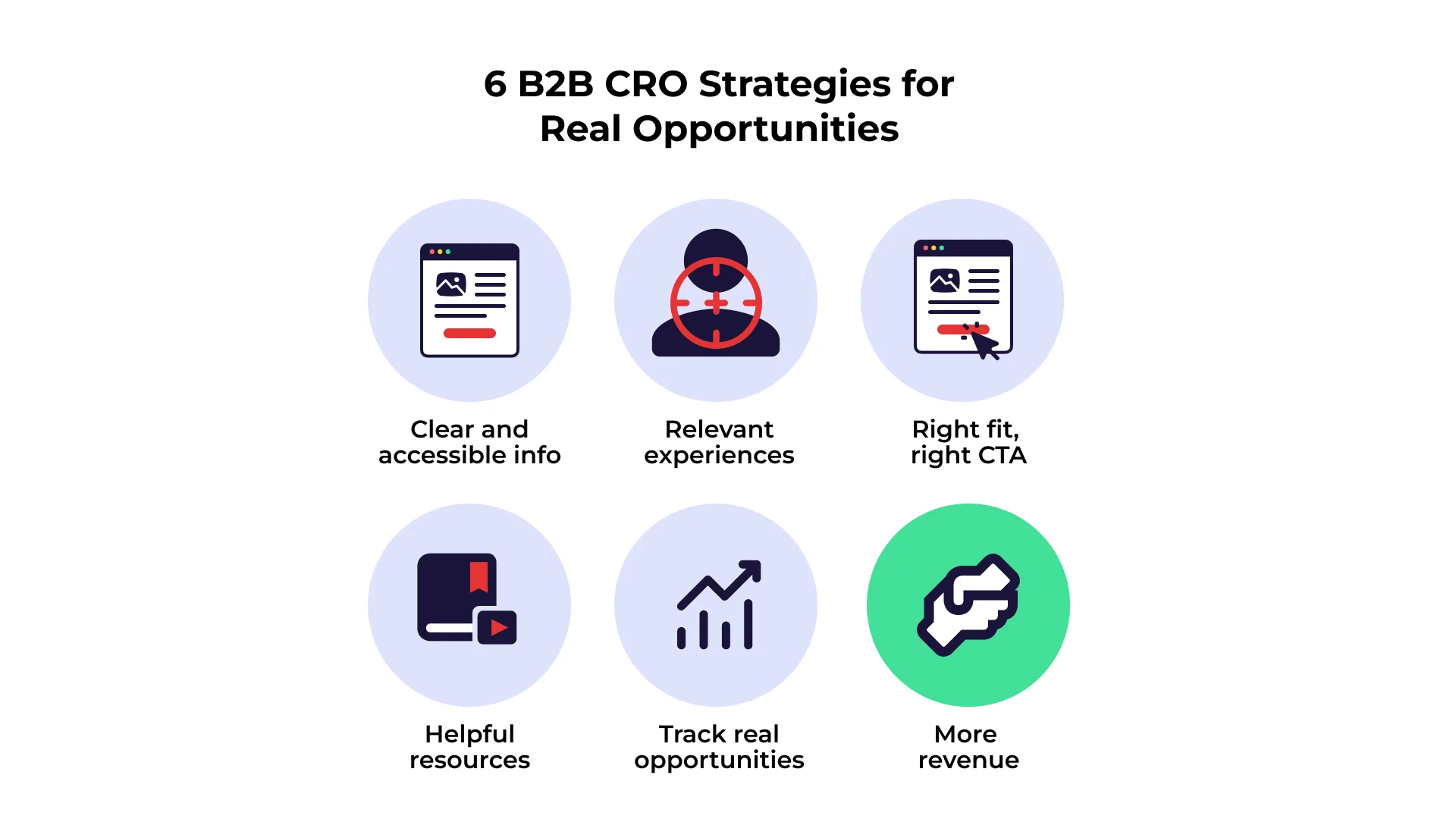
Effective B2B conversion optimization strategies help the right buyers take the next useful step. The goal is not simply to collect more form fills. It is to help people understand your offer, see why it fits their needs, and move forward with confidence.
Start with the basics:
- Make your value, use cases, proof, pricing guidance, and next steps easy to find.
- Send visitors to pages built for their industry, role, or campaign instead of sending everyone to the homepage.
- Make forms and calls to action feel proportionate to the step you are asking buyers to take.
- Offer useful ways to learn, such as product tours, FAQs, comparison pages, and practical guides.
- Measure whether leads become real sales conversations and opportunities, not just whether they submit a form.
Many B2B decisions involve more than one person. A marketer may need to explain the customer value, a technical reviewer may need product details, and a leader may need to understand cost and risk. Your website should help each person find what they need without making them start over.
That also means a conversion can be more than a demo request. A visit to a pricing page, a return visit, a product-tour completion, or a download from a target account may show meaningful progress. Look for the steps that signal real interest in your own buying process.
From a customer-behavior perspective, the strongest B2B sites reduce uncertainty. They answer common questions early, show relevant proof near important decisions, and make the next step clear.
The Reality of B2B Funnels and Account-Level Journeys
B2B buyers often need time and input from others before they make a decision. They may compare options, review technical requirements, ask about security, and build an internal case for change. A website that only pushes visitors to “Talk to Sales” can leave many early-stage buyers without the information they need.
At SiteTuners, we view the website as a practical tool for the full buying journey. It should help a buying group learn, compare, discuss, and take the next step. That is why it is useful to look beyond lead volume and also watch for better-quality conversations, stronger account engagement, and progress toward opportunities.
Multi-Stakeholder Buying Dynamics
Different people arrive with different questions. An end user may want to know whether the product will make daily work easier. A technical reviewer may look for integration details, documentation, and security information. A finance leader may want clear pricing context and a realistic view of value.
Give each audience a simple path forward:
- For end users: Show the main workflow, common use cases, and the day-to-day benefit.
- For technical reviewers: Make product requirements, integrations, security information, and support resources easy to locate.
- For business leaders: Explain the problem you solve, the expected business value, and what happens after they engage.
Not every visitor is ready to speak with sales. Offer a mix of lower-commitment next steps, such as helpful articles, product overviews, case studies, a self-guided tour, or a pricing conversation. A clear journey map can help you spot where each audience needs more support. Mapping user journeys for optimal conversions is a useful starting point.
Improve Lead Quality Without Creating Unnecessary Work
A long form may be reasonable when someone requests a detailed proposal. It is rarely the best first step for a visitor who wants a basic guide. Match the amount of effort you ask for to the value you are offering.
Try these practical changes:
- Ask for less at first: Request only the information needed to begin a conversation or deliver the resource.
- Use a short, step-by-step form: Split a longer request into smaller, easier steps when you truly need more detail.
- Place proof near the decision: Add relevant client results, testimonials, certifications, or clear process details close to forms and calls to action.
The aim is not to remove every question. It is to make each question feel useful and fair. For more ideas on building trust at key decision points, see leveraging persuasion to boost conversion rates.
Core B2B Conversion Optimization Strategies for Modern Pipelines
B2B sites may support a sales-led journey, a self-serve buying journey, or a mix of both. The right conversion path depends on what you sell and how your customers buy.
| Optimization area | Sales-led B2B journey | B2B ecommerce journey |
|---|---|---|
| Main next step | Book a demo, request a consultation, or start a sales conversation | Create an account, request terms, place an order, or reorder |
| Common barriers | Unclear value, long forms, missing proof, or unclear pricing | Hard-to-use product search, unclear prices, account setup, or checkout issues |
| Helpful improvements | Product tours, useful comparison content, clear scheduling, and strong proof | Saved company details, clear product information, easy reordering, and simple checkout |
| What to watch | Quality of sales conversations and opportunity progress | Completed orders, repeat orders, and checkout completion |
Use the table as a guide, not a rigid rule. Start with the customer problem. Then choose the simplest improvement that helps a buyer make progress.
Offer Useful Self-Serve Product Experiences
People should not have to wait for a sales call to understand the basics of your offer. If a buyer has a simple question, give them a simple way to find the answer.
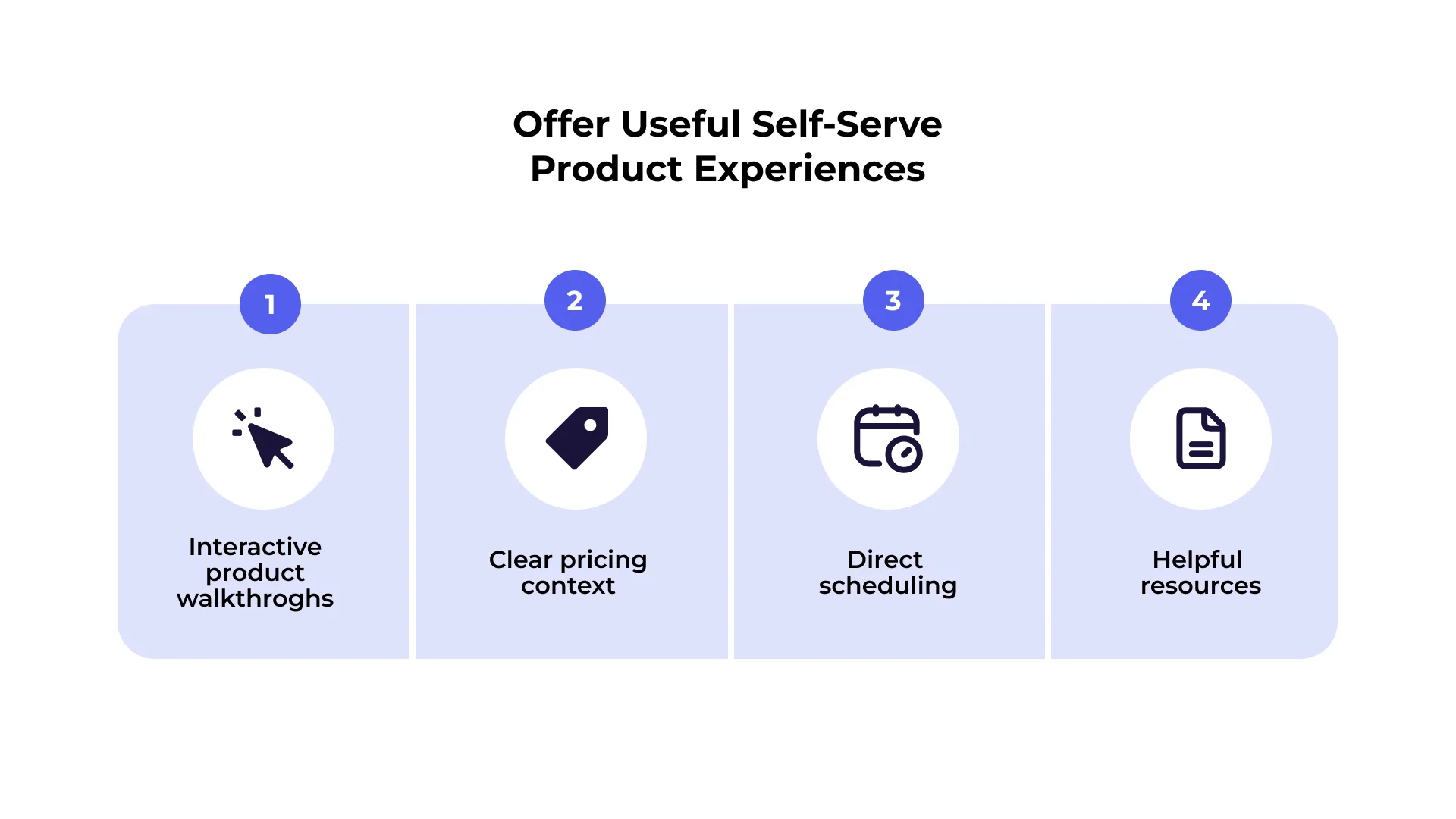
Useful self-serve options can include:
- Interactive product walkthroughs: Let visitors explore key tasks or features at their own pace.
- Clear pricing context: If you cannot publish a full price list, explain what affects price and what a buyer can expect from the process.
- Direct scheduling: Give high-intent visitors a quick way to choose a time instead of asking them to wait for a reply.
- Helpful resources: Use FAQs, comparison pages, case studies, and guides to answer questions before a buyer needs to ask them.
Make Enterprise Pages Feel Relevant
Large organizations often need more detail before they can move forward. Generic pages can make it harder for visitors to see whether your offer fits their role, industry, or situation.
Start with practical relevance instead of complicated personalization systems. Create pages that speak to a specific industry, customer problem, or role. Show the proof, examples, and product details that matter to that audience.
For example, a page for a technical audience might lead with integrations, implementation expectations, and security resources. A page for an executive audience might lead with the business problem, customer outcomes, and the decision process.
Remove Friction From the B2B Experience
A buyer should be able to understand what you offer, why it matters, and what to do next without working too hard. Confusing pages, slow experiences, and vague calls to action create doubt at the moment you need clarity.
Focus on a few basics first:
- Make pages easy to use on any device: Buyers may research between meetings or while away from their desk. Check important pages on mobile as well as desktop.
- Make the page easy to scan: Use clear headings, short paragraphs, bullets, and visual callouts. Put the most important message near the top.
- Use specific calls to action: “Book a technical review,” “See the product tour,” and “Compare options” tell visitors more than “Learn more.”
- Remove distractions: A landing page should support one clear decision. Cut links, messages, or design elements that pull attention away from that task.
A small change in wording or page order can make a meaningful difference when it helps visitors understand the next step.
Diagnosing Friction Points and Experimentation Frameworks
Good optimization starts with evidence, not assumptions. Before changing a page, learn where buyers hesitate, leave, or fail to find the information they need.
Find Barriers in the Buyer Journey
Look at the path from first visit through the next meaningful business step. You do not need to begin with a complex reporting project. Start with the questions your team can answer now:
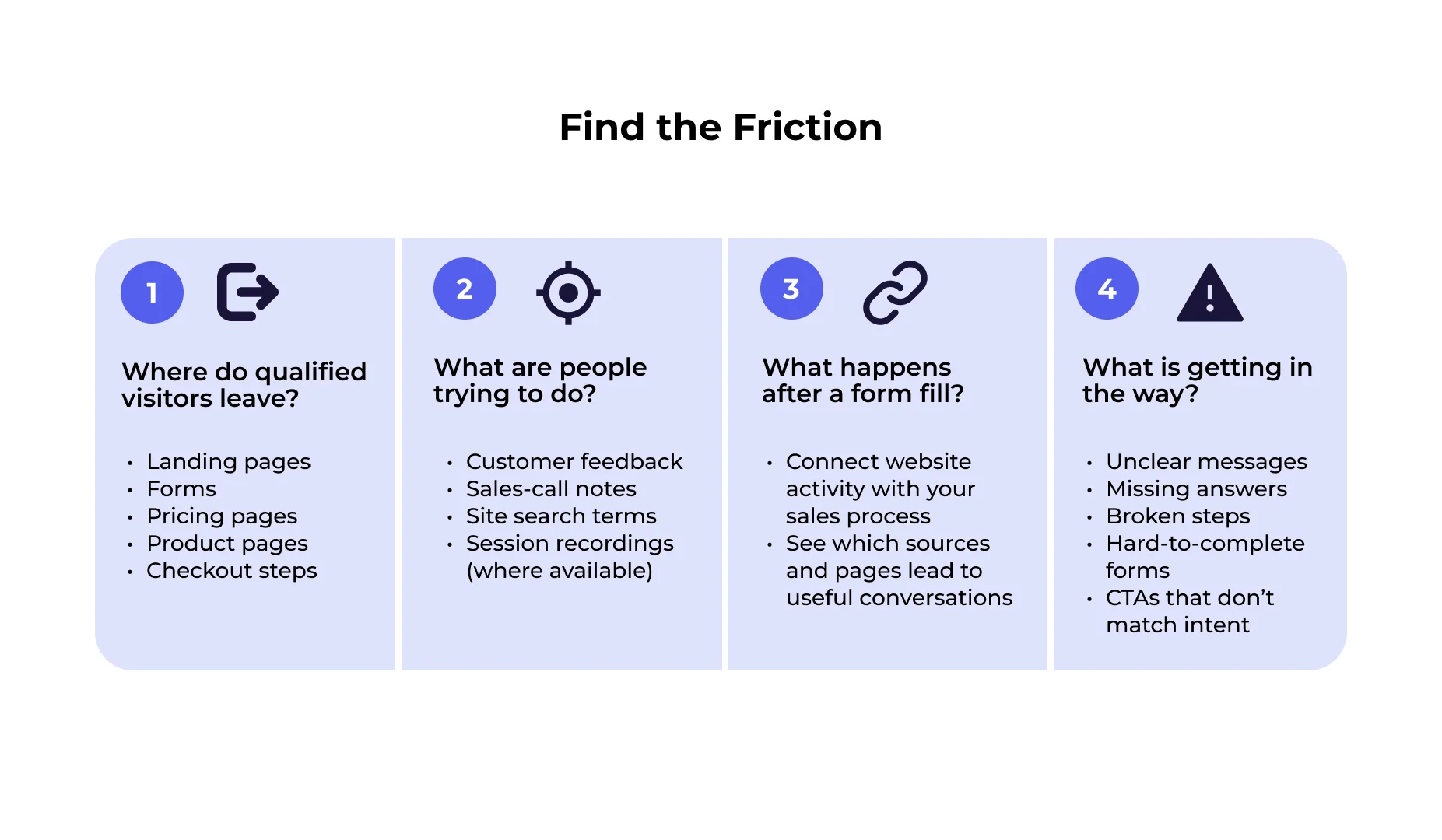
- Where do qualified visitors leave? Review key landing pages, forms, pricing pages, product pages, and checkout steps.
- What are people trying to do? Use customer feedback, sales-call notes, site search terms, and session recordings where available.
- What happens after a form fill? Connect website activity with your sales process so you can see which sources and pages lead to useful conversations.
- What is getting in the way? Look for unclear messages, missing answers, broken steps, hard-to-complete forms, or calls to action that do not match the visitor’s intent.
For B2B ecommerce teams, this guide to auditing a B2B ecommerce site for conversion problems can help you review account setup, product information, and ordering steps.
Prioritize Tests With a Simple Score
You will usually have more ideas than time. A simple scoring method helps your team focus on the changes most worth testing.
One option is ICE:
- Impact: If this works, how much could it help the buyer or improve a meaningful business result?
- Confidence: What evidence supports the idea? Consider customer feedback, analytics, sales input, or previous tests.
- Ease: How much time and effort will it take to build, review, and measure?
Use the score to start a conversation, not to pretend you have perfect certainty. A clear hypothesis is more useful than a long list of random page changes. For example: “If we explain implementation steps next to the demo form, more qualified visitors may feel ready to book a conversation.”
Frequently Asked Questions About B2B CRO
What is a realistic benchmark for B2B conversion rates?
There is no single benchmark that tells you whether a B2B website is working. Conversion rates vary based on traffic source, offer, audience, price, sales cycle, and the action you count as a conversion.
Start with your own baseline. Then look at whether changes improve the quality of leads, sales conversations, opportunities, and revenue over time. A lower number of form fills can still be a win if those leads are a better fit.
How do you run CRO experiments when sales cycles take time?
Do not wait for every deal to close before learning from a test. Choose early signals that matter in your business, such as qualified demo requests, completed meeting bookings, repeat visits from target accounts, or use of high-value resources.
Then keep watching those leads as they move through your sales process. This gives you a faster way to learn while still keeping the focus on business results.
Why do some common CRO tactics not fit B2B?
B2B buyers often need more information, more proof, and more time than a single quick decision allows. A tactic that pushes urgency without answering real questions can create doubt instead of confidence.
Focus on helping visitors make a good next decision. Explain the offer clearly, show relevant proof, reduce unnecessary work, and give people a path that fits their level of readiness.
Conclusion
B2B CRO is not about chasing the highest possible form-fill count. It is about helping qualified visitors find the information, proof, and next step that will move them closer to a real buying decision.
Start by looking for the moments where buyers get stuck. Make the message clearer, make the next action easier, and give each audience the proof it needs. Then measure whether those improvements produce better sales conversations and stronger opportunities.
SiteTuners helps organizations identify conversion barriers and improve the customer experience across key website journeys. If you are ready to take a closer look at your own site, explore our guide on how to increase your conversion rate.