B2B Ecommerce vs. B2C: What’s the Difference?
Business-to-business (B2B) ecommerce means one company sells products or services to another company through a website. Business-to-consumer (B2C) ecommerce means a company sells directly to individual shoppers.
B2B ecommerce is not a shopper buying a personal item on Amazon. It is a facilities manager ordering supplies from a distributor, a retailer buying inventory from a manufacturer, or an industrial company reordering replacement parts online.
If you work at a B2B company, or you are thinking about selling B2B online, you have probably noticed something important: your website needs to work differently than a typical consumer store. This guide explains why and what to improve.
Conversion rate optimization (CRO) means improving a website so more visitors take a valuable action. In B2B ecommerce, that action may be a purchase, but it may also be a quote request, account registration, sample request, spec sheet download, or repeat order.
Common B2B ecommerce differences include:
- More people are involved: Buyers, finance teams, managers, technical evaluators, and end users may all influence the decision.
- Buyers need practical details: They often need specifications, compliance information, pricing, delivery timelines, and proof that the vendor can deliver reliably.
- Pricing may not be simple: Some customers expect negotiated rates, volume discounts, or account-specific catalogs.
- Payment can work differently: Orders may use purchase orders, invoice terms, credit lines, or ACH instead of a simple credit card checkout.
Because of these differences, a B2B website should not be judged only by single-session purchases. Quote requests, account registrations, sample requests, saved carts, repeat logins, and reorder activity can all show that a buyer is moving closer to purchase.
Why the B2B Buying Committee Matters
To increase conversions on a B2B ecommerce site, the experience has to work for different people with different questions.
Here is a simple example. Your company wants to buy new warehouse software. Several people may get involved:
| Person | What They Need to Know |
|---|---|
| The technical reviewer | “Will this work with our current systems?” |
| The finance reviewer | “What is the total cost, including setup, fees, and terms?” |
| The end user | “Will this make our job easier?” |
Your website has to answer all three questions, or the deal can stall.
A technical reviewer may need product dimensions, compatibility details, safety documentation, CAD drawings, or installation guides. A finance reviewer may care about total cost, payment terms, taxes, delivery costs, and approval paperwork. An end user may want to know whether the product is easy to use and solves the problem they have today.
High-converting B2B product pages make these answers easy to find.
What Is a Good B2B Ecommerce Conversion Rate Benchmark?
If your B2B ecommerce site converts at 2%, is that good or bad? The honest answer is: it depends.
B2B conversion rates differ depending on what you sell, who you sell to, and what counts as a successful step. There is no one-size-fits-all number.
External benchmark reports can be useful for orientation, but they should not be treated as universal targets. For example, Shopify’s B2B CRO guidance emphasizes that B2B conversion measurement should account for longer buying cycles, account-level behavior, and multiple stakeholders rather than relying only on a simple visitor-to-purchase rate.
Rather than asking, “Are we above or below the average?” ask clearer questions:
- Are qualified buyers finding the right products quickly?
- Are they getting enough information to move forward?
- Are quote, account, and checkout steps easy to complete?
- Are returning customers reordering without friction?
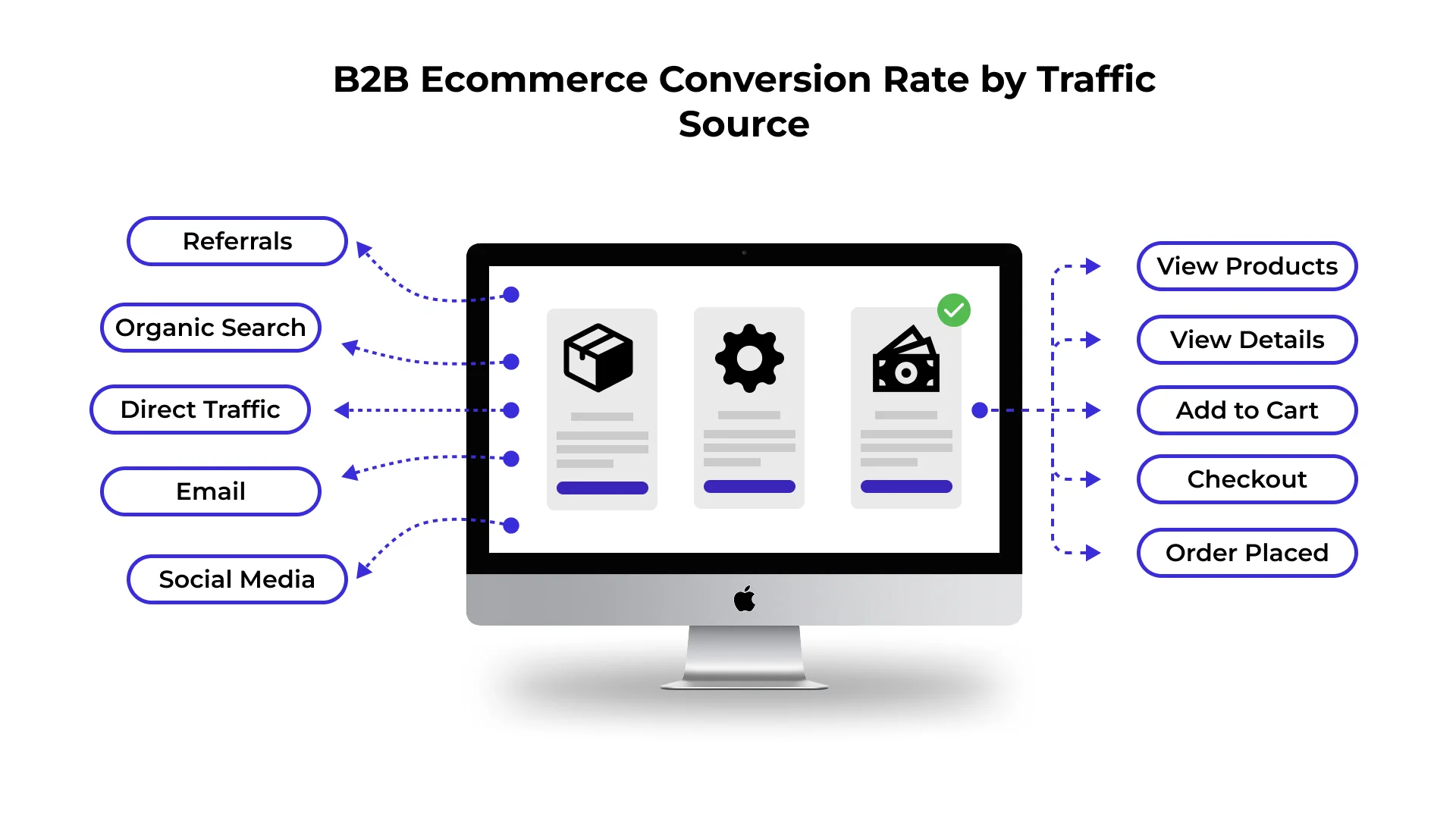
- Are different traffic sources converting in ways that match their intent?
For a B2B ecommerce company, the most useful benchmark is usually your own baseline, broken down by audience, channel, customer type, and conversion type.
| Benchmark Question | Why It Matters |
|---|---|
| Purchase conversion rate | Shows how many visitors complete a paid order online. |
| Quote request rate | Useful when pricing, configuration, or approval happens before purchase. |
| Account registration rate | Shows whether qualified buyers are willing to start a buying relationship. |
| Sample or demo request rate | Useful for products that require evaluation before purchase. |
| Reorder rate | Indicates whether existing customers can buy again easily. |
Metrics to Track Beyond Conversion Rate
Conversion rate is important, but it does not tell the whole story. In B2B ecommerce, SiteTuners often looks at the full buying path to understand where revenue is being lost.
Useful supporting metrics include:
- Average order value (AOV): The average amount each customer spends per order.
- Quote-to-order rate: The percentage of quote requests that become purchases.
- Account registration completion: How many visitors successfully create or activate an account.
- Sales cycle length: How long it takes a buyer to move from first visit or first inquiry to purchase.
- Reorder frequency: How often existing customers return to buy again.
These metrics help reveal whether the site is simply attracting traffic or actually helping qualified buyers move forward.
Why Are Your B2B Website Visitors Not Converting?
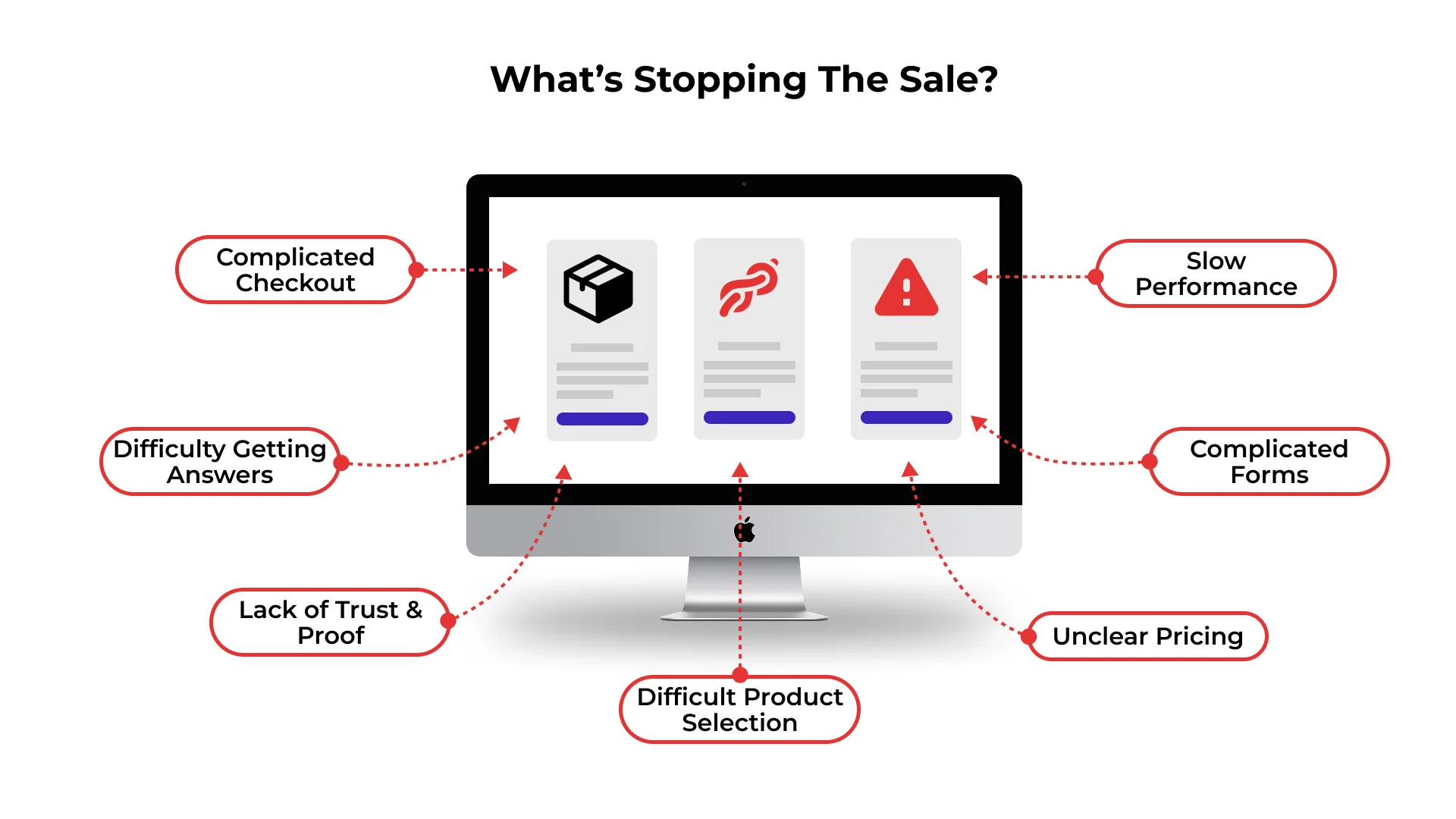
When B2B buyers leave a site without converting, the problem is often not a lack of interest. It is usually friction: the site makes it too hard to understand the product, justify the purchase, get pricing, or complete the next step.
Here are common barriers SiteTuners looks for during B2B ecommerce conversion audits.
1. Slow Website Performance
Speed matters because business buyers are usually trying to complete a task. If category pages, product search, account portals, or checkout pages load slowly, buyers may abandon the process and contact a competitor instead.
2. Complicated Forms
Long or confusing forms can stop motivated buyers from requesting a quote, creating an account, or asking for help. If a field is not needed at that moment, it should usually be removed, delayed, or made optional.
3. Unclear Pricing or Costs
Many B2B buyers need pricing approval before they can move forward. If the site hides contract pricing, shipping costs, taxes, fees, or quote requirements until late in the journey, the buyer may pause or leave.
For example, a distributor may need to reorder parts and get budget approval by Friday. If your website only says “Call for pricing,” that buyer has to stop, call, wait for a quote, and then confirm delivery costs. If a competitor shows pricing and delivery options upfront, the competitor may win the order.
Different B2B businesses have different pricing needs. A wholesaler may need to show bulk discounts and freight costs. A manufacturer may need to support tax exemptions and custom pricing for each customer.
4. Difficult Product Selection
B2B products can be complex. Buyers may need to compare models, confirm compatibility, choose the right replacement part, or configure a product correctly.
Imagine a facilities manager needs replacement gaskets for industrial equipment. There are dozens of sizes on your site, the search tool is weak, and the filters are confusing. They spend too much time looking and still are not sure which part fits. A competitor lets them filter by equipment type, material, and size. That competitor is more likely to get the order.
5. Lack of Trust and Proof
B2B purchases carry professional risk. Buyers want to know that the vendor is credible, experienced, and able to deliver. Case studies, customer logos, certifications, reviews, detailed policies, and clear contact options can help reduce uncertainty.
6. Complicated Checkout or Purchasing Processes
B2B checkout often has to support purchase orders, invoice terms, saved addresses, approval workflows, and repeat orders. If those steps are confusing, buyers may abandon the process even after choosing products.
7. Difficulty Getting Answers
Some buyers are ready to self-serve. Others need help before they can move forward. If technical support, sales assistance, live chat, phone numbers, or account rep contact options are hard to find, the site may lose buyers who simply needed one answer.
How Can You Improve Conversion Rates on Your B2B Ecommerce Site?
Improving B2B ecommerce conversion rates starts with making the buying journey easier, clearer, and more trustworthy. The best changes depend on your business model, but these recommendations apply broadly.
- Make product discovery easier: Improve navigation, filters, product search, and category pages so buyers can quickly find the right item, service, or solution.
- Clarify pricing and next steps: If exact pricing cannot be shown publicly, explain how pricing works and make quote requests easy. For logged-in customers, show negotiated pricing whenever possible.
- Provide complete product information: Include specifications, images, documentation, compatibility details, shipping information, and return policies where buyers expect them.
- Simplify forms and checkout: Remove unnecessary fields, reduce repeated questions, and support the payment or approval methods your buyers actually use.
- Add trust signals near decision points: Place proof close to the moments where buyers hesitate: product pages, quote forms, account registration pages, and checkout.
- Support repeat buying: For existing customers, make it easy to reorder previous purchases, save lists, access invoices, and manage account details.
- Help buyers configure complex orders: If customers need help choosing the right options or getting accurate pricing, consider a Configure, Price, Quote (CPQ) tool. A CPQ tool lets buyers select what they need and generate a quote without waiting for a salesperson.
Create a Consumer-Grade Experience for B2B Buyers
Many B2B buyers now expect the convenience they experience on consumer sites: clear navigation, fast search, transparent next steps, and helpful product content. But B2B sites also need business-specific features such as account pricing, saved lists, quote workflows, and approval support.
The goal is not to copy B2C ecommerce. The goal is to make business buying feel less difficult.
For returning buyers, this may mean quick reorder tools, saved carts, or the ability to upload a spreadsheet of SKUs. For new buyers, it may mean clearer product education, comparison tools, and easy access to a specialist.
Make Delivery and Fulfillment Clear
Delivery details can affect whether a buyer is comfortable placing an order. If timing, shipping costs, pickup options, or delivery requirements are unclear, the buyer may delay the purchase.
For a wholesaler, this may mean showing bulk discounts and freight costs. For a manufacturer, it may mean showing tax exemption handling, inventory availability, and custom pricing for each customer. Different businesses have different pricing and delivery needs, but the principle is the same: buyers need to understand what happens next.
The Systems Behind the Scenes: Why Accurate Data Matters
Behind every B2B ecommerce site, there are systems managing the information buyers see. If those systems get data wrong, buyers notice immediately.
For example:
- One system manages prices and inventory. If that data is wrong, the website may show the wrong price or claim a product is out of stock when it is available.
- Another system tracks orders and shipping. If that breaks, customers may not be able to complete a purchase or understand when an order will arrive.
- Another stores product details like specifications, photos, manuals, and compatibility information. If this is incomplete, buyers cannot make confident decisions.
- Another tracks customer relationships and order history. If this is wrong, returning customers may see broken pricing, missing saved addresses, or incorrect past orders.
Some companies call these systems ERP, OMS, PIM, or CRM platforms. Beginners do not need to memorize those acronyms. What matters is that pricing, inventory, product details, customer accounts, and order information must be accurate.
Buyers do not need to know these systems exist. They only notice when something breaks: the site shows the wrong inventory, pricing loads slowly, product details are missing, or checkout does not show their saved address.
From a CRO perspective, accurate data matters because it affects trust. If the site feels slow, inconsistent, or unreliable, buyers may worry that the company will be difficult to work with after the order is placed.
The practical goal is simple: make sure the website gives buyers accurate information quickly. That may require better product data, faster search, cleaner pricing rules, or more reliable connections between systems. SiteTuners covers related ecommerce UX and conversion principles in our CRO Ecommerce Ultimate Guide.
How Do You Know What to Improve First?
When a B2B ecommerce site is underperforming, it is tempting to implement every best practice at once. That usually leads to scattered effort and unclear results.
A better approach is to identify where your own buyers are getting stuck.
SiteTuners typically looks at several types of evidence:
- Analytics data: Where do visitors drop off? Which pages have high exits? Which forms or checkout steps lose users?
- User behavior: Do visitors actually use your search? Do they click through your filters? Where do they get stuck?
- Customer feedback: What do buyers say is confusing, missing, or frustrating?
- Sales team input: What questions come up repeatedly before buyers are willing to purchase?
- Testing results: Which changes actually improve behavior?
For a simple prioritization process, score each idea by:
- Impact: How much could this improve conversions or revenue?
- Confidence: How much evidence supports the change?
- Effort: How much time, cost, or technical work is required?
Start with changes that have strong evidence, meaningful business impact, and reasonable effort. For many B2B sites, that means fixing product findability, clarifying pricing or quote steps, improving forms, and making checkout easier before investing in more advanced personalization.
How Should B2B Ecommerce Companies Test Improvements?
Testing helps you avoid guessing. But B2B ecommerce testing can be harder than consumer ecommerce because traffic may be lower, buying cycles may be longer, and not every valuable action is an immediate purchase.
That is why B2B companies should watch for signs that someone is getting ready to buy, like saving a product, requesting a quote, or downloading specifications. These actions often happen before the final order.
A/B testing can still be useful. In an A/B test, one group of visitors sees the current version of a page and another group sees a changed version, such as a shorter form, clearer headline, or different call to action. The goal is to see which version performs better.
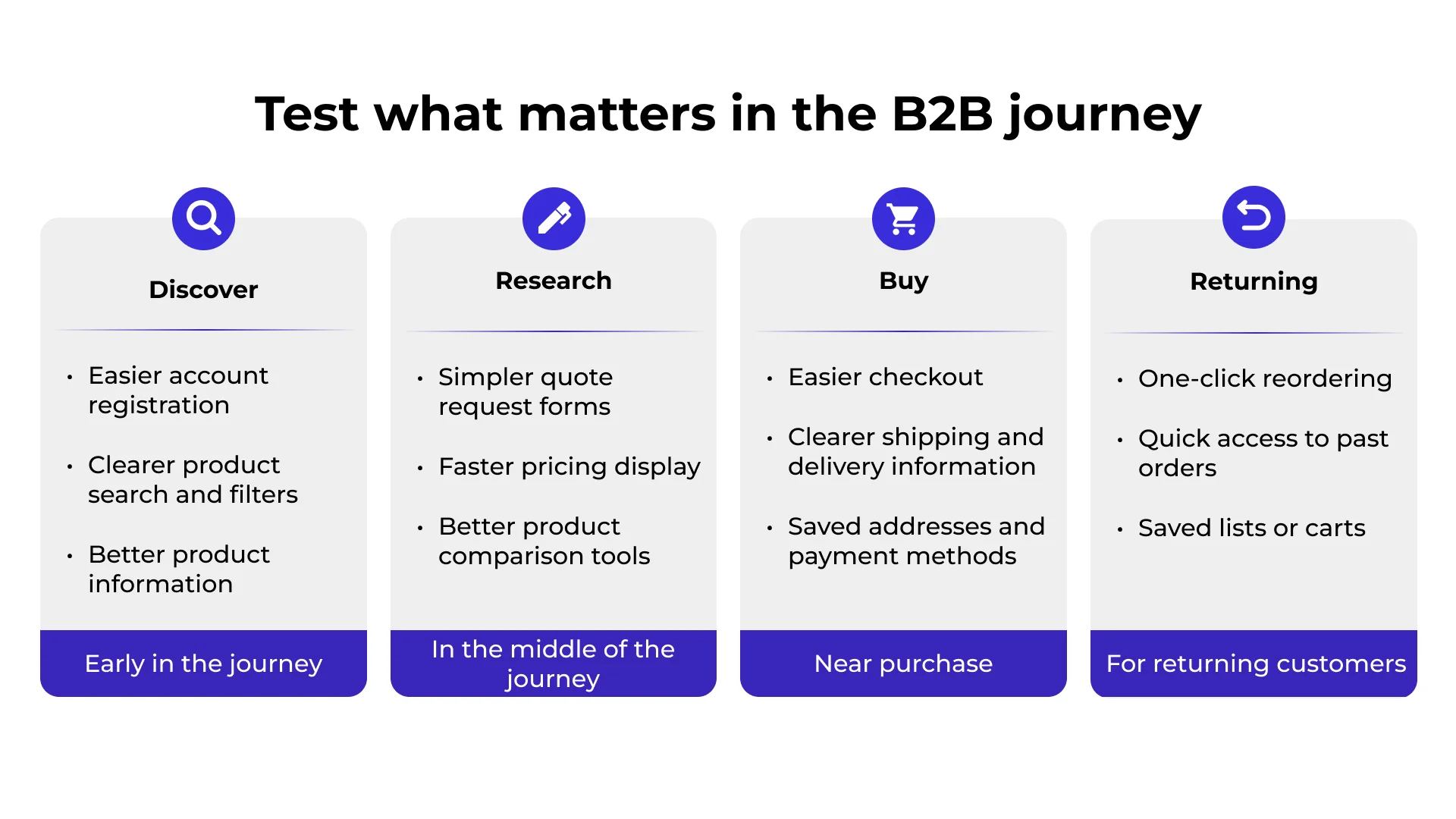
What Should You Test in B2B Ecommerce?
Early in the journey:
- Easier account registration
- Clearer product search and filters
- Better product information
In the middle:
- Simpler quote request forms
- Faster pricing display
- Better product comparison tools
Near purchase:
- Easier checkout
- Clearer shipping and delivery information
- Saved addresses and payment methods
For returning customers:
- One-click reordering
- Quick access to past orders
- Saved lists or carts
For lower-traffic B2B sites, testing may also include usability studies, session recordings, customer interviews, sales-call analysis, and before-and-after measurement. The key is to connect every improvement to a real buyer problem, not just a generic best practice.
Frequently Asked Questions About B2B Ecommerce CRO
What is a good conversion rate for a B2B ecommerce website?
There is no universal “good” conversion rate for every B2B ecommerce website. External benchmark reports can provide useful context, but your target should depend on your industry, traffic mix, product complexity, average order value, and conversion definition. A quote request, account registration, sample request, or reorder may be more meaningful than a simple visitor-to-purchase rate for some B2B models.
How is B2B ecommerce different from just having a sales team?
With sales alone, a buyer has to wait for someone to respond. With B2B ecommerce, they can browse products, check information, request quotes, and reorder online at any time. It is faster for buyers and can take some routine work off the sales team.
Do all B2B sites need a request a quote button?
Not all. If you sell simple products at fixed prices, like office supplies, a straightforward checkout may work well. If you sell complex products with custom pricing, like industrial equipment, a quote workflow usually makes more sense. Match your site to how your customers actually buy.
What if we are a small B2B company? Do we need all these features?
No. Start with what matters most to your buyers: Can they find products easily? Do they understand pricing and next steps? Can they contact you when they need help? You do not need every feature to start converting better.
How long does it take to see results from B2B conversion rate optimization?
Some fixes, such as simplifying forms, clarifying calls to action, improving page speed, or making quote steps easier to find, can show directional improvement relatively quickly. Larger changes, such as rebuilding product data, improving integrations, or changing checkout workflows, usually take longer and should be measured over a longer buying cycle.
How do you run CRO tests when the B2B sales cycle takes several months?
Watch for signs that someone is getting ready to buy instead of waiting only for final purchases. Quote requests, account registrations, technical document downloads, sample requests, saved carts, and repeat logins can all help show whether buyers are moving closer to purchase.
Conclusion: Improve the Journey, Not Just the Benchmark
Knowing your benchmark is useful, but the real question is not whether your conversion rate is “good” compared with an industry average. It is where qualified buyers are dropping out of your specific journey, and why.
A stronger B2B ecommerce experience helps buyers find the right product, understand pricing and next steps, trust the vendor, get answers, and complete the purchasing process with less friction. The right improvements depend on your audience, your products, and your buying process.
At SiteTuners, we help companies identify the barriers that prevent qualified visitors from becoming leads, buyers, and repeat customers. Our work is grounded in conversion research, user behavior, analytics, and practical CRO experience across more than 2,100 client engagements.
Now that you understand how B2B ecommerce is different, the next step is to see where your specific buyers may be getting stuck. Request a free expert review of your website and get a fresh perspective on the friction points, missed opportunities, and conversion barriers that could be costing you sales.