What Is Tactical Design (and Why It Matters for Your Business)
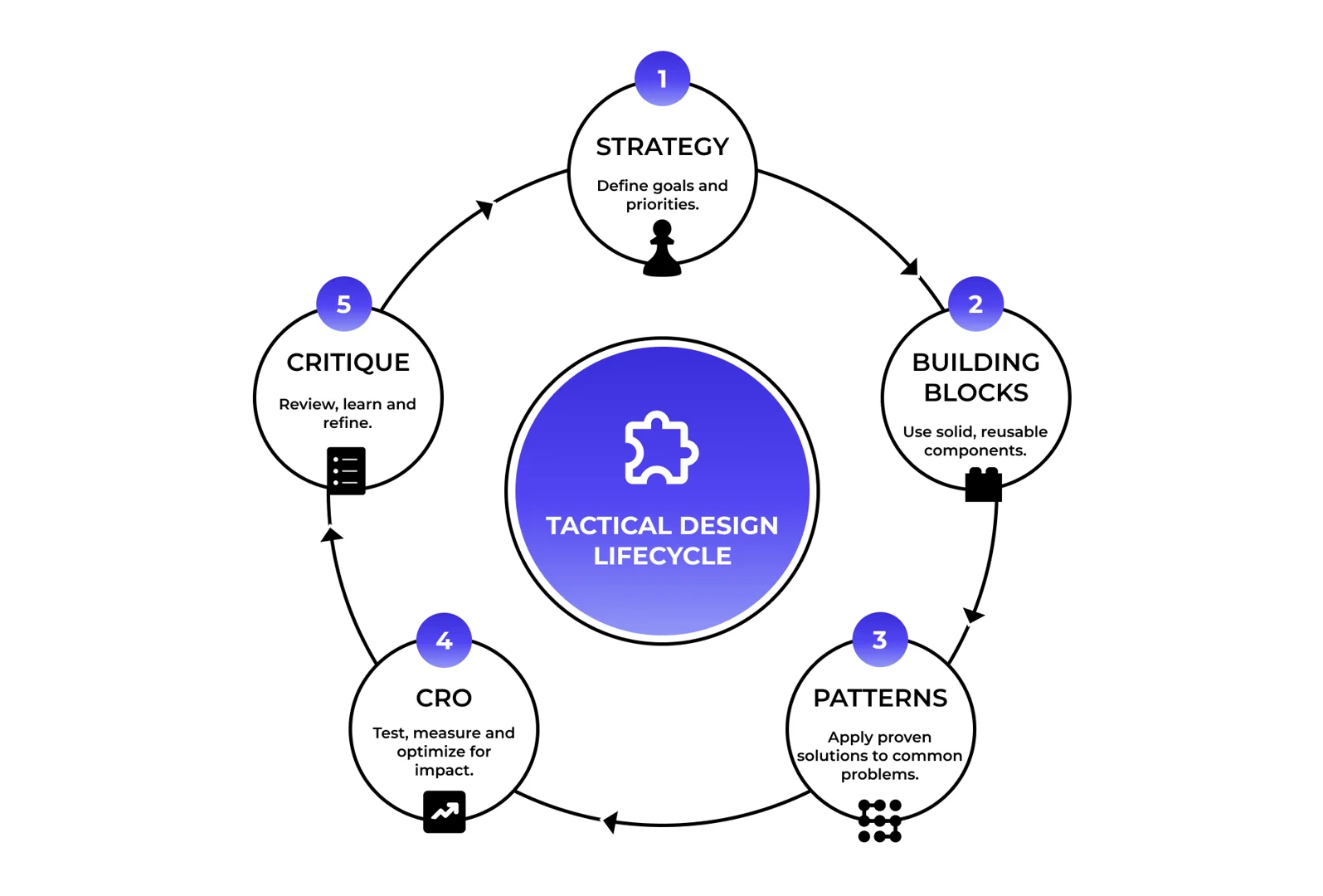
Tactical design is the practice of solving specific, immediate problems through precise, executable decisions — the “how” that turns strategy into results.
In practice, it means:
- What it is: The hands-on execution layer of design — patterns, decisions, and implementations that solve defined problems now
- Where it applies: Software architecture, UX/UI, product development, and conversion rate optimization (CRO)
- How it differs from strategic design: Strategy defines why and what; tactical design defines how and when
- Core tools: Value objects, entities, aggregates, architectural patterns, A/B tests, critiques, and rapid prototypes
- The risk: Without strategic oversight, tactics can optimize the wrong things
If your traffic is growing but conversions remain flat, tactical design can help uncover the specific, fixable issues preventing users from taking action.
This guide explains what tactical design means, how it works across software, UX, and CRO, and when to prioritize tactics versus strategy.
What Is Tactical Design? Definition and Core Differences
To use tactical design well, you need to understand its boundary with strategy. In software, UX, product, or marketing work, teams operate on two planes: strategic and tactical.
Strategic design is the high-level map. It defines the destination, audience, and long-term vision — the “why” and “what.” Tactical design is the execution layer: the concrete choices, patterns, and implementation details that make the strategy real.
For example, a broad brand philosophy only becomes useful when it translates into physical, emotional, and digital interactions — how a button feels, how a screen flows, or how a product guides the user.
| Dimension | Strategic Design | Tactical Design |
|---|---|---|
| Primary Focus | The “Why” and “What” | The “How” and “When” |
| Time Horizon | Months to years | Days to weeks |
| Scope | Organizational, market-level | Specific, contextual, component-level |
| Key Deliverables | Bounded contexts, core subdomains, positioning | Value objects, entities, UI components, A/B tests |
| Risk of Ignoring | Directionless execution | Analysis paralysis and slow delivery |
What is Tactical Design?
Tactical design is immediate, structured action. It identifies the friction point in front of you and uses the right tool to resolve it.
In software, that may mean clean, decoupled domain models. In UX, it may mean simplifying a checkout flow. In CRO, it may mean fixing the form step that keeps users from converting.
Strategic vs. Tactical: The “Why” vs. the “How”
Teams often stumble when they confuse the two layers. A strategy might say, “Become the most trusted financial platform for young investors.” But that goal does not tell a designer, developer, or optimization team exactly what to change or implement.
Tactical implementation makes it real through onboarding flows, secure transaction logic, and domain services that support the intended experience.
The Technical Architecture of Tactical Design
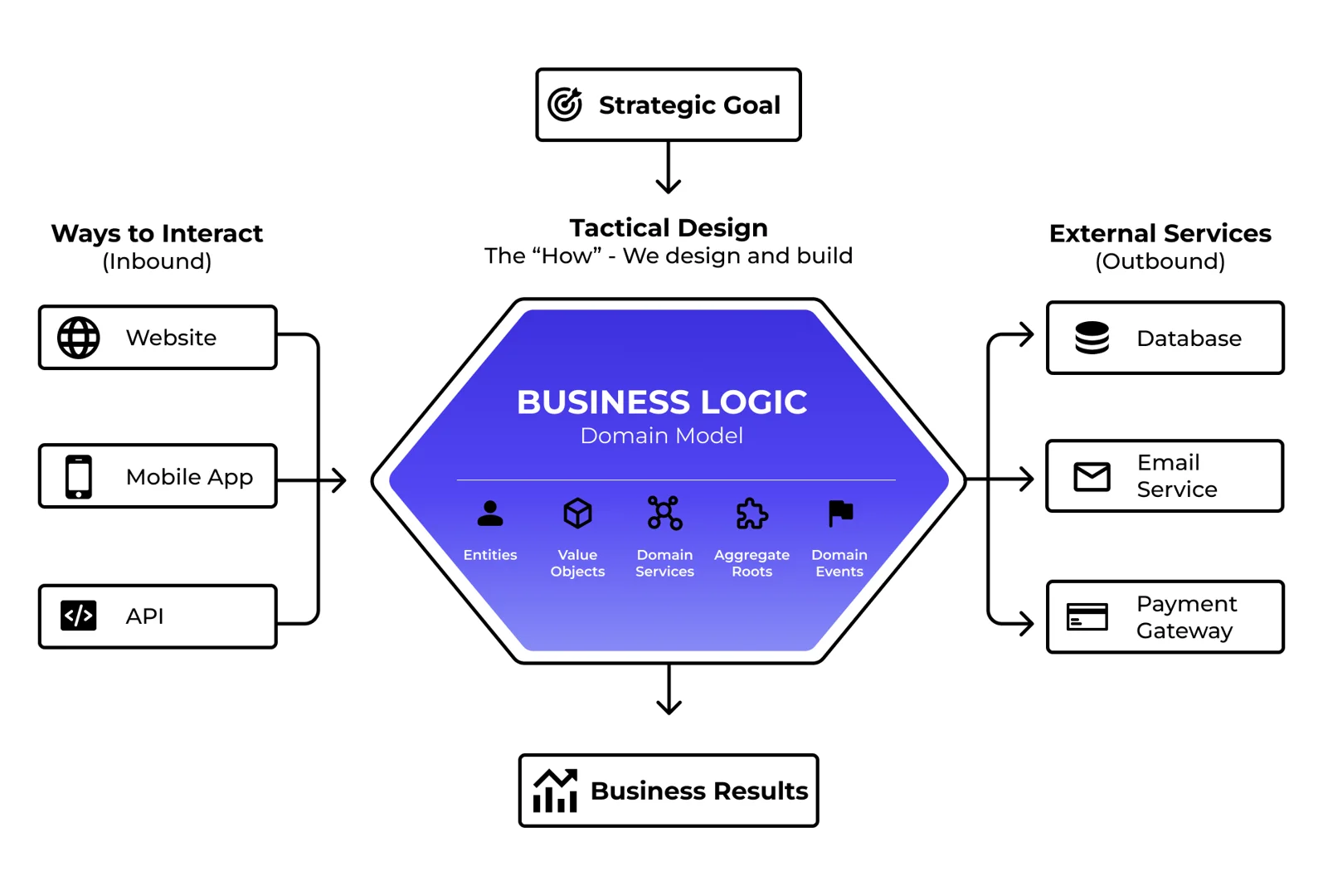
In software development, particularly Domain-Driven Design (DDD), tactical design provides the building blocks teams use to translate business requirements into working systems.
These building blocks include Value Objects, Entities, Aggregates, Domain Services, and Domain Events. Together, they help developers organize business logic, maintain clear system boundaries, and make complex applications easier to evolve.
Architectural approaches such as layered architecture, hexagonal architecture, and CQRS can then help protect that core business logic as systems grow.
The principle is the same across software, UX, and CRO: strategy defines the direction, while tactical design determines how that direction is implemented.
Tactical Design in UX/UI and Product Development
Tactical design also shapes user experiences, interfaces, and products. At SiteTuners, we often start with visual hierarchy and information architecture because changing colors or graphics before fixing the flow only hides the real conversion barrier.
Running a Tactical Design Critique (TDC) to Prevent Atrophy
Interfaces suffer from design atrophy as teams add features, change code, and introduce new visual patterns. Over time, too many choices and inconsistencies increase cognitive load and weaken conversion.
A Tactical Design Critique (TDC) is a structured 20-minute session that isolates visual and functional “tensions” without turning feedback into debate.
A simple TDC format:
- Facilitator: Shares the interface or flow and keeps the session on track.
- Tension rounds: Each participant shares one specific issue, such as an unclear hover state or confusing mobile hierarchy.
- No cross-talk: No defending, arguing, or solving during the round; only brief clarifying questions.
- Capture and log: Every tension is recorded.
- Resolution: The design team addresses the logged issues after the meeting.
This keeps feedback fast, focused, and more constructive for the team.
Rapid Prototyping and Quick-Win Deployments
In product development, waiting months for a perfect launch can slow learning. Tactical design favors rapid prototypes and fast deployment cycles.
For local service businesses, tactical deployments often focus on the essentials: a clear call-to-action, mobile responsiveness, fast load times, and a foundation for local visibility. These quick wins can produce value before a larger redesign is justified.
The Role of Tactical Design in CRO and Experimentation
In Conversion Rate Optimization (CRO), tactical design targets the friction that prevents users from acting: confusing forms, weak calls to action, unclear pricing, or poor checkout flow.
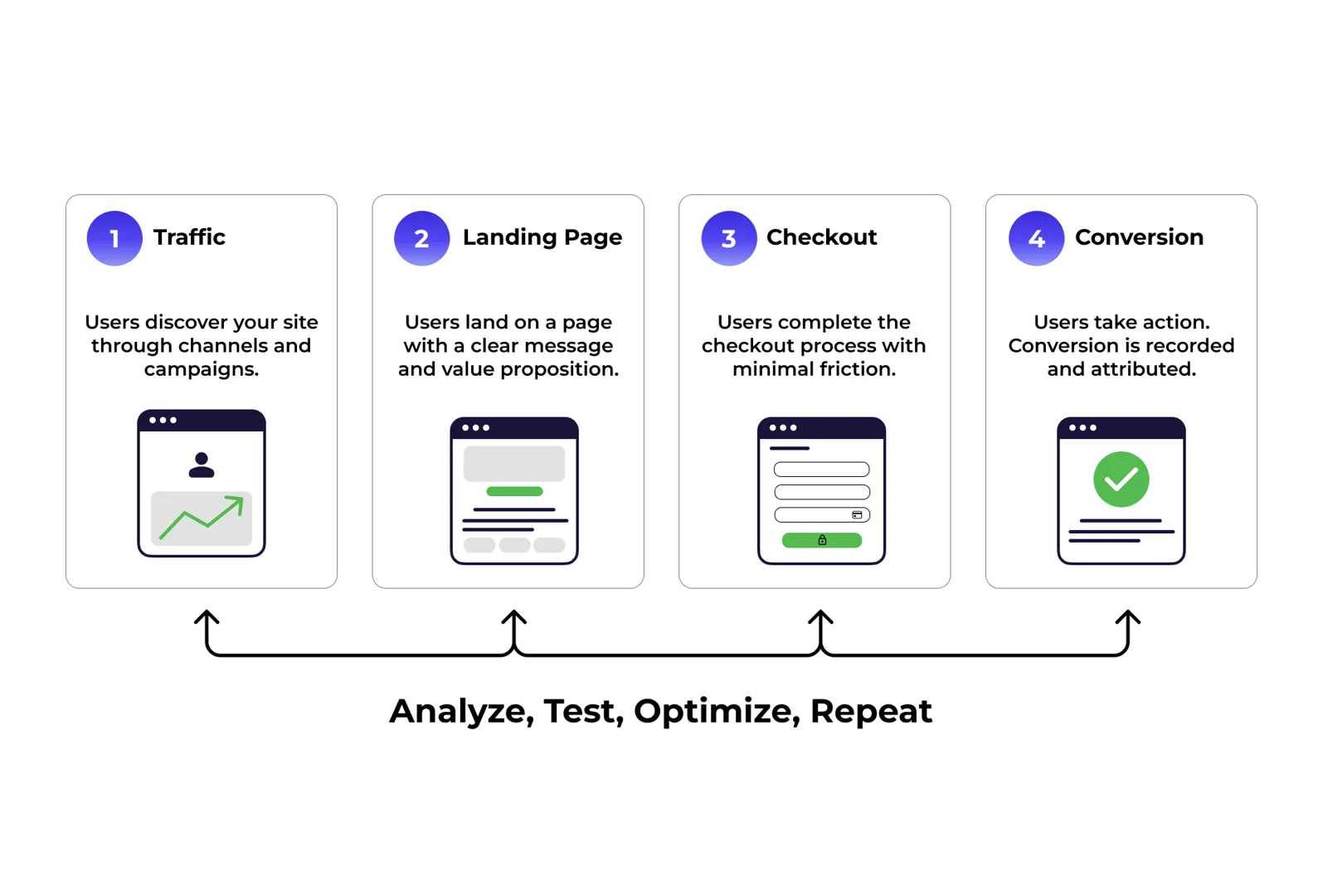
Quick tests can create fast wins, but ad-hoc changes can also create a fragmented optimization program.
Tactical Testing vs. Strategic Experimentation
Tactical testing treats each experiment as an isolated change, often based on heuristics, best practices, or competitor approaches. While these tests can produce wins, they rarely build reusable knowledge about your audience.
Transitioning to a Strategic Experimentation Framework
To make tactical execution compound, connect tests to a strategic framework:
- Step 1: Define a SMART goal: Set a clear business objective, such as increasing subscription revenue by 25% in 12 months.
- Step 2: Build a KPI tree: Break the goal into testable metrics like average order value, trial-to-paid conversion, or checkout completion.
- Step 3: Identify behavioral levers: Find the barriers behind the numbers: confusion, distrust, anxiety, or lack of perceived value.
- Step 4: Deploy Minimum Viable Experiments: Validate the lever with a simple test before building a larger feature.
SiteTuners Case Study: Heller Tax Tactical CRO Wins
SiteTuners’ work with Heller Tax shows how tactical design compounds when small, data-driven improvements are tied to a larger optimization program. Heller Consultants, a property tax reduction firm on Long Island, partnered with SiteTuners on ongoing optimization, website redesign, SEO management, and PPC campaign management.
The engagement combined weekly strategy sessions, high-impact page prioritization, upstream messaging alignment, and a redesign focused on stronger CTAs and conversion paths. As detailed in the Heller Tax case study, the work helped double revenue and leads over a four-year optimization engagement, while the redesigned website contributed to a 30% year-over-year increase in conversions. The lesson is practical: tactical wins become more valuable when each improvement builds on visitor data, campaign intent, and a clear conversion goal.
Want to know which tactical fixes would move the needle on your site? Speak with a conversion expert — a live 1-on-1 session with a SiteTuners optimization specialist. Give us 30 minutes and we’ll show you where your biggest opportunities are.
Balancing Tactical and Strategic Design: When to Prioritize Which
Tactical and strategic design need each other. Strategy without tactics never ships; tactics without strategy can polish a product that serves the wrong need.
When to Prioritize Tactical Design
Prioritize tactical execution when speed and specificity matter:
- Quick-win opportunities: Fixing a broken checkout link, unclear form field, or weak mobile button that can improve performance quickly.
- Supporting subdomains: Using simpler patterns, such as Transaction Script or Active Record, when the business logic does not justify complex modeling.
- Rapid hypothesis validation: Testing demand with a prototype or landing page before investing in a full build.
The Pitfalls of Relying Solely on Tactical Design
Tactical design is useful because it produces visible progress, but relying on it alone creates risks:
- The local maxima trap: You may optimize a flawed offer in small increments instead of making the strategic change that would unlock real growth.
- Design and technical debt: Quick fixes can fragment the interface or codebase, making future changes harder.
- Isolated, non-compounding tests: If each A/B test runs without a larger hypothesis, you may win individual tests without learning why they worked.
Frequently Asked Questions about Tactical Design
What is the main difference between an Entity and a Value Object in tactical design?
An Entity has a unique identity that persists over time, even when its state changes. A Value Object has no unique identity; it is defined by its properties and is immutable. If a property changes, it becomes a new Value Object.
Why is purely tactical testing risky for long-term CRO?
Purely tactical testing focuses on surface-level changes, such as button colors or layout tweaks. It can create short-term wins, but it does not explain why users behave as they do. Without that insight, teams risk running out of ideas, hitting a local maximum, and creating a disjointed experience.
How can tactical design improve conversion rates?
Tactical design can improve conversion rates by addressing specific points of friction in the user experience, such as unclear messaging, confusing forms, weak calls to action, or unnecessary steps in the conversion path. When these improvements are guided by user data and a broader CRO strategy, tactical changes can contribute to both immediate performance gains and long-term optimization.
Conclusion
Since 2002, SiteTuners has helped more than 2,100 clients across 56 countries remove conversion barriers and improve digital performance.
Tactical design is the toolkit for solving the problems in front of you. It provides the patterns to build clean software, the structure to run useful design critiques, and the agility to test ideas quickly. But tactics only matter when they serve a larger, user-centered strategy.
If you are ready to stop guessing and start systematically optimizing your digital experience, explore our SiteTuners Optimization Services to see how tactical quick wins can become long-term revenue growth.