Most businesses come to CRO conversion rate optimization after they’ve already tried everything else. They’ve spent on paid traffic, refreshed the design, and rewritten the copy. The numbers still don’t move the way they should. After working with more than 2,100 clients across two decades, the pattern is almost always the same. It’s not a traffic problem. It’s not even always a design problem. It’s a diagnostic problem. And the fix starts with asking different questions.
Most Businesses Are Solving the Wrong Problem
There’s a tendency in digital marketing to optimize for what’s visible and easy to measure. Button colors get tested. Hero images get swapped. New copy gets written. And yet the underlying reason visitors aren’t converting often goes completely untouched.
What drives conversion rates isn’t usually the surface-level elements. It’s the trust gap that shows up two seconds before someone decides whether to hand over their payment details. It’s the value proposition that sounds clear to the team who wrote it, but lands as vague to the person reading it for the first time. It’s the moment where a visitor hits friction they didn’t expect and quietly leaves.
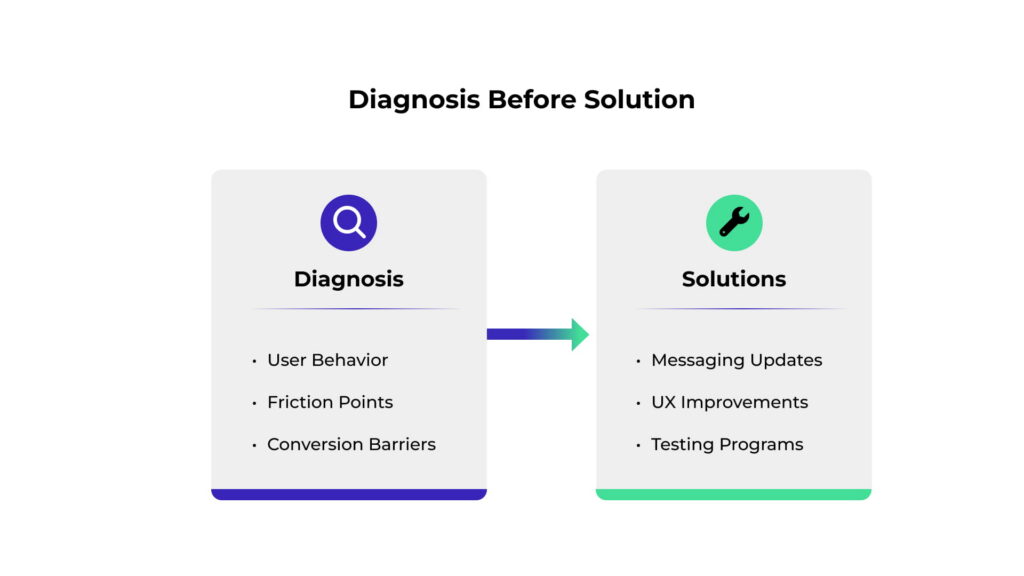
The businesses that see real, sustained growth from CRO are the ones that resist the pull toward quick fixes. They start by diagnosing before they start testing. That shift in approach changes everything.
The Patterns That Show Up Across Every Industry
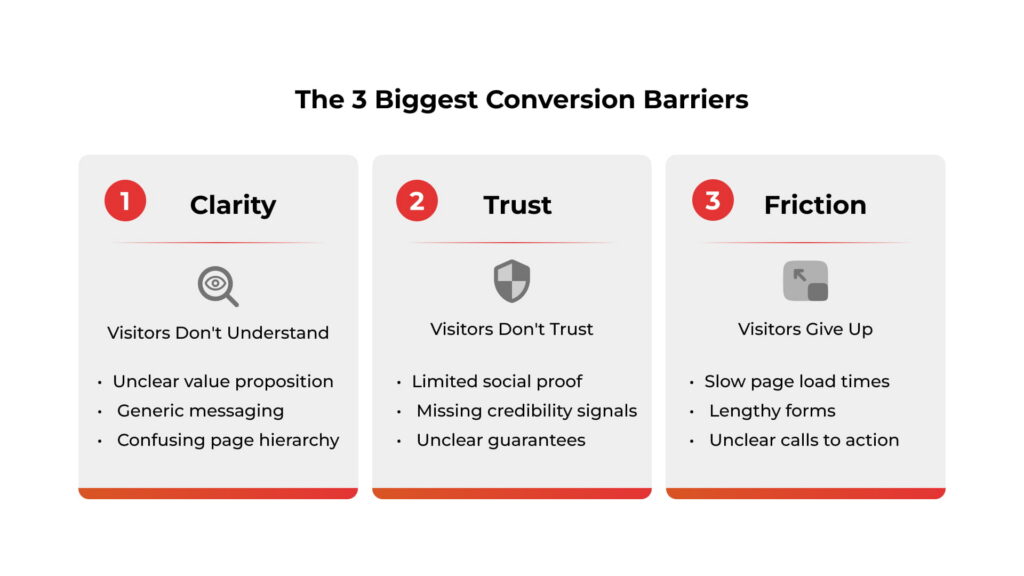
Two decades of client work across e-commerce, professional services, financial services, healthcare, and education reveal something consistent: the same core barriers appear regardless of industry, price point, or audience size.
They tend to cluster around three things.
Clarity Beats Cleverness Every Time
Visitors can’t quickly understand what’s being offered, who it’s for, and why it matters to them. When the value proposition is murky, no amount of design polish compensates. Heller Tax is a good example of what happens when this gets fixed properly. After restructuring their messaging and page hierarchy to address real visitor hesitation, they achieved real conversion gains alongside a doubling of revenue. The product didn’t change. The communication did.
Trust Is Built (or Broken) Before the CTA
Visitors arrive with skepticism, especially for higher-commitment purchases or services. Social proof, credibility signals, transparent pricing, and clear guarantees do more conversion work than most teams realize. And most sites underinvest here compared to the effort they put into acquisition.
Friction Compounds
A slow page load, a multi-step form that asks for too much too soon, and an unclear CTA. Individually, these feel minor. But to a visitor, they compound. What looks like three small issues in the analytics is often experienced as one reason to leave.
These three barriers account for the majority of conversion losses across virtually every site we’ve audited. Recognizing which one is the primary constraint is the first job of any serious conversion optimization strategy.
Why Testing Without Strategy Is Just Expensive Guesswork
There’s a statistic worth sitting with: businesses spend $92 on customer acquisition for every $1 spent on increasing conversions. That imbalance explains a lot about why so many companies are traffic-rich and conversion-poor.
But the answer isn’t simply to test more. Testing without a structured hypothesis is just accelerated trial and error. It generates data without generating understanding. And it’s surprisingly common—research from Invesp suggests that nearly 47% of companies run only one or two A/B tests per month, with no documented strategy behind them.
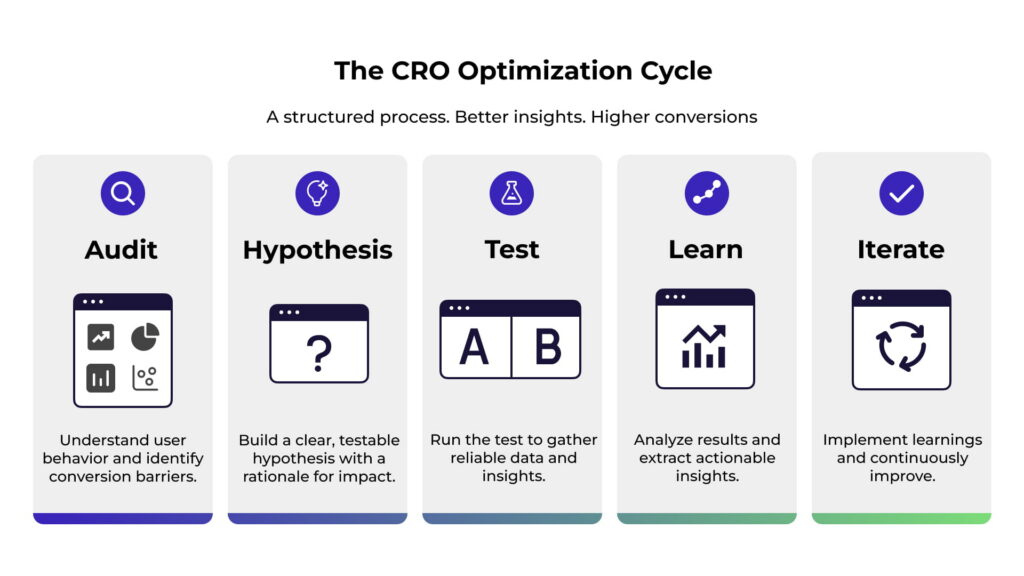
A proper website optimization program starts with a structured audit: understanding where users are dropping off, what the behavioral data is actually signaling, and which barriers are costing the most revenue. From there, every test is built around a specific hypothesis with a defined reason for why this change should improve conversion.
That’s the difference between a structured CRO program and a testing backlog. One builds knowledge that compounds. The other produces a list of inconclusive results.
CRO best practices aren’t a checklist of tactics. They’re a commitment to a process: audit, hypothesize, test, learn, iterate. That cycle, repeated consistently, is where real gains come from.
What the Numbers Actually Tell You (If You Know How to Read Them)
Data is only as useful as your ability to interpret it correctly. Most teams are looking at the right numbers and drawing the wrong conclusions.
Bounce rate is a good example. A high bounce rate on a product page looks like a problem. But if those bouncing users are spending 45 seconds on the page before leaving, that’s not disengagement. That’s unresolved hesitation. The fix is different from what a raw bounce rate would suggest.
The same applies to scroll depth, click patterns, and drop-off points in checkout flows. Each of these signals tells you something specific about where visitors are losing confidence or hitting friction. The goal isn’t to report on these numbers. It’s to use them to identify the single most expensive conversion barrier on the page and address that first.
Session recordings, heatmaps, and funnel analysis all sharpen this picture. But the interpretation layer is where experience matters. Knowing what a particular behavioral pattern usually means, and when it means something different, is a skill built over thousands of audits, not a few months of testing.
If you want to understand how these same insights feed into your broader channel performance, it’s worth reading more on improving your marketing ROI across digital channels.
The Compounding Effect: Why CRO Rewards Consistency
One test rarely transforms a business. But a structured, ongoing program of learning and iteration does something more valuable than any single win: it builds a picture of your customer that gets sharper over time. Every test, whether it wins or loses, adds a layer to that picture.
Over a sustained program, that learning accumulates in specific, practical ways:
- Message resonance: Not just which headlines get clicks, but which framing reflects how your customer thinks about their own problem and what they’re looking for when they arrive.
- Where confidence breaks down: Patterns emerge across tests that point to the exact moments in the journey where visitors hesitate, stall, or leave. That knowledge shapes every future hypothesis.
- Trust signals that actually work: Social proof formats, guarantee placement, credibility signals. The details that move your specific audience become clearer with every round of testing.
This is what separates businesses that see one-off lifts from those that see compounding improvement year on year. The SiteTuners team has seen this pattern play out across industries from e-commerce to financial services to SaaS. Companies using CRO tools see an average ROI of 223%, but that number reflects sustained effort, not a single project. The return compounds precisely because the learning does.
What Two Decades of CRO Conversion Rate Optimization Have Taught Us
Growth through CRO conversion rate optimization doesn’t come from having the cleverest tests or the most sophisticated tools. It comes from understanding your customer’s decision-making process well enough to remove the barriers that are standing between them and converting.
That understanding is built through disciplined diagnostic work, hypothesis-driven testing, and a willingness to let data challenge your assumptions. It’s less glamorous than it sounds in a conference talk. And it’s far more effective than most of what gets called optimization in practice.
The businesses that have grown the most through CRO, not just a quarter but year over year, share one characteristic. They treat it as a discipline, not a campaign. And they invest in getting the diagnosis right before they start building solutions.
Ready to See What’s Actually Holding Your Conversions Back?
You can’t afford to leave money on the table. Every visitor who leaves your site because of an unclear message, a trust gap, or an unexpected friction point is a missed opportunity that paid traffic alone won’t fix.
At SiteTuners, we’ve spent over two decades diagnosing and removing conversion barriers for more than 2,100 clients. We know how to find what’s actually costing you and build a clear path to fixing it.
Get a free website review from our CRO experts and find out exactly where your conversions are being lost and what it would take to recover them.