What Is Website Optimization? (Quick Answer)
Most people think website optimization is simply about improving page speed or SEO. While both are important, they aren’t what ultimately determines whether visitors become customers.
Whether they realize it or not, every visitor arrives at your website trying to answer three questions:
- Am I in the right place?
- Can I trust this company?
- What should I do next?
Website optimization is about reducing uncertainty so visitors can confidently move from curiosity to action. In practice, that means improving your website’s speed, usability, content, navigation, and conversion performance to create a better experience for users and better results for your business.
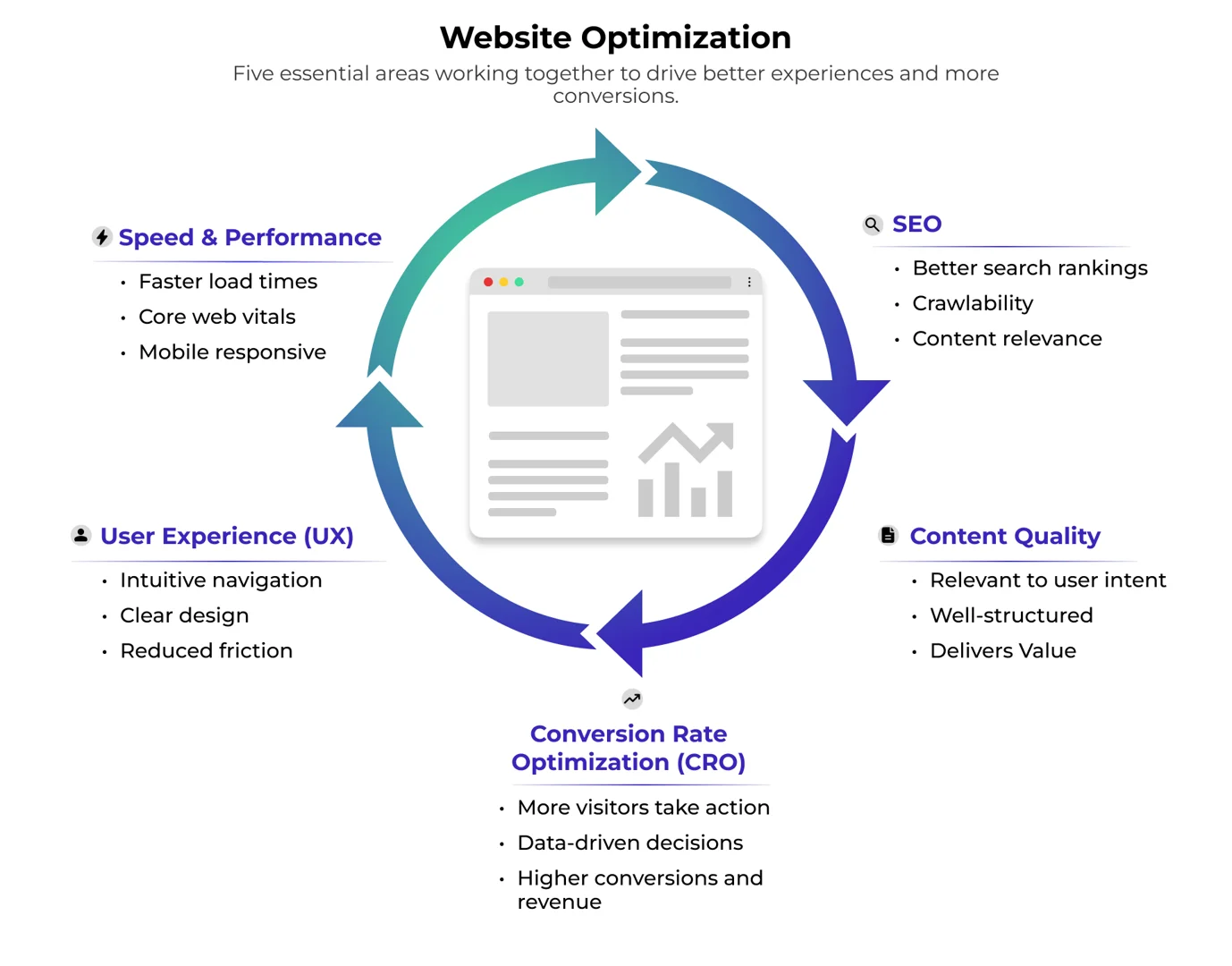
Page speed, SEO, UX, content, and CRO aren’t separate disciplines; they’re all different ways of helping visitors make confident decisions.
Each of these areas plays a different role, but they all work together toward the same objective: helping more visitors become customers.
Here’s a quick overview of what it covers:
| Area | What It Means |
|---|---|
| Speed & Performance | Faster load times, Core Web Vitals, mobile responsiveness |
| SEO | Better search rankings, crawlability, and content relevance |
| User Experience (UX) | Intuitive navigation, clear design, reduced friction |
| Conversion Rate (CRO) | More visitors taking action — buying, signing up, contacting |
| Content Quality | Relevant, well-structured content that matches search intent |
Your website is likely your most powerful sales tool. But if it’s slow, confusing, or failing to convert, you’re leaving money on the table — every single day.
Consider this: Faster-loading websites consistently achieve higher conversion rates than slower websites, making page speed a critical business metric. And with nearly 60% of all web traffic now coming from mobile devices, the stakes for getting optimization right have never been higher.
The problem is that most businesses treat website optimization as a one-time fix. It’s not. It’s an ongoing discipline that combines technical performance, user behavior analysis, content strategy, and controlled experimentation — all working together to turn more visitors into customers.
This guide covers everything you need to know to do it right.
What is Website Optimization and Why Does It Matter?
After optimizing thousands of websites over the past two decades, we’ve found that most websites don’t underperform because they’re ugly or technically broken. They underperform because visitors experience uncertainty. They aren’t sure they’re in the right place, they don’t fully trust what they see, or they can’t quickly figure out what to do next.
Website optimization combines technical performance, user experience, content strategy, and conversion optimization into a continuous process of improving both the customer experience and business performance. It isn’t just about making things look pretty; It is a data-driven approach to ensuring every visitor who lands on your page has the best possible experience. When we talk about performance, we are looking at a holistic picture that includes fixing technical bugs, slashing page load times, and learning how to convert your online visitors on your website.
Why should you care? Because if your site isn’t optimized, you are likely pouring money into a leaky bucket. You might spend thousands on ads or social media to drive traffic, but if those visitors hit a slow, confusing wall, they leave. Optimization can help build trust by creating a faster, clearer, and more reliable user experience and ensuring that your hard-earned traffic actually results in revenue.
We rarely see businesses losing revenue because of one major problem. Instead, it’s usually dozens of small friction points spread across the customer journey. Individually, they seem insignificant. Together, they quietly reduce conversions every single day.
The Core Benefits of Optimization
The rewards of a well-executed strategy are massive. First, you’ll see higher conversion rates. When a site is intuitive, people buy more. Second, you’ll enjoy better SEO rankings. Search engines like Google prioritize sites that provide a stable, fast experience.
The real-world impact is clear: local searches frequently lead to in-store visits and purchases, especially when users have high purchase intent. If your site loads quickly and helps users find what they need, you’re much more likely to earn their business. Furthermore, optimization reduces “churn”—that frustrating moment when a user gives up on your site and heads straight to a competitor.
Website Optimization vs. Standard SEO
We often get asked: “Isn’t this just SEO?” Not quite. While they are cousins, they have different jobs. Standard SEO is primarily about visibility—getting the search engine to find you and rank you. Website Optimization is broader. It takes over where SEO leaves off, focusing on technical performance, user behavior, and removing conversion barriers.
| Feature | Standard SEO | Website Optimization |
|---|---|---|
| Primary Goal | Search visibility and rankings | Business ROI and user satisfaction |
| Focus Area | Keywords, backlinks, and indexing | Speed, UX, CRO, and technical health |
| Success Metric | SERP position and organic traffic | Conversion rate and revenue per visitor |
Technical Foundations: Speed and Core Web Vitals
If your website were a car, the technical foundation would be the engine. You can have a beautiful paint job (design), but if the engine doesn’t start, you aren’t going anywhere. Google uses a set of specific metrics called Core Web Vitals to judge this “engine” performance.
To truly learn about web performance, we have to look at three specific pillars:
- Largest Contentful Paint (LCP): How fast does the main content load?
- Cumulative Layout Shift (CLS): Does the page jump around while loading? (We’ve all experienced the frustration of trying to click a button only for it to move at the last second!)
- Interaction to Next Paint (INP): How responsive is the site when a user clicks or taps?
Data shows that the 1.65 seconds average load time for top rankings is the gold standard. If you are slower than that, you’re fighting an uphill battle. This is especially true given that 59.5% of visits come from mobile devices. If your site isn’t mobile-responsive, you are essentially ignoring more than half of your potential audience.
Techniques for Faster Website Optimization
How do we get those speeds down? We start by eliminating “render-blocking” resources—scripts that stop the page from showing up until they are finished loading. We also use Content Delivery Networks (CDNs) to serve your site from a server physically closer to the user.
Other “quick wins” include minification (removing unnecessary characters from code) and lazy loading (only loading images as the user scrolls down to them). We always recommend that businesses check out the Page Speed Checklist to ensure they aren’t missing the basics like browser caching and resource hints.
Prioritizing Mobile Performance
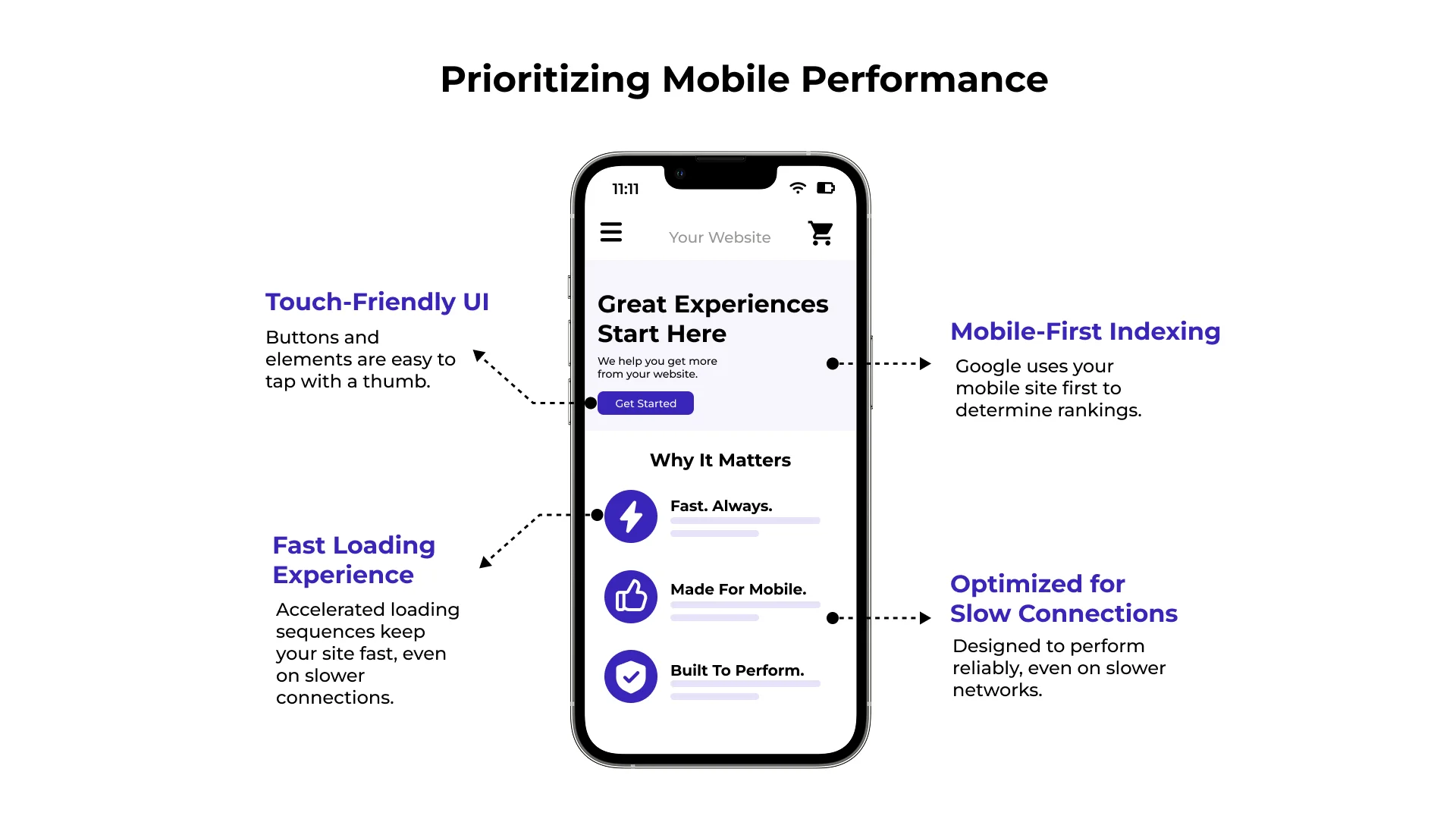
The majority of Google searches now happen on mobile devices. Mobile performance is no longer optional. Google now uses mobile-first indexing, meaning it looks at your mobile site first to determine your rank. We focus on creating a touch-friendly UI—buttons that are easy to tap with a thumb—and accelerated loading sequences that work even on slower 4G connections.
Driving Conversions Through User Behavior and UX Design
You can’t optimize what you don’t understand. To drive real growth, we have to look at how people actually use your site, not just how you hope they use it. This is where we employ 11 methods to improve your visitors online user experience.
Tools like heatmaps and session recordings provide valuable insight into how visitors interact with your website. For instance, if we see a high “Frustration Score” (like rage-clicking on a non-clickable image), we know exactly what to fix. This is critical for e-commerce, where the 70% average abandonment rate often stems from small, fixable friction points in the checkout flow.
Enhancing UX with Website Optimization Tools
When we analyze user recordings, we look for the “why” behind the data. Why did they leave the form? Was it too long? Did it ask for too much personal info? Once we have a hypothesis, we use A/B testing to find the winner. If you’re wondering which web optimization tools should you be using?, we generally point toward platforms that allow for A/B testing with statistical significance. Data-driven testing helps reduce risk and identify changes that genuinely improve performance.
Optimizing Internal Site Search
Don’t overlook your “Search” bar. Research indicates that many shoppers rely on internal search to quickly find products. These users are often your most motivated buyers; users who use internal search often convert at significantly higher rates than those who don’t.
To optimize this, an optimized search experience should handle misspellings, offer auto-complete, and—crucially—never show a dead-end “No Results” page. Even if you don’t have the exact item, show them your best sellers or related categories to keep them in the funnel.
Content Strategy and On-Page SEO Authority
Content is the bridge between a user’s problem and your solution. But to work, that content must be discoverable and authoritative. We know that many searches have local intent, making locally relevant content important for businesses serving specific geographic areas. So your content strategy needs to be grounded in what people are actually typing into that search box.
Establishing Authority via Website Optimization
We use a “Pillar and Cluster” model to build authority. A pillar page is a comprehensive guide (like this one!) that covers a broad topic. We then surround it with “clusters”—shorter articles that dive deep into specific long-tail keywords. This tells search engines that you are an expert in the field.
On-Page Elements and Content Quality
Once the user is on the page, the content has to be readable. We use clear heading structures (H1, H2, H3) and descriptive image alt text to help both users and bots.
But the real closer is social proof. Since 84% of people trust online reviews as much as their friends, we integrate testimonials and case studies directly into the content flow. Finally, we apply 10 quick fixes to improve website conversion rate, such as ensuring your Call-to-Action (CTA) is high-contrast and uses persuasive, action-oriented language.
A Step-by-Step Process for Long-Term Success
Optimization isn’t a “set it and forget it” task. It requires a disciplined, iterative cycle. We follow a website optimization roadmap that moves from data to action.
_compressed.webp?alt=media&token=3b95513b-c53c-47cd-ba31-413c89ab0037 "user-inserted")
- Objective Setting: What is the goal? (e.g., more leads, higher sales).
- Data Analysis: Use tools to find where the site is failing.
- Hypothesis: “If we change X, then Y will happen because of Z.”
- Experimentation: Run an A/B test.
- Measurement: Did it work? If yes, implement. If no, learn and try again.
By tracking web site success through these cycles, you ensure that every change you make is backed by evidence, not just “gut feeling.”
Identifying and Fixing Performance Hindrances
We often find the same “conversion killers” across different industries. Broken links and 66% of pages have unsized images are common technical debt issues. Unsized images are particularly annoying because they cause the page layout to jump, hurting your CLS score. We also look for “thin” or low-quality content that doesn’t answer the user’s intent, which can lead to high bounce rates and low dwell time.
Measuring Ongoing Optimization Metrics
To stay on track, we use 3 Google Analytics gems for maximum efficiency: tracking your conversion rate, revenue per visitor, and customer satisfaction scores. Conversion rates vary widely depending on industry, traffic source, and business model. Rather than comparing your performance to an industry average, the goal should be continuous improvement based on your own baseline.
Frequently Asked Questions about Website Optimization
How does website optimization differ from standard SEO?
SEO focuses primarily on search engine rankings and visibility, while website optimization is a broader discipline that includes speed, usability, and conversion rate optimization (CRO) to improve the overall user experience and business ROI. Think of SEO as the invitation to the party, and optimization as making sure the guests have a great time and want to stay once they arrive.
What are the most common factors that hinder website performance?
Common issues include slow page load times due to unoptimized images, render-blocking JavaScript, poor mobile responsiveness, confusing navigation, and a lack of clear value propositions or calls-to-action. Often, it’s a “death by a thousand cuts”—many small errors adding up to a frustrating user experience.
Is website optimization a one-time project or an ongoing process?
It is an ongoing process because user behavior, search engine algorithms, and web technologies are constantly evolving. Continuous testing and data analysis are required to maintain a competitive edge and maximize long-term growth. What worked two years ago might be obsolete today.
Conclusion
Website optimization isn’t about chasing rankings, improving a single metric, or making your website look more modern. It’s about creating an experience that helps visitors make confident decisions.
Every visitor arrives at your website with three questions in mind:
- Am I in the right place?
- Can I trust this company?
- What should I do next?
The highest-performing websites answer those questions quickly and consistently. They remove friction, reduce uncertainty, and make every next step feel obvious.
That’s why website optimization goes far beyond page speed or SEO. It combines technical performance, user experience, messaging, content, and continuous experimentation to improve both the visitor experience and business results.
At SiteTuners, we’ve spent more than two decades helping businesses uncover the hidden friction that prevents visitors from converting. Through user research, behavioral analysis, and data-driven experimentation, we help companies make optimization decisions based on evidence—not assumptions.
Ready to uncover what’s preventing more visitors from becoming customers? Speak with a CRO Expert to discover where visitors are getting stuck, uncover hidden conversion barriers, and prioritize the improvements that will have the greatest impact.
>
Let’s build a website that turns more visitors into customers.