Why Most Marketing Budgets Fail to Deliver — and How to Fix It
Improving digital marketing ROI is the single most important lever you can pull to get more out of every dollar you spend on marketing.
Here’s a quick answer if you need it fast:
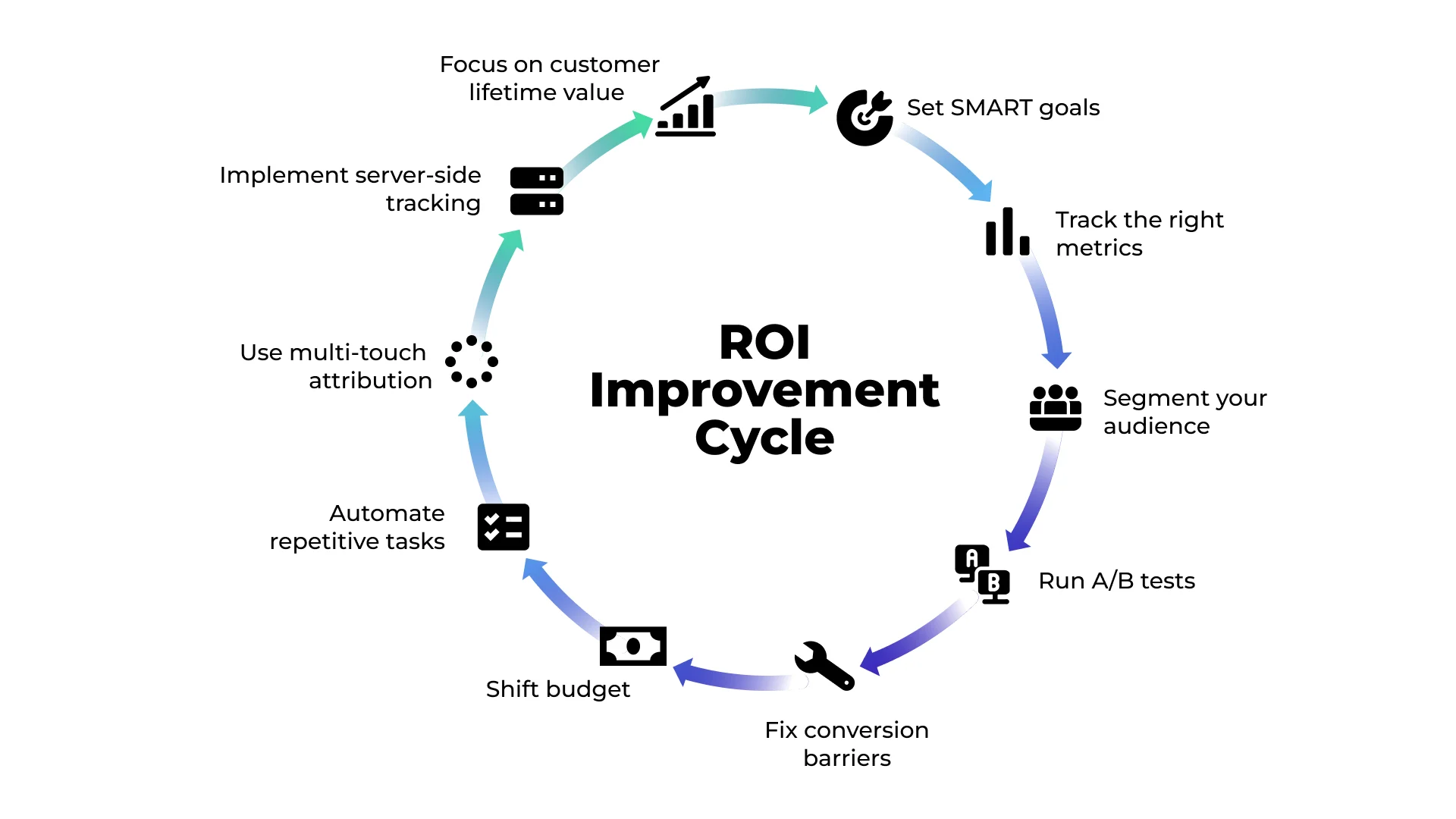
How to improve digital marketing ROI:
- Set SMART goals tied to real business outcomes
- Track the right metrics — not just traffic and likes
- Segment your audience and personalize messaging
- Run A/B tests on ads, landing pages, and emails
- Fix conversion barriers on your website
- Shift budget toward your highest-performing channels
- Use multi-touch attribution to see the full customer journey
- Implement server-side tracking for more accurate data
- Automate repetitive tasks to reduce cost and scale faster
- Focus on customer lifetime value — not just first-time conversions
Most businesses are spending money on digital marketing, but far too many are flying blind. They’re measuring vanity metrics — page views, follower counts, impressions — while the metrics that actually matter, like cost per acquisition, conversion rate, and return on marketing spend, go untracked.
The result? Budget wasted. Growth stalled. Teams frustrated.
Here’s a sobering reality: a 2:1 ROI — earning just $2 for every $1 spent — is barely profitable once you factor in overhead, product costs, and operations. Most marketers consider a 5:1 ratio the baseline for “good”, and 10:1 the mark of an exceptional campaign. Yet many businesses never get there, not because their product is bad, but because their marketing system has gaps.
The good news is that these gaps are fixable — with the right data, the right tools, and the right optimization strategy.
I’m Jeffery Loquist, VP at SiteTuners, with over 18 years of experience across e-commerce, paid media, SEO, and conversion optimization — all focused on how to improve digital marketing ROI for real businesses. In this guide, I’ll walk you through exactly how to measure, diagnose, and systematically improve your marketing returns.
Measuring the Baseline: How to Calculate and Benchmark ROI
Before we can blast off, we need to know where our “ground zero” is. If you don’t know your current numbers, you can’t tell if you’re actually improving.
The Essential ROI Formula
At its simplest, Return on Investment (ROI) measures the profit you make relative to what you spent. According to the Harvard Business Review ROI formula, the calculation looks like this:
ROI = (Incremental Financial Gain – Cost of Investment) / Cost of Investment
To get an accurate result, we must include all relevant costs. It’s not just your ad spend. You need to factor in:
- Agency fees or staff salaries
- Creative production (graphic design, video, copy)
- Software subscriptions (CRM, email tools, analytics)
- Overhead related to campaign management
ROI vs. ROAS: Know the Difference
We often see marketers use these terms interchangeably, but they serve different purposes. ROAS (Return on Ad Spend) is a “micro” metric used to evaluate specific ad effectiveness, while ROI is the “macro” metric for business health.
| Metric | Calculation | Purpose |
|---|---|---|
| ROI | (Net Profit / Total Cost) x 100 | Measures overall business profitability. |
| ROAS | Gross Revenue from Ads / Ad Spend | Measures the effectiveness of a specific ad campaign. |
Benchmarking Your Success
What counts as a “good” return? While it varies by industry, we generally look at these benchmarks:
- 5:1 Ratio: This is considered solid. You are earning $5 for every $1 spent.
- 10:1 Ratio: This is exceptional. At this level, your marketing is a high-performance engine.
- 2:1 Ratio: You’re likely just breaking even after accounting for the cost of goods sold and business overhead.
To truly maximize your returns, we recommend shifting your focus from short-term wins to long-term value. You can learn more about CLV calculation to understand how much a customer is worth over their entire relationship with your brand, which often justifies a higher initial acquisition cost.
Proven Strategies to Improve Digital Marketing ROI
Once you have your baseline, it’s time to start the optimization process. Improving digital marketing ROI isn’t about one “magic” trick; it’s about a series of disciplined, data-driven moves.
Audience Segmentation and Personalization
Broad, “spray and pray” marketing is the fastest way to burn a budget. We’ve found that audience segmentation—dividing your market by demographics, behavior, or purchase intent—is foundational.
- Demographics: Age, location, income.
- Psychographics: Values, lifestyle, hobbies.
- Behavioral: Previous purchases, website interactions.
_compressed.webp?alt=media&token=db754e00-aba9-4ab8-8355-d974eda80c7e "Audience Segmentation and Focus (1)")
When you tailor your message to a specific segment, it feels personal. Research shows that nearly 90% of marketers see a positive ROI when they use personalization. It builds trust and loyalty, which naturally increases engagement and conversions.
Strategic Pricing and Offers
Sometimes the barrier isn’t your ad; it’s the offer itself. We use 10 techniques to make pricing more appealing to help clients nudge users toward a purchase. Whether it’s using “anchoring” (showing a premium price first to make the mid-tier look like a bargain) or the “decoy effect,” small psychological tweaks can lead to massive ROI gains.
SMART Goals and Automation
Every campaign should follow SMART criteria: Specific, Measurable, Achievable, Relevant, and Time-bound. Instead of saying “we want more sales,” say “we want to increase conversion rates by 15% by the end of Q3.”
To scale these efforts without ballooning your costs, leverage marketing automation. Tools that handle lead scoring, email sequences, and retargeting allow your team to focus on strategy while the software handles the repetitive “heavy lifting.”
Using CRO to Improve Digital Marketing ROI
At SiteTuners, we believe your website is your most important salesperson. If your site has “friction”—confusing navigation, slow load times, or a cluttered design—you are effectively throwing away the money you spent on ads.
To get started, try these 10 quick fixes to improve website conversion rate:
- Simplify your Call-to-Action (CTA): Make it clear what the user should do next.
- Optimize for Mobile: Ensure the experience is seamless on every device.
- Reduce Form Fields: Every extra field in a signup form is an opportunity for a user to leave.
- Improve Site Speed: Even a one-second delay can significantly drop your ROI.
By fixing these conversion barriers, you lower your Cost Per Acquisition (CPA) and instantly improve digital marketing ROI.
Advanced Attribution Models to Improve Digital Marketing ROI
The customer journey is rarely a straight line. A user might find you through SEO, follow you on social media, and finally buy after clicking a retargeting ad. If you only give credit to the “last click,” you’re missing the big picture.
We recommend moving toward multi-touch attribution. Common models include:
- First-Click: Gives 100% credit to the first interaction. Great for measuring brand awareness.
- Last-Click: Gives credit to the final touchpoint. Often overvalues direct search or ads.
- Linear: Distributes credit equally across all touchpoints.
- Time-Decay: Gives more credit to interactions that happened closer to the conversion.
- Data-Driven Attribution: Uses machine learning to assign credit based on how much each touchpoint actually influenced the sale.
Refer to Google’s Attribution Guide for a deeper look at how to set these up in your analytics.
Technical Setup: Tracking and Attribution for Accurate Returns
You can’t manage what you can’t measure. A robust technical setup is the backbone of any ROI-focused strategy.
Google Analytics 4 (GA4) and UTMs
GA4 is the industry standard for tracking user behavior. However, it only works if your data is clean. Always use a consistent UTM parameters guide to tag your URLs. This allows you to see exactly which campaign, source, and medium drove a specific conversion.
The Power of Server-Side Tracking
With the decline of third-party cookies and the rise of ad blockers, traditional browser-based tracking is becoming less reliable. We are seeing businesses lose 15–30% of their conversion data because of these privacy changes.
The solution? Server-side tracking and the Conversions API (CAPI). By sending data directly from your server to the ad platform (like Meta or Google), you bypass browser limitations. Real-world case studies show that switching to server-side tracking can lead to a 30% increase in reported conversions and a 58% lower cost per purchase. It’s a game-changer for anyone looking to improve digital marketing ROI.
CRM Integration and Data Hygiene
To see the full picture, your marketing data must talk to your sales data. Integrating your CRM (like Salesforce or HubSpot) with your analytics platform allows you to track “offline” conversions—like a phone sale that started with a web click. This “closed-loop” reporting is essential for high-ticket items and B2B services.
Channel-Specific Optimization for Maximum Impact
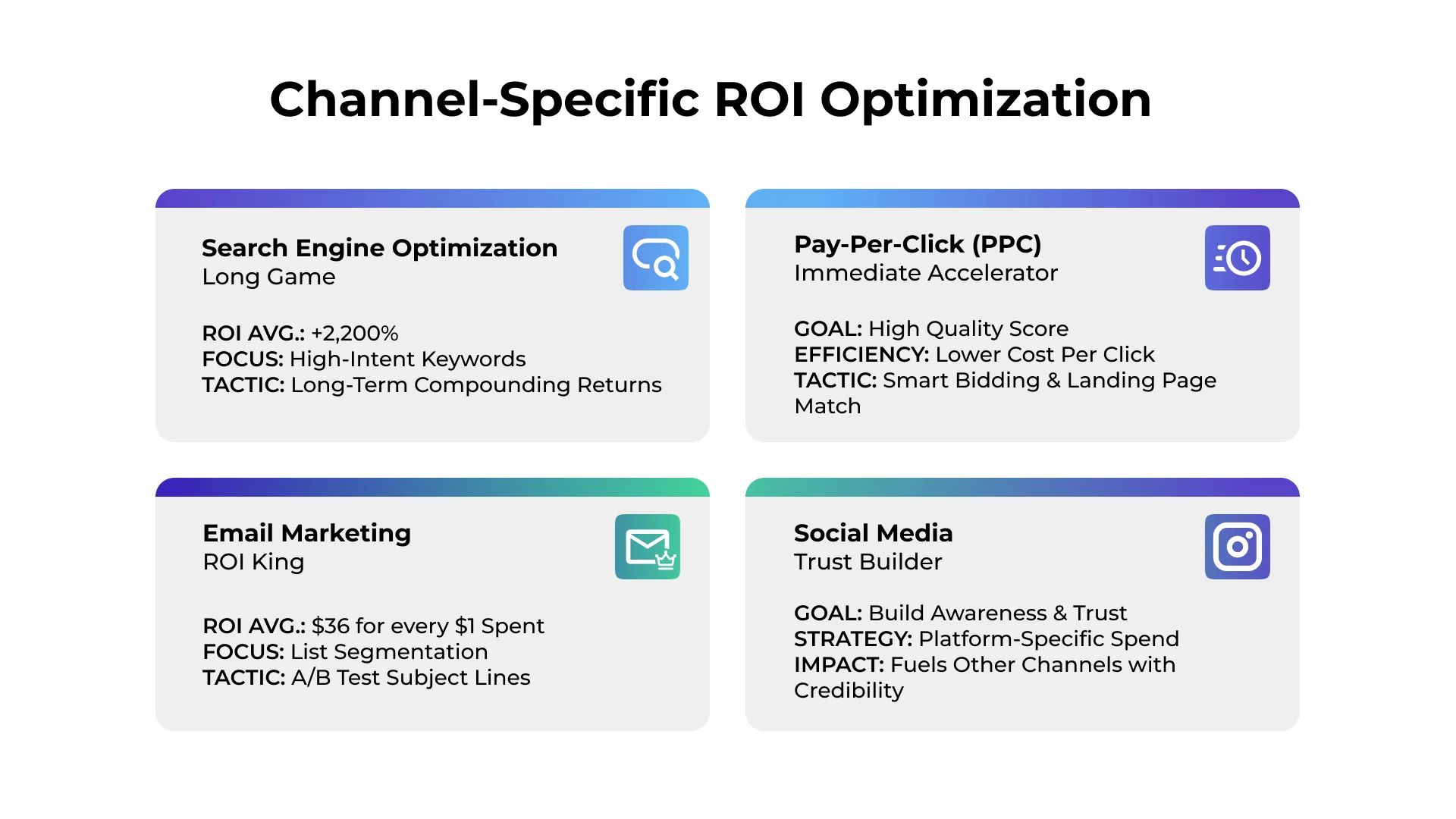
Every channel has its own “rules” for ROI. Here is how we optimize the big four:
Search Engine Optimization (SEO)
SEO is the “long game,” but it offers some of the highest returns—averaging a 2,200% ROI. Unlike paid ads, you aren’t paying for every click. Focus on high-intent keywords and track your progress using a SEO metrics guide. SEO leads have a 14.6% close rate, compared to just 1.7% for outbound leads.
Pay-Per-Click (PPC)
PPC is great for immediate results, but it can get expensive fast. To keep costs down, focus on your Quality Score. A higher Quality Score in Google Ads leads to lower costs per click and better ad placement. We suggest these 3 ways to make your ppc efforts pay off:
- Use negative keywords to filter out junk traffic.
- Match your ad copy perfectly to your landing page.
- Use Smart Bidding to let AI optimize your bids for ROI.
Email Marketing
Email continues to be the ROI king, with an average return of $36 for every $1 spent. The ROI of email marketing is so high because you are communicating with an audience that has already expressed interest. Use A/B testing on subject lines and segment your list to keep engagement high.
Social Media
Social media is often better for “indirect” ROI. It builds the trust and awareness that makes your other channels perform better. Before choosing a platform, check the Pew Research on social media users to ensure your target audience is actually there. For example, Pinterest often drives higher e-commerce spend than Facebook for fashion and home decor.
Frequently Asked Questions about Marketing ROI
What is a realistic ROI for different digital channels?
Benchmarks vary, but here are the industry averages we often see:
- Email Marketing: 3,600% – 4,000% ROI.
- SEO: 2,200% ROI.
- PPC Advertising: 200% average (or a 2:1 return on ad spend).
- Content Marketing: 3x more leads than outbound for 62% less cost.
How often should I evaluate my marketing ROI?
We recommend a tiered reporting cadence:
- Weekly: Monitor leading indicators like CTR and CPA to catch sudden drops.
- Monthly: Full ROI review to adjust budgets between channels.
- Quarterly: Strategic review to align marketing with overall business goals and evaluate long-term trends like CLV.
What are the most common pitfalls that destroy ROI?
- Vanity Metrics: Focusing on “likes” instead of “leads.”
- Siloed Data: Not seeing how different channels work together.
- Last-Click Bias: Cutting off top-of-funnel awareness campaigns because they don’t get the “final” credit.
- Ignoring Customer Lifetime Value: Focusing only on the first sale and ignoring the profit from repeat customers.
- Poor Targeting: Showing the right message to the wrong person.
Conclusion: Take Command of Your ROI Rocket
Improving digital marketing ROI is not a one-time event; it is a continuous process of testing, learning, and refining. At SiteTuners, we’ve spent over two decades helping businesses move past vanity metrics to achieve real, measurable growth.
By setting SMART goals, fixing website conversion barriers, and implementing advanced tracking like server-side tagging, you can stop guessing and start growing. Even a small increase in your conversion rate can lead to a massive jump in your bottom line.
Ready to take the next step? You can supercharge your e-commerce performance by diving deeper into our specialized optimization guides. Let’s turn your marketing spend into a high-performance investment.