
Most websites are built around a version of the customer that no longer exists. The design decisions, the messaging, the checkout flow — all of it reflects how visitors behaved at the time the site launched. But customer behavior changes continuously, and the gap between what your site expects and what your visitors actually do compounds quietly over time. By the time conversion rates start dropping noticeably, the drift has usually been building for months. Here’s how to spot it early and know exactly what to do about it.
Why Most Websites Fall Behind Their Own Visitors
There’s a natural tendency to treat a website as a finished project. It gets built, launched, and then updated only when something is visibly broken or a redesign budget gets approved. But visitors don’t experience a website as a completed thing. They experience it as a live interaction, and their expectations keep moving.
Customer behavior trends have shifted significantly over the past few years alone. Mobile now accounts for 72.9% of e-commerce sales globally, according to multiple commerce data sources, yet many sites were still designed with desktop-first layouts in mind. Trust expectations have risen, with buyers doing more research and requiring more credibility signals before they commit. Decision-making has accelerated, meaning visitors have less patience for friction they didn’t expect.
None of these shifts announced themselves loudly. They accumulated. And sites that weren’t actively monitoring for them found out the hard way, through softening conversion rates and rising acquisition costs, chasing the same volume of buyers.
The Early Warning Signs That Something Has Shifted
Before conversion rates drop sharply, there are subtler signals in the data that point to a growing disconnect. The problem is that most teams aren’t looking for them until the overall numbers trigger concern.
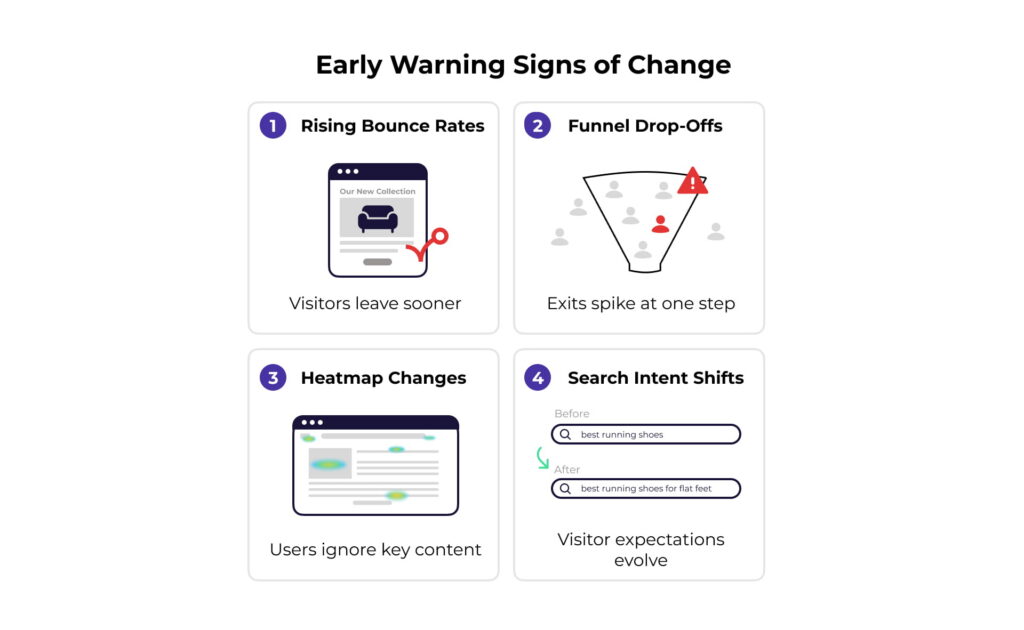
User behavior analysis is what catches these signals early. The specific patterns worth watching include:
- Rising bounce rates on previously stable pages: If a page that used to hold attention is now losing visitors faster, something in the visitor-to-page match has broken down.
- Increased drop-off at a specific funnel step: When exit rates spike at a particular point in the journey, it usually points to unmet expectations at that exact moment.
- Heatmap changes over time: Elements users used to scroll to and engage with, getting ignored in more recent session data, is a clear sign that what once felt relevant no longer does.
- Shifts in incoming search queries: If the phrases bringing visitors to your site are changing, the intent they arrive with may no longer align with what the page delivers.
These aren’t vanity metrics. They’re customer insights that, when read together, tell a coherent story about where visitor expectations have moved and where the current site experience hasn’t kept pace. The earlier you catch them, the smaller the gap you have to close.
How to Diagnose What’s Actually Changed
Spotting the signals is one thing. Understanding what they mean requires a layer of interpretation that raw analytics alone can’t provide.
Session recordings are where this usually starts. Watching real visitors move through a page reveals the difference between what the design intended and what actually happens. Where do users pause? Where do they scroll past something that was supposed to stop them? Where do they try to click on something that isn’t clickable? These moments of friction show up in the recordings long before they show up in the aggregate data.
Exit surveys add the “why” that behavioural data can’t tell you directly. A visitor who leaves the checkout page is captured in your funnel data. A visitor who leaves and tells you it was because they couldn’t find their preferred payment method gives you something actionable. Even low survey response rates produce patterns that are worth building hypotheses around.
Funnel analysis ties it together by showing exactly where changing customer behavior is having the most impact. If a step that used to have a 70% pass-through rate is now sitting at 52%, that’s a measurable shift that deserves a specific diagnostic response, not a general redesign. It’s also worth segmenting this analysis by device and traffic source, because a friction point that affects mobile visitors disproportionately won’t show up clearly in blended data.
For a broader look at the diagnostic mindset behind effective CRO, it’s worth understanding how structured analysis feeds every stage of an optimisation program.
Adapting Your Website Without Rebuilding It From Scratch
One of the most common misconceptions about adapting your website to shifting visitor behaviour is that it requires a full redesign. It rarely does. What it requires is targeted, evidence-led changes to the specific elements that are creating friction for the current visitor.
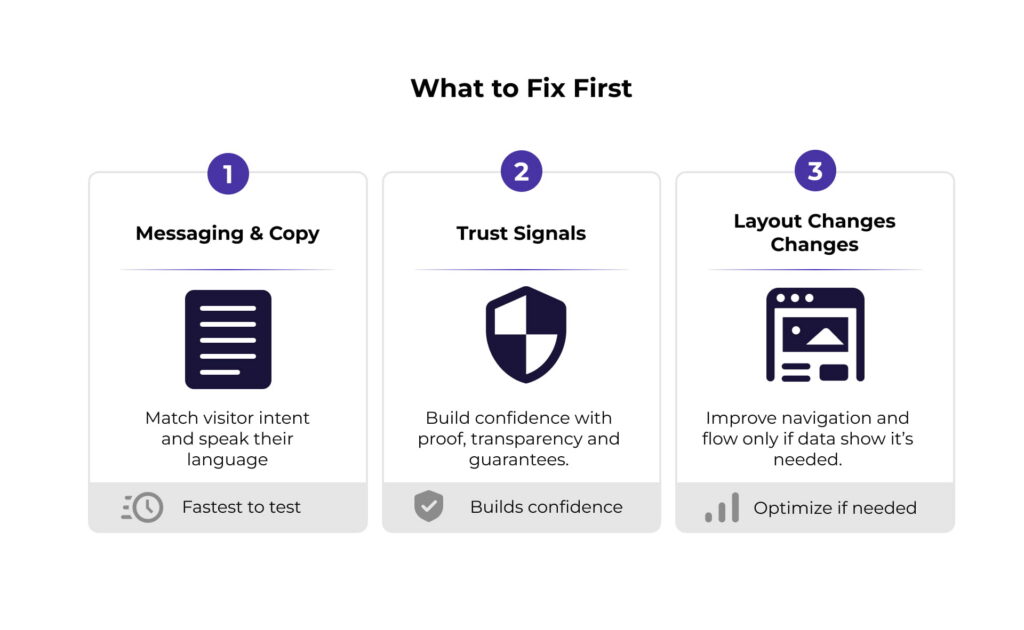
The hierarchy of changes matters here. Messaging and copy updates come first. They’re the fastest to test, they don’t require development resources, and they often address the largest single gap: the mismatch between what visitors are looking for and how the current page describes its value. If the audience’s language has shifted, the page needs to shift with it.
Trust signals come next. What builds confidence for today’s visitor may not be the same as what worked two years ago. Review formats, guarantee placement, social proof style, and transparency around pricing and shipping all influence whether a visitor feels safe enough to proceed. These elements age faster than most teams realise.
Structural and layout changes come last, and only when the diagnostic work points specifically to a navigation or flow problem that copy and trust elements can’t fix. Website updates for customer needs should always follow the evidence, not precede it. Intuition and trend-chasing are expensive ways to guess. A structured website optimization support program builds this kind of prioritisation into the process from the start, so every change is made for a documented reason and measured against a specific outcome.
What Conversion Data Tells You About Whether It’s Working
After changes are made, the temptation is to check the overall conversion rate and draw a conclusion. That number tells you the outcome but not the story. The behavioural metrics beneath it tell you whether the change actually addressed the problem or just moved it somewhere else in the funnel.
The questions worth asking after each round of changes: Are visitors now engaging with elements they were previously ignoring? Has the drop-off at the specific funnel step improved, or has it shifted to a different step? Are session durations on the updated page tracking the way the change was intended?
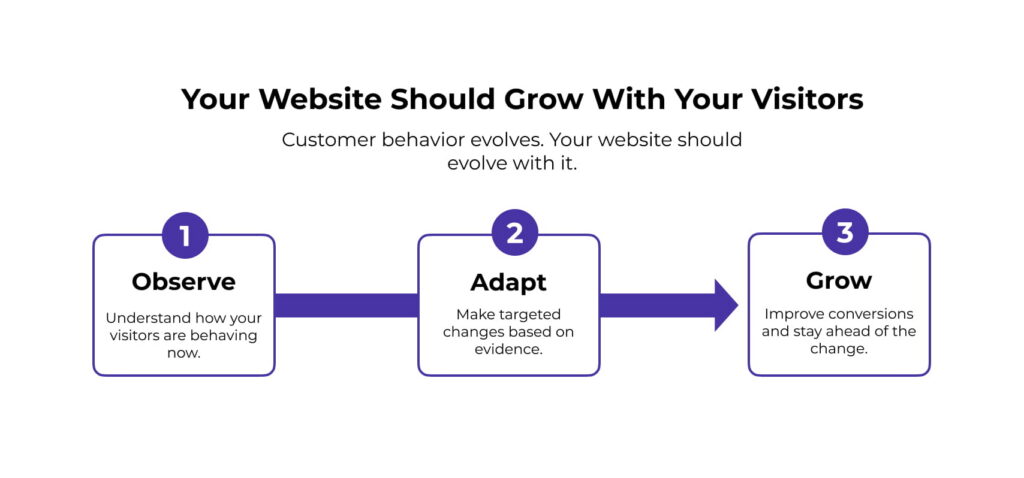
Conversion Rate Optimization works as a feedback loop, not a one-time project. Each round of changes produces new data, and that data feeds the next round of diagnosis. Website optimization for changing needs means building that loop into how the team operates, so adaptation becomes a continuous capability rather than a crisis response. Real client adaptation results from structured CRO programs consistently show that sustained iteration outperforms one-off redesigns, both in the size of conversion lift and how long those gains hold.
Your Website Should Grow With Your Visitors
Customer behavior changes whether or not your website is ready for it. The question isn’t whether your visitors will evolve. It’s whether your site will keep pace with them or fall quietly behind.
The businesses that consistently outperform on conversion aren’t the ones with the most recently redesigned sites. They’re the ones with the clearest picture of how their visitors are actually behaving right now, and a structured process for responding to what that picture shows. That combination of insight and process is what turns adaptation from a reactive scramble into a reliable competitive advantage.
And once you’ve adapted effectively, the next challenge is holding on to the visitors you’ve won back. That’s worth thinking through early, which is why keeping customers once you’ve adapted is a natural next step from here.
Is Your Website Still Built for the Customer You Have Today?
Most sites drift from their audience gradually, not all at once. Every visitor who leaves because the experience no longer matches their expectations is a missed opportunity that more traffic won’t fix. At SiteTuners, we’ve spent over two decades helping 2,100+ clients close exactly that gap.
Get a free website review from our CRO experts and get a clear picture of where your visitors are now and where your site needs to catch up.