Everyone’s talking about AI right now. Marketing teams are using it to write copy, generate test ideas, and build personalization at scale. And the results sound incredible until you actually look at the conversion numbers.
The truth is, most businesses experimenting with AI and conversions are still stuck with the same drop-offs, the same abandoned checkouts, the same landing pages that don’t quite close the deal. Not because AI isn’t useful — it genuinely is. But because a tool doesn’t equal a strategy. That’s the distinction worth unpacking.
What AI Is Actually Good At (And Why That’s Still Not Enough)
Let’s be fair, first, AI tools for marketing have gotten remarkably capable, and dismissing them entirely would be a mistake. There are real, measurable things AI does well in a CRO context.
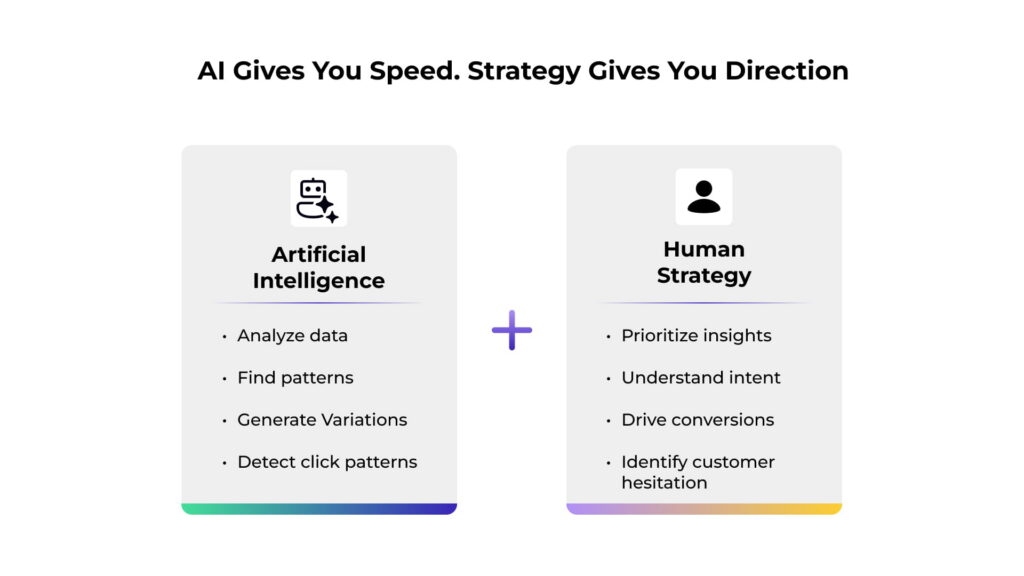
It processes behavioral data at a speed no human team can match. It surfaces patterns across thousands of sessions — scroll depth, click clusters, drop-off points—far faster than manual analysis. AI copywriting tools can generate a dozen headline variations in minutes, which used to take a full brainstorming session and a copywriter’s afternoon.
These are genuine accelerators. If you’re running an ongoing optimization program, anything that speeds up research, ideation, or iteration is valuable.
But here’s the honest gap: generating more content faster and analyzing more data quickly doesn’t automatically produce higher conversions. What’s missing is judgment. Knowing which insight actually matters for this customer, on this page, at this stage of their decision.
Knowing which headline variation speaks to the specific hesitation your buyer has right before they add to cart or abandon the page entirely is something AI can’t determine for you. AI gives you speed. Human strategy gives you direction. You need both, but you can’t swap one for the other.
The Hype vs. The Reality — Where AI Actually Falls Short
The gap between what AI is marketed to do and what it actually delivers in a CRO context becomes most obvious when you get into the details.
AI-assisted test ideation increases win rates by 23% — that’s a real and meaningful lift. But it also means 77% of tests still don’t win, even with AI in the loop. All AI does is improve your odds; it doesn’t guarantee the outcome.
Here’s where the honest limitations sit:
| What AI Does | What AI Can’t Do |
|---|---|
| Identify where users drop off on a page | Explain why the drop-off is happening |
| Generate multiple copy variations quickly | Determine which one resolves your buyer’s specific anxiety |
| Deliver AI personalization at scale | Build the audience insight that makes personalization meaningful |
| Surface patterns in session data | Make judgment calls on which patterns are actually worth acting on |
| Speed up test iteration | Design a hypothesis grounded in conversion psychology |
| Flag pages with high exit rates | Diagnose whether the issue is trust, clarity, friction, or offer |
The “why” is where it gets expensive. A tool can tell you that 68% of users are leaving your checkout at the payment step. What it can’t tell you is whether they’re leaving because the form feels too long, because there’s no trust badge near the credit card field, or because your shipping cost appeared too late in the process.
Each of those diagnoses leads to a completely different fix. Getting it wrong wastes your test cycles and your team’s time.
Segment’s 2024 State of Personalization report found that 89% of business leaders believe personalization is crucial to success over the next three years. That enthusiasm is well-placed. But AI’s impact on conversions through personalization only compounds when the underlying audience understanding is solid.
Without that foundation, you’re delivering personalized versions of the wrong message, faster. And AI limitations in business tend to show up hardest exactly here: when the data is good, but the strategic framework behind it isn’t.
Where Human Expertise Still Drives the Conversion
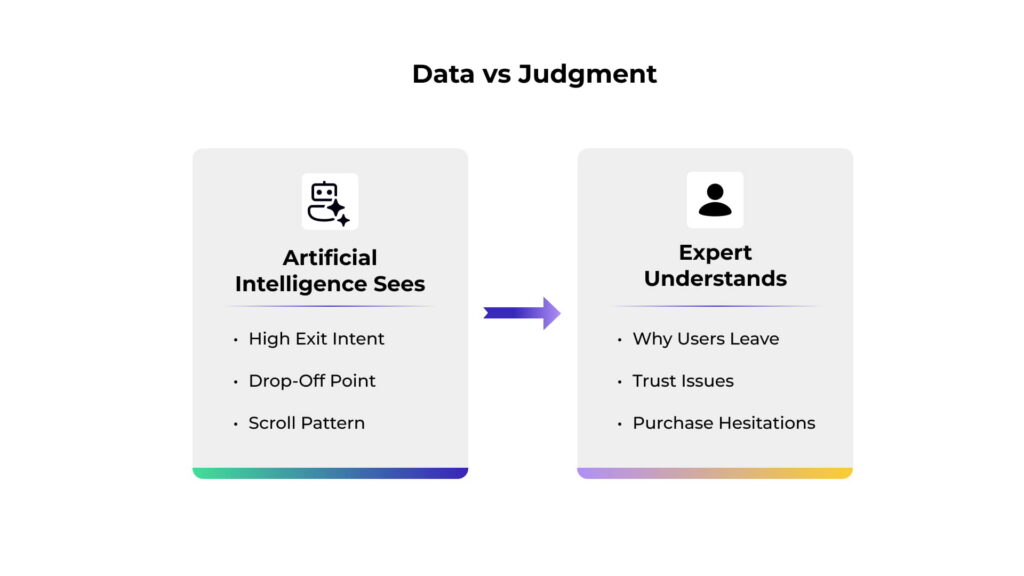
There are decisions in CRO that don’t get better just because a machine is making them faster. Knowing that a user has high exit-intent is not the same as knowing what will make them stay.
This is where artificial intelligence in CRO hits a genuine ceiling. It can assist a skilled practitioner, but it can’t replace one. Consider what actually goes into a page-level diagnosis after 20+ years of optimization work.
Reading a layout and immediately knowing the visual hierarchy is pulling attention away from the CTA. Recognizing that a product page feels untrustworthy not because of any single element, but because the spacing, typography, and low-budget image quality together signal the wrong thing. Understanding that moving a single trust badge above the fold rather than below it can shift a buyer’s confidence enough to complete a purchase.
These are judgments that come from having seen thousands of pages, tested hundreds of hypotheses, and built intuition about how real people make decisions under real conditions. They’re not transferable to a model that hasn’t lived through that work. AI can surface the signal. A trained CRO strategist knows what to do with it.
How to Use AI as a CRO Accelerator (Not a Replacement)
The right mental model is this: AI is an exceptional research assistant. Human strategy is the decision-maker. When you build the workflow that way, the combination is genuinely powerful.
Here’s what that looks like in practice across a CRO program:
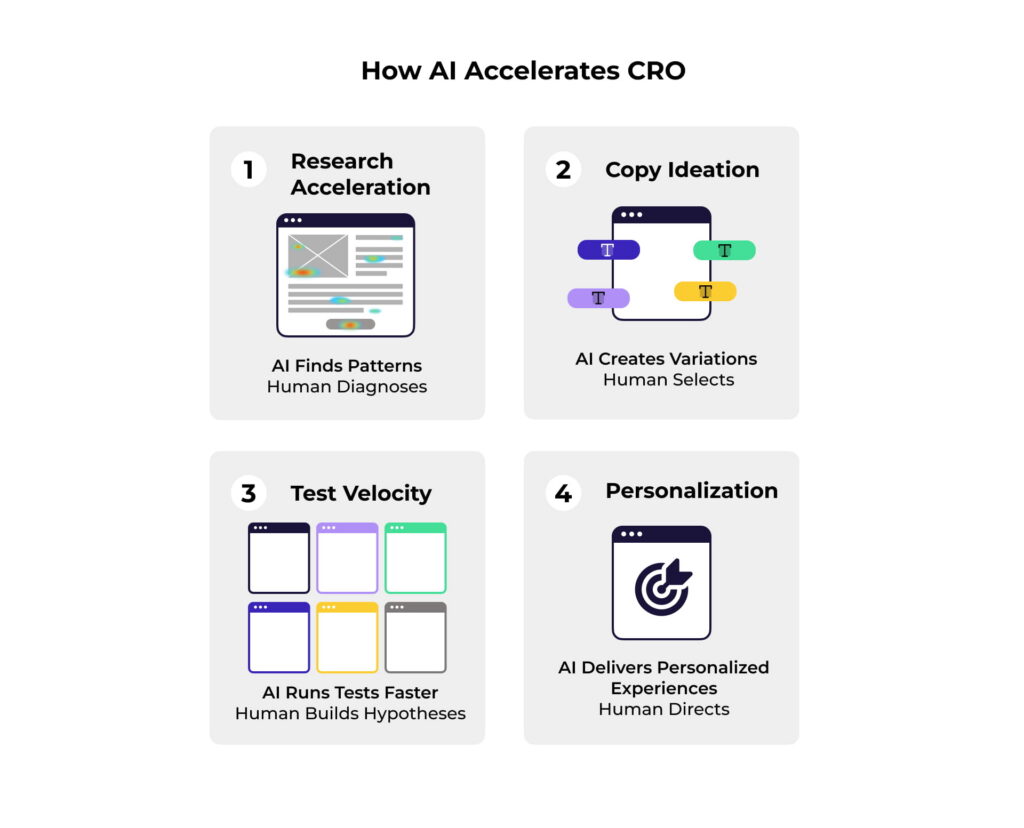
- Research acceleration: Use CRO and machine learning tools to identify drop-off patterns across your funnel quickly, but bring a strategist in to diagnose the cause before you build any test hypothesis. The data tells you where to look; the practitioner tells you what you’re actually seeing.
- Copy ideation: Use AI copywriting tools to generate variation drafts at pace, then have a conversion specialist select based on psychology principles, not just surface-level preference. The speed of output is only useful if the selection process is smart.
- Test velocity: Website optimization with AI genuinely shines when it comes to running more experiments, faster. But every test still needs to be hypothesis-driven. Random variation testing without a structured reason is just expensive noise.
- Personalization delivery: Use AI personalization tools to execute tailored experiences at scale, but build your audience segments and messaging strategy with human insight first. The technology delivers the experience; the strategy determines whether it’s the right one.
According to SaveMyLeads data, AI-powered personalization increases conversions by 40%. But that result comes from AI tools being pointed in the right direction by people who understand the customer deeply. The lift doesn’t come from the technology alone; it comes from the combination.
This is the workflow that actually produces compounding returns: human strategy sets the direction, AI accelerates the execution, and a rigorous test-and-learn process validates what’s working. None of those three elements is optional.
The Right Question Isn’t Just “Do AI and Conversions Go Together?”
The question most teams are asking: Can AI improve my conversion rate? — is the wrong starting point. Of course, it can help. The more useful question is: do you have a conversion strategy that AI can actually accelerate?
Because without clear hypotheses, a structured testing methodology, and a genuine understanding of your customer’s decision-making process, AI doesn’t solve your problem. It makes your current approach move faster. And if the current approach isn’t grounded in conversion thinking, faster is just failing more efficiently.
AI and conversions become a powerful combination when the human fundamentals are already in place: knowing your user’s real objections, reducing friction at the right moments, and building trust where it’s actually breaking down. Those insights don’t come from a model. They come from the kind of diagnostic work that’s been at the center of effective CRO for over two decades.
The teams seeing the best results right now aren’t the ones who replaced their CRO strategy with AI. They’re the ones who gave their existing strategy a significantly better set of tools.
Ready to Put the Right Strategy Behind Your AI Tools?
You can’t afford to leave money on the table. Every visitor who leaves your site because of a confusing layout, a slow checkout, or a lack of trust is a missed opportunity for growth.
AI is changing how CRO work gets done, and that’s genuinely exciting. But the fundamentals haven’t changed: understand your user, reduce friction, build trust, test rigorously.
At SiteTuners, we’ve been putting those fundamentals into practice for 2,100+ clients since 2002. We know how to pair that expertise with the tools that actually move the needle.
Not sure where your biggest conversion opportunities are?
Start with our free AI CRO Analyzer. In minutes, you’ll get AI-powered insights into potential friction points, trust issues, clarity gaps, and conversion opportunities across your website.
Want expert guidance on what to prioritize next?
Get a free website review from our CRO experts and receive actionable recommendations tailored to your business.