Why CRO Needs a Broader View
People rarely decide to buy after one visit to one page. They may find a business on their phone, read reviews, return from an email, talk with sales or support, and buy later on another device. CRO works better when it looks at that whole path, not just one landing page.
For years, many CRO programs followed a simple pattern: pick a high-traffic page, test two headlines or calls to action, and keep the version that gets more clicks. That can be useful, but it is only one part of the job.
Customers do not experience a business one page at a time. They notice whether the message stays consistent, whether the next step is easy, and whether the business does what it promised. Each moment affects how clearly they understand the offer, how much they trust it, and whether they move forward.
When CRO focuses only on one page, teams can miss larger problems in the journey:
- Broken message match: A landing page makes a promise that the product, pricing page, or onboarding process does not clearly deliver.
- Lost context: Returning visitors have to start over because the experience does not reflect what they have already seen or done.
- Misleading wins: More form submissions can look good while lead quality, sales conversion, or retention gets worse.
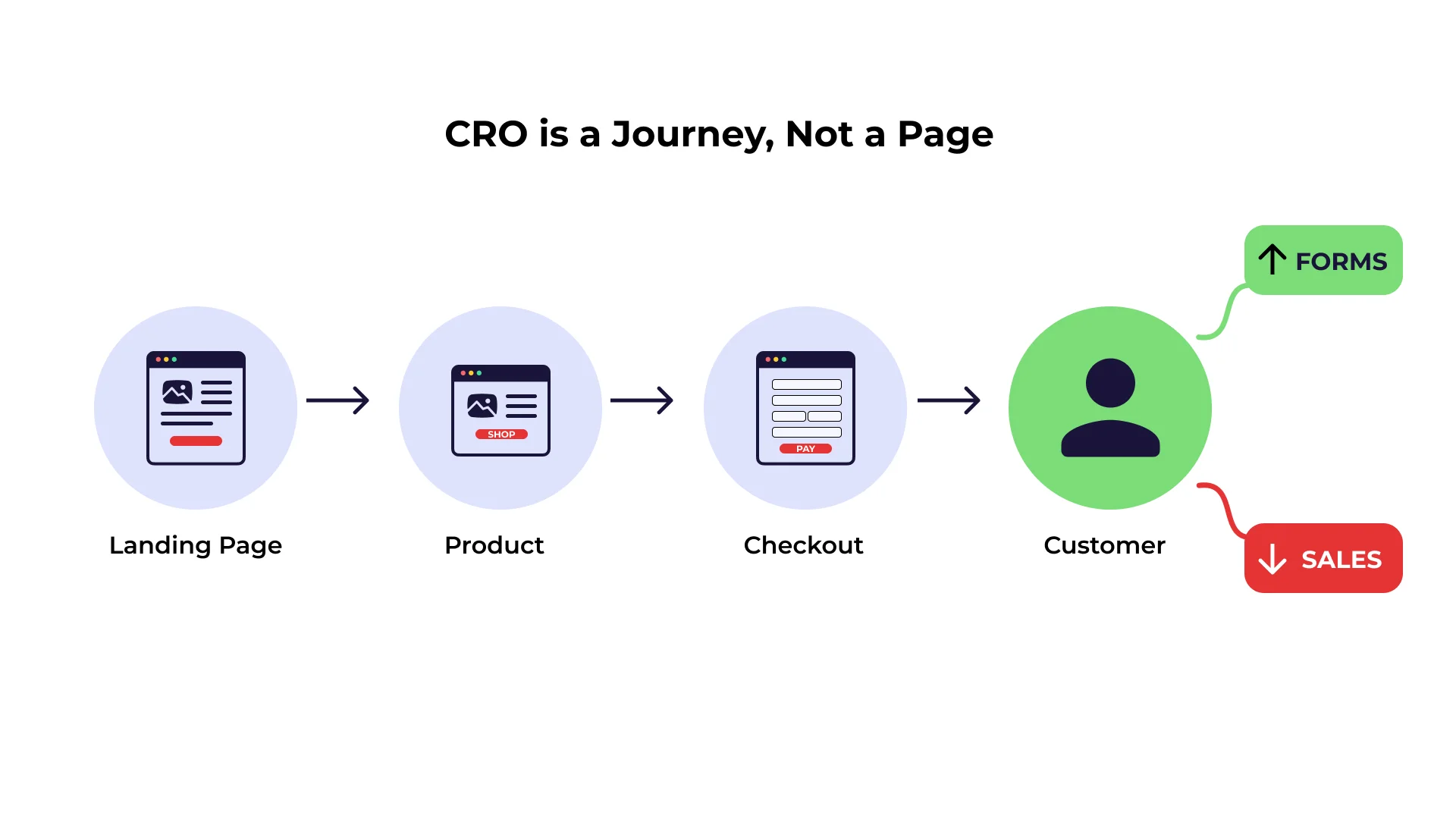
A broader approach does not replace page-level testing. It gives each test a clearer purpose. When teams use customer research, shared data, and goals that reach beyond clicks, CRO can help people understand the offer, take action with more confidence, and stay customers longer.
Why Page-Level Tests Are Not Enough
Page-level tests matter, but they do not tell the full story. A clearer headline, shorter form, or stronger call to action can help only when the page is fast, easy to use, and consistent with the rest of the customer journey.
Good CRO looks at what happens before and after the test. Can visitors understand the offer quickly? Does the page work well on the devices they use? After someone signs up, does onboarding, sales follow-up, or checkout make the next step clear? If not, a winning test may only move the problem somewhere else.
Site performance is part of the experience too. Slow pages, shifting layouts, intrusive pop-ups, and unreliable forms can make people lose trust before they have a fair chance to consider the offer. Testing tools should support a stable experience, not create delays or distractions that affect the result.
| Optimization Attribute | Isolated Page Testing | Broader CRO Approach |
|---|---|---|
| Primary Scope | A button, form, banner, or single page | The connected journey across key touchpoints |
| Main Question | Which version gets more immediate action? | What helps customers understand, trust, and move forward? |
| Data Used | Clicks and page conversions | Behavioral data, customer feedback, CRM, and lifecycle results |
| Success Measure | Short-term lift in a micro-conversion | Better lead quality, revenue, retention, and customer experience |
| Team Involved | Often marketing alone | Marketing, product, design, engineering, sales, and support |
The goal is not to make every test more complicated. It is to solve the right problem. Before testing a small visual detail, make sure the offer is clear, the path is easy to use, and the next step delivers on the promise that brought the visitor there.
Where a Broader CRO Strategy Helps
A broader CRO strategy reaches beyond the acquisition team. Any team that shapes what prospects and customers see, do, or feel can affect conversion.
That means looking at how marketing, product experience, and customer service work together. When those touchpoints answer the same customer needs, people face fewer surprises and can move forward with more confidence.
Product Experience and Onboarding
For SaaS, digital platforms, and e-commerce sites, marketing and product experience are closely connected. Starting a free trial or creating an account shows interest, but the person still needs to see the value they came for. The next step is helping them reach an early, meaningful result.
CRO can improve onboarding by:
- Simplifying sign-up: Remove profile fields and decisions that are not needed to get started.
- Guiding feature discovery: Use timely, relevant prompts instead of putting every new user through the same long product tour.
- Improving empty states: Show new users what to do first and why that step matters.
By finding where people stall after sign-up, teams can reduce friction, shorten the time it takes to see value, and give customers a stronger reason to continue.
Customer Service and Post-Purchase Experience
Customer service teams see friction firsthand. Support tickets, live-chat questions, returns, and cancellation requests can show where customers did not get the information or reassurance they needed earlier.
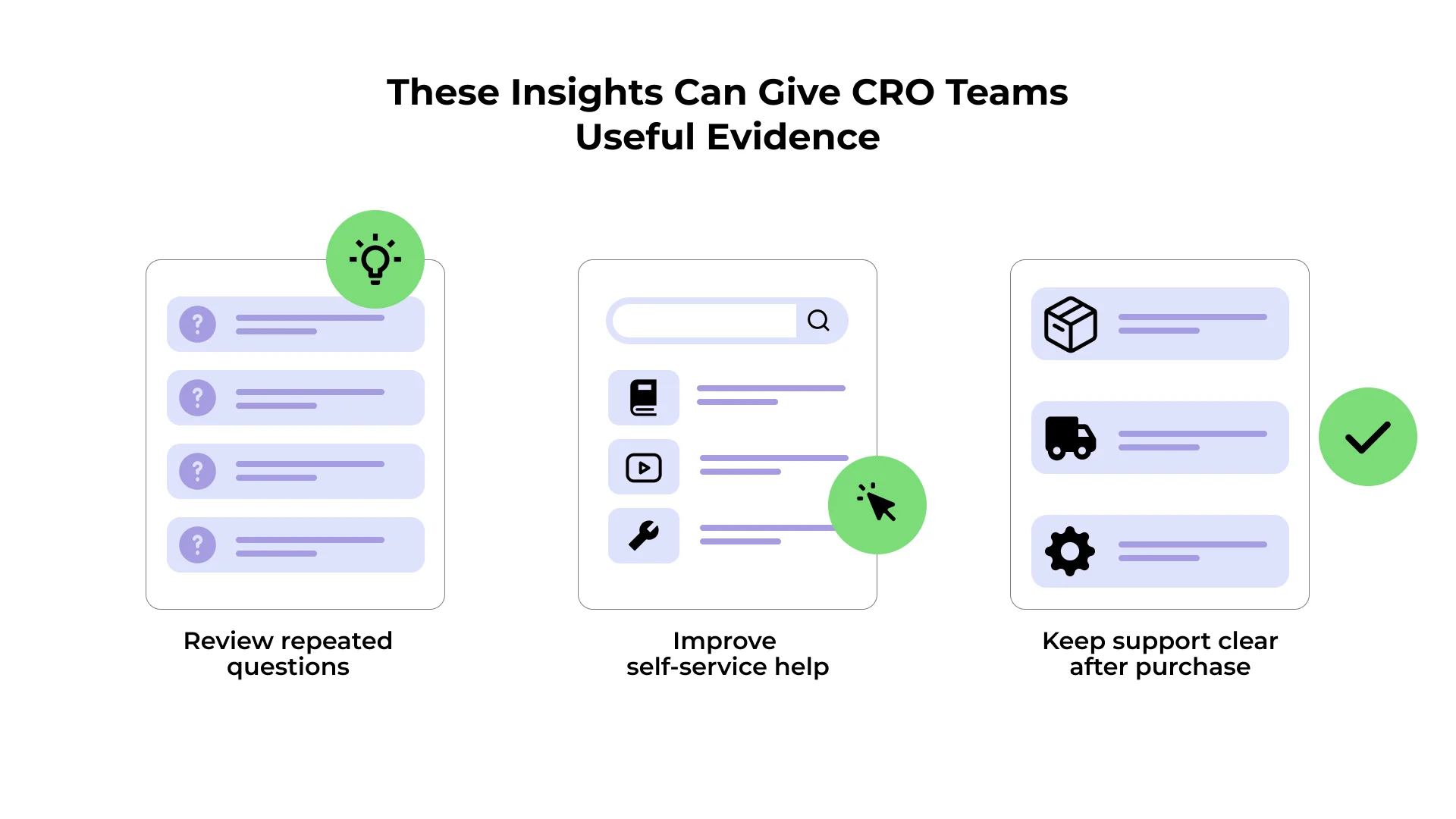
Those insights can give CRO teams useful evidence:
- Review repeated questions: If prospects often ask about shipping, pricing, security, or implementation, make those answers easier to find before they have to ask.
- Improve self-service help: Clear knowledge-base content and troubleshooting paths can help hesitant buyers get unstuck when support is not available.
- Keep support clear after purchase: Helpful confirmation pages, shipping updates, and setup guidance can reduce uncertainty and build confidence.
Marketing Across Channels
Campaigns lose momentum when an ad, social post, email, or search snippet promises one thing and the destination page feels unrelated. Someone who clicks for a specific solution should not have to search a generic homepage to see whether they are in the right place.
Message match across channels means:
- Keeping the promise consistent: Match the language, offer, and visual cues from the campaign to the landing page.
- Routing by intent: Send high-intent visitors to pages that help them evaluate or buy. Give early-stage visitors useful educational content.
- Using retargeting thoughtfully: Address the questions or concerns that may have caused someone to leave instead of showing the same message again.
How to Build a Customer-Centered CRO Framework
A broader CRO program starts with understanding customers. Instead of guessing what to test next, teams should look for the places where people hesitate, what they are trying to do, and what gets in their way.
Experimentation tools can show behavior, but the tools do not explain it by themselves. The useful work is connecting data to real customer questions, concerns, and needs.
Build the program around two practical habits: learn why customers struggle, then test changes that address those problems.
Customer Discovery and Journey Review
Analytics can show where people leave. Customer research can help explain why. Use both before deciding what to change.
A practical review can include:
- Voice-of-Customer (VoC) surveys: Add short, non-intrusive surveys on high-exit pages. Ask open-ended questions such as, “Is there anything preventing you from completing your purchase today?”
- Session analysis: Review session recordings and aggregated heatmaps for signs of confusion, such as repeated clicks, erratic scrolling, or hesitation around form fields.
- Usability testing: Ask people who resemble your target customers to complete key tasks while explaining what they expect and what feels unclear.
- Journey mapping: Review attribution paths to see how many visits, devices, and days customers usually need before converting.
Test the Friction You Find
Once research points to a real problem, turn it into a clear, prioritized test. Avoid a long list of unrelated ideas. Group tests around a customer problem, such as uncertainty about pricing, trouble getting started, or lack of trust in the offer.
A strong hypothesis connects a problem, a practical change, and a business outcome:
“Because customer research shows that users are confused about post-purchase setup requirements, simplifying our technical specifications and adding a clear three-step onboarding preview should reduce checkout hesitation and increase completed transactions.”
Use frameworks such as PIE (Potential, Importance, Ease) or ICE (Impact, Confidence, Ease) to prioritize. Give more attention to changes that improve clarity, ease of use, or trust in an important part of the journey than to small cosmetic changes. When a test works, document what customers responded to so the learning can inform emails, sales materials, onboarding, and future pages.
How to Measure Broader CRO Results
_compressed.webp?alt=media&token=eefaf1a9-bfb6-4c42-aff4-b0ec9f868d05 "user-inserted")
When CRO reaches beyond a landing page, measurement should reach beyond it too. A change that increases lead volume may still hurt the business if it brings in poor-fit leads, slows sales, or leads to more churn.
Use a mix of customer and business measures:
- Customer Lifetime Value (LTV): The revenue a customer generates throughout their relationship with your business.
- Net Revenue Retention (NRR): How recurring revenue changes through renewals, expansions, upgrades, and churn.
- Customer Acquisition Cost (CAC) payback period: How long it takes for gross margin from a new customer to cover the cost of acquiring them.
- Pipeline velocity: How quickly qualified prospects move from first inquiry to closed deal.
- Lead-to-opportunity ratio: Whether traffic and form-fill gains create more real sales opportunities.
These measures can also help teams work together. CRO efforts often slow down when marketing, product, and engineering have separate priorities. Product teams may see tests as distractions, while engineers may worry about reliability or added work.
Bring teams together around customer evidence. Share what people are struggling with, which changes helped, and how those changes affected support volume, sales conversations, or retention. When CRO focuses on problems that each team recognizes, it becomes a shared way to improve the customer experience and business results.
Common Questions About Broader CRO
How is broader CRO different from traditional conversion rate optimization?
Traditional CRO often focuses on improving a page-level metric with a localized A/B test. Broader CRO still uses testing, but it also looks at how messaging, product experience, customer service, and post-purchase communication work together across the customer journey.
Which teams should take part in a broader CRO program?
A strong program includes people who understand different parts of the customer experience:
- Conversion strategists: Guide journey mapping, prioritization, and hypothesis development.
- User researchers and data analysts: Find behavior patterns and gather customer feedback.
- UX/UI designers: Create clear, easy-to-use experiences based on customer needs.
- Frontend engineers: Build reliable, fast changes and testing variations.
- Product managers and customer support leads: Surface onboarding problems, repeated questions, and product friction.
How do companies measure ROI when CRO goes beyond web pages?
Do not rely on page-level conversion rates alone. Look at downstream results, such as customer lifetime value, trial-to-paid conversion, customer acquisition cost, retention, and sales pipeline speed for the audiences you want to reach.
How to Move to a Broader CRO Model
Moving from occasional A/B tests to a broader CRO practice takes a practical plan:
- Review the full customer journey: List the main interactions prospects have with your business, from ads and search results to landing pages, onboarding emails, sales conversations, and support resources. Look for unclear steps, broken promises, and unnecessary effort.
- Connect the evidence you have: Bring together web analytics, CRM data, support tickets, and customer feedback so teams can see the same customer problems from different angles.
- Create a shared testing backlog: Keep research-backed hypotheses in one place so product, marketing, design, and other teams can prioritize the most important issues together.
- Get help when it is useful: Outside CRO support can help a team build a disciplined testing process and spend less time on low-impact changes.
- Document what you learn: Record successful and unsuccessful tests, including the customer insight behind each result, so future work starts with evidence rather than opinion.
The point is not to test everything. It is to improve the moments that matter most to customers. When the path from first visit through post-purchase support is clearer and easier, CRO can support stronger conversion, customer confidence, and long-term business performance.