Why Are Businesses Obsessed With Traffic Instead of Experience?
A clear user experience and a straightforward path to conversion drive revenue. More traffic simply magnifies the problem when a landing page does not explain its value, answer key objections, or make the next step easy.
Every marketing team has heard someone say, “We just need more traffic.” It is a common diagnosis in digital business—and often the wrong one.
Traffic is easy to measure, buy, and report. Analytics dashboards put sessions, visitors, and page views front and center. When those numbers rise, the charts turn green and the team feels productive. But visits alone do not tell you whether people understood your message, found what they needed, or took action. Counting traffic without looking at the experience is like counting cars that pass a billboard without knowing whether anyone noticed it or stopped at the store.
The mistake is assuming that more top-of-funnel visitors will automatically create more sales. A team may assume that if 1,000 visitors produce 10 sales, 10,000 visitors will produce 100 sales. But that rarely holds true. If the funnel has leaks, more acquisition spend does not create growth. It scales the waste.
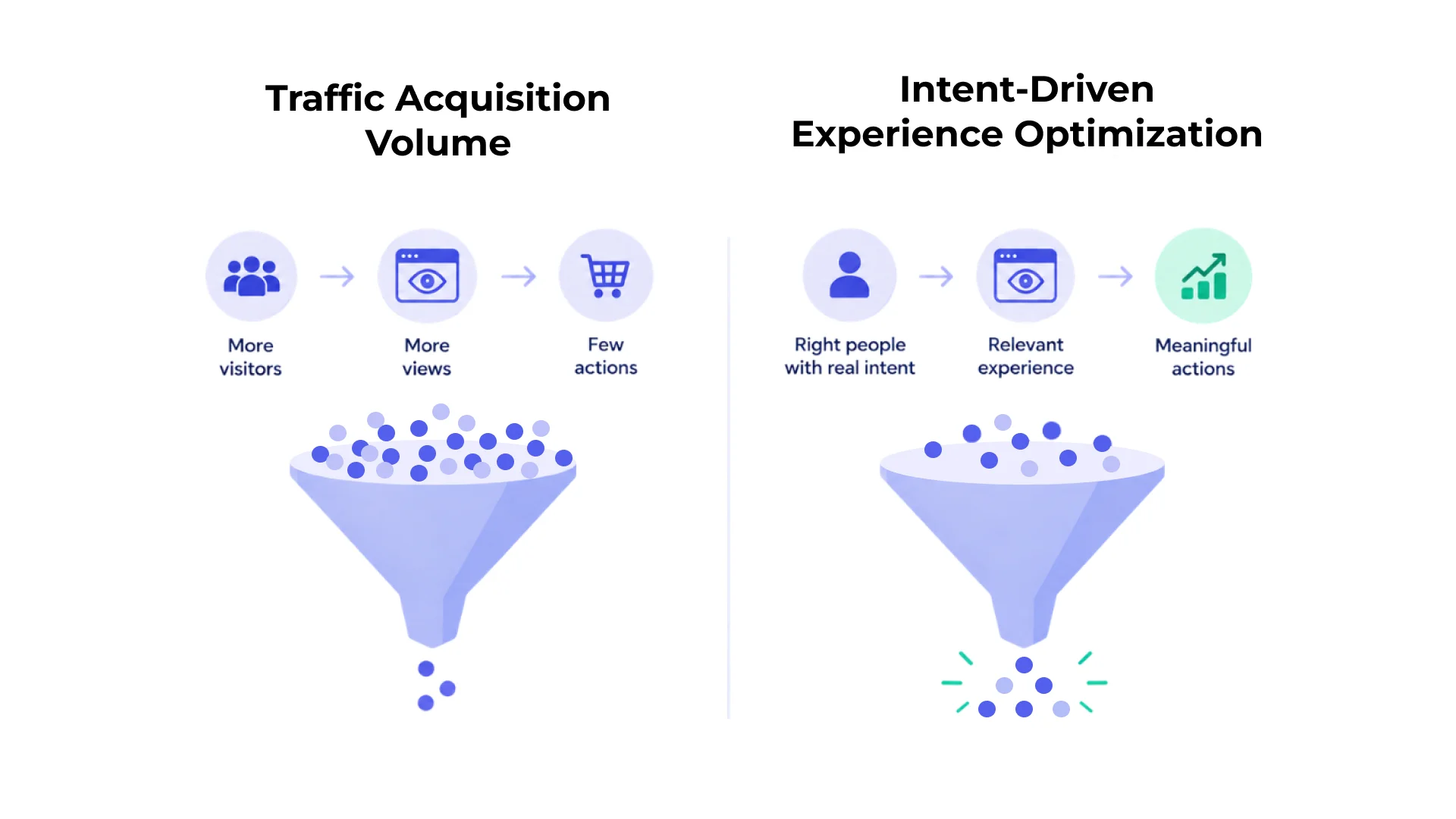
Visitors are not abstract data points. They arrive with a specific problem, limited time, and questions about whether your solution is right for them. If a page does not quickly show its value, build confidence, and make the next step clear, people leave. Buying more media cannot fix that experience problem; it only uses the acquisition budget faster.
Why Does High Traffic Fail to Drive Meaningful Downstream Action?
High traffic often fails to produce revenue because people judge digital experiences very quickly. Before a visitor reads every bullet point, they are already asking: Am I in the right place? Do I trust this? Can this solve my problem now?
When visitors have to hunt for answers, decode corporate jargon, or work through a cluttered layout, they experience cognitive overload. Decisions slow down. People respond better to information that is easy to process and relevant to their needs than to dense, hard-to-scan content. When an experience feels confusing or disconnected, many visitors simply go back and look elsewhere.
The same principle applies on physical roads. In the United States, 13 car accidents happen every minute, and accidents account for roughly 25% of traffic delays. Drivers lost an average of 51 hours to congestion in 2022, at an estimated cost of $869 per driver. Nationwide, congestion costs about $190 billion a year in wasted time and fuel.
Roads struggle when their infrastructure cannot handle the volume of vehicles. Digital funnels do the same when the page experience cannot support the intent of the people arriving.
The Fallacy of “Attendance as a Result”
You can see this problem in both marketing and live events. A conference organizer may celebrate a packed keynote room, then find no sales pipeline from attendees the following quarter. A marketing team may celebrate 100,000 monthly blog sessions while qualified leads stay flat.
Attendance is an input, not an outcome.
When leadership treats traffic or attendance as the main sign of success, teams optimize for volume instead of impact. They write clickbait headlines, use broad ad targeting, and build pages for passive browsers rather than qualified buyers. Better reporting separates vanity metrics from the customer actions that actually create business value.
The Phantom Traffic Jam of Digital Funnels
Have you ever sat in a traffic jam for 20 minutes, only to reach the end and find no accident, construction, or lane closure?
Traffic engineers call this a phantom traffic jam. One driver brakes a little too sharply. The next driver brakes harder, then the next one slows even more. A few miles back, that small moment of hesitation has brought hundreds of cars to a stop.
_compressed.webp?alt=media&token=0e606484-d298-43b8-9ff7-fc9877cebec6 "The Phantom traffic jam")
Digital conversion funnels can work the same way:
- Early hesitation: A vague headline makes a visitor pause and wonder what the product actually does.
- Growing doubt: As they scroll, they find unclear pricing, little customer proof, or slow-loading images.
- Abandonment: By the time they reach the form or checkout, the unanswered questions are enough to make them leave.
Smooth traffic flow depends on predictable movement and spacing. A high-converting funnel depends on a clear, consistent experience from the first message through the next step. Removing small points of friction early makes it easier for qualified visitors to act later.
What Are the Hidden Costs of Prioritizing Traffic Over User Intent?
When traffic acquisition becomes the main growth lever, it creates costs that rarely show up clearly on a marketing budget.
First, the push for bigger visitor numbers usually broadens targeting. Instead of focusing on buyers with urgent, well-defined problems, campaigns start attracting casual browsers, students, job seekers, and people outside the service area. That makes the data less useful.
Second, low-intent traffic can distort analytics. When large numbers of unqualified visitors bounce, overall conversion metrics fall. Product and design teams may then change features or rewrite copy to serve people who were never likely to buy, while making the experience worse for high-intent prospects.
| Factor | High-Volume Vanity Traffic | High-Intent Experience Optimization |
|---|---|---|
| Primary Metric | Sessions, impressions, raw clicks | Task completion rate, lead quality, revenue per visit |
| Audience Profile | Broad, informational, geographically mixed | Pre-qualified, problem-aware, commercially motivated |
| Messaging Focus | Generic, clever, feature-heavy | Clear, outcome-focused, objection-handling |
| Cost Trajectory | Increasing ad spend with diminishing returns | Fixed optimization investment with compounding gains |
| Data Impact | Distorts analytics with high bounce rates | Produces cleaner behavioral data on ideal buyers |
Intent Mismatch: Research Language vs. Decision Language
Traffic is only valuable when it matches the visitor’s intent. Someone researching a general industry topic has different needs from someone trying to solve an immediate business problem.
- Research Intent (Informational): Queries such as “what causes conversion issues” or “how to improve website speed.” These visitors are learning. Sending them straight to a high-pressure sales page creates a mismatch.
- Decision Intent (Commercial): Queries such as “enterprise landing page audit services” or “hire conversion rate optimization specialists.” These visitors understand the problem and are comparing solutions.
When ads and landing pages mix these intents, neither audience gets what it needs. High-intent prospects may find only surface-level education, while early-stage researchers may feel pushed into a sales conversation too soon.
The Danger of Metric Distortion
A large increase in low-quality traffic can make sitewide conversion rates look worse. For example, a business that converts 4% of 10,000 qualified visitors generates 400 leads. If it adds 40,000 unqualified visits and no new conversions, the aggregate conversion rate drops from 4.0% to 0.8%.
That kind of distortion can send leadership in the wrong direction:
- They may assume the offer is broken.
- They may spend months changing pricing or rebuilding features.
- They may launch a major redesign that does little for revenue.
Before changing code or copy, separate visitor cohorts. Evaluate page performance based on the people who have real commercial intent.
How Do You Diagnose Whether Your Problem Is Traffic, Clarity, or Friction?
Before spending more on paid search, social campaigns, or content production, assess the digital experience itself. Many businesses do not have an acquisition problem. They have a clarity or friction problem that has not been addressed.
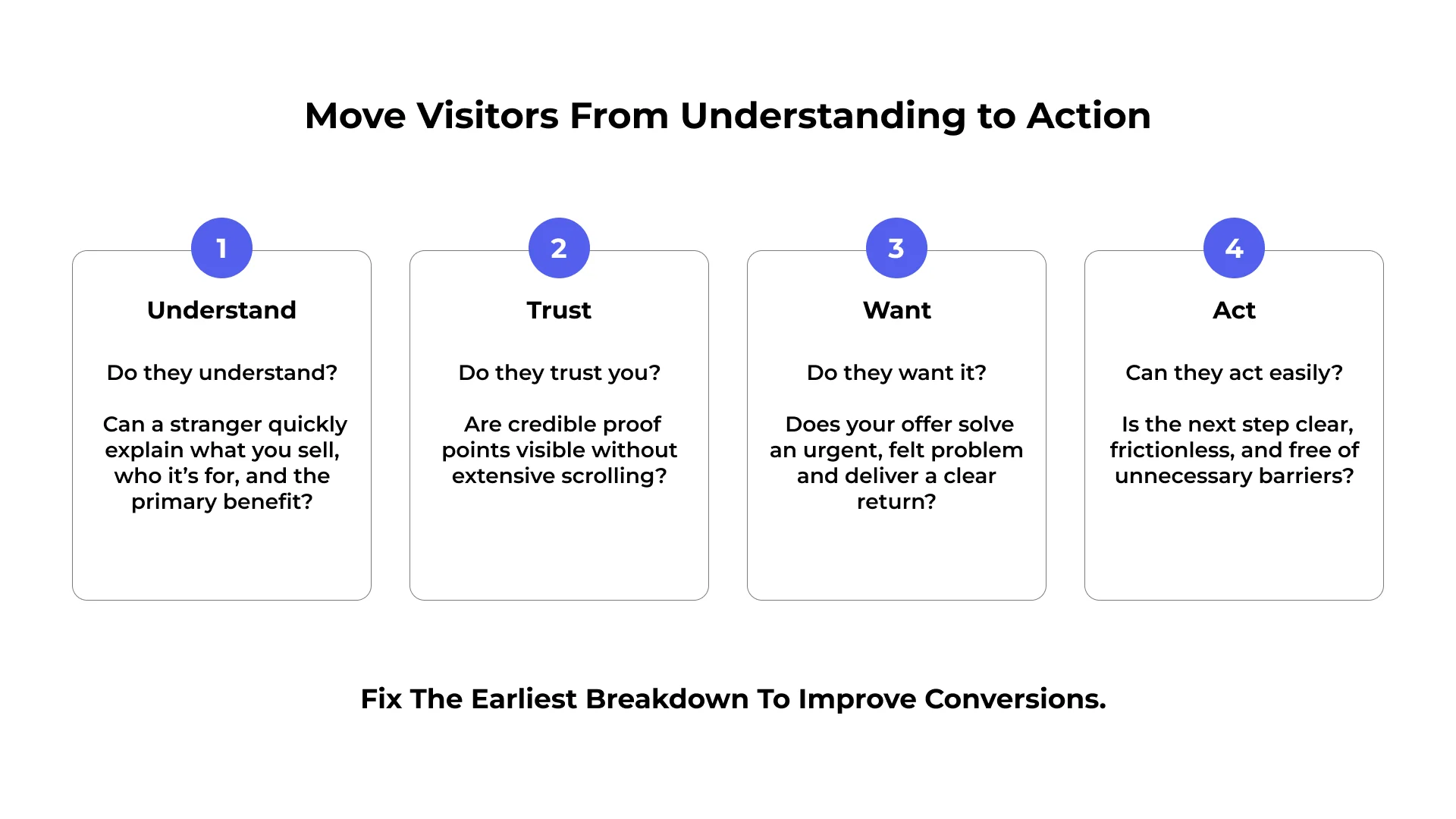
- Do they understand? Can a complete stranger look at the landing page for 10 seconds and explain what you sell, who it is for, and the main benefit? If not, the messaging may be too clever or too vague.
- Do they trust you? Can visitors see credible proof—such as case studies, measurable outcomes, security information, or customer testimonials—without digging through the page?
- Do they want it? Does the offer address an urgent, felt problem, or does it only list features without making the business or personal value clear?
- Can they act easily? Is the next step obvious and simple, without unnecessary form fields, confusing navigation, or visual clutter?
The Four-Pillar Experience Audit
A practical experience audit looks at four areas:
- 1. Messaging Clarity: Replace internal jargon with plain, benefit-led language. Lead with the outcome customers want, not the process you use to deliver it.
- 2. Trust Signals: People look for reassurance before making a financial or professional decision. Put relevant social proof, client logos, and compliance certifications near key decision points.
- 3. Offer Relevance: Match the ask to the visitor’s level of commitment. Do not require a 60-minute software demo when a self-guided two-minute overview better fits where they are in the buying process.
- 4. Friction Reduction: Simplify forms, remove broken interactions, improve mobile speed, and make sure the layout works well across devices.
Uncovering Silent Conversion Killers
Most dissatisfied visitors never complain or contact support. They simply close the tab. To learn why, use a one-question exit-intent survey:
“What almost kept you from completing your request today?”
This question captures objections at the moment people hesitate. Common answers include:
- “I couldn’t find pricing information anywhere.”
- “I wasn’t sure if your service works for companies in my industry.”
- “The sign-up form asked for too much sensitive information.”
Those answers give you a practical roadmap for improving the page. Addressing common objections in the copy and flow can improve conversion performance without increasing traffic.
The Technical Architecture of Tactical Design
Improving a weak user experience is not just a creative exercise. It requires a practical approach to visual hierarchy, information flow, and the way users expect to find answers.
Visitors scan pages in predictable ways. When the value proposition, supporting proof, and key actions compete for attention or appear out of sequence, it becomes harder for people to move forward.
A well-designed page should include:
- Above-the-Fold Context: Make the headline, supporting message, and core value proposition easy to understand in the first screen view.
- Objective Validation: Put specific proof, such as “Helped over 2,100 clients eliminate conversion bottlenecks,” close to the primary headline or main call to action.
- A Clear Primary Next Step: Make the main action obvious while keeping secondary options from competing for attention.
- Technical Integrity: Make sure the site loads quickly, works well on mobile devices, and avoids layout shifts that interrupt reading or interaction.
How Can Teams Shift From a ‘More Traffic’ Mindset to a ‘Better Experience’ Strategy?
Moving from a volume-first culture to an experience-first strategy requires changes in day-to-day work and executive reporting.
When teams stop treating traffic as the answer to every revenue shortfall, they can focus resources on the digital paths that influence customer decisions.
Moving From Information Pushing to User Supporting
Traditional landing pages often read like internal org charts or technical manuals. They list every feature, explain company history, and push visitors through a rigid sales process.
A user-centered approach starts with what the visitor needs:
- Mirror the User’s Mental Model: Organize information in the order buyers naturally consider it: define the problem, show how the solution helps, provide proof, and make the next step simple.
- Streamline Calls to Action: Rather than filling a page with competing buttons—“Download Whitepaper,” “Schedule Call,” “Read Blog,” and “Contact Us”—choose one main action that fits the visitor’s intent. Use clear, consistent wording for calls to action across the page.
- Anticipate Objections Upfront: If customers often ask about implementation time, technical compatibility, or contract flexibility, answer those questions on the page instead of hiding them behind a form.
If your team does not have the time or testing resources to find these issues, a conversion rate optimization agency can bring outside research, testing discipline, and a clearer view of where visitors get stuck.
Measuring Downstream Impact Over Upstream Volume
To make this shift stick, leadership needs metrics that reflect experience quality—not just volume:
- Conversion Velocity: How quickly does a qualified visitor move from landing on the site to completing a transaction or submitting a sales inquiry?
- Task Completion Rate: What percentage of users who start a form or checkout process finish it?
- Revenue Per Visit (RPV): How much revenue does each visit generate on key landing pages?
- Sales Pipeline Acceptance Rate: What percentage of website leads meet the sales team’s qualification criteria?
These measures help acquisition teams and experience teams work toward the same goal: making each marketing dollar more likely to produce a meaningful outcome.
Frequently Asked Questions About Traffic vs. User Experience
Why does doubling website traffic rarely double sales?
Doubling traffic rarely doubles revenue because audience quality often declines as campaigns expand. Broader targeting brings visitors with lower intent, different locations, and different levels of problem awareness. If the landing page still has confusing copy, weak trust signals, or unnecessary friction, that additional traffic is likely to leave without converting.
What is the fastest way to discover why visitors are leaving without converting?
A practical starting point is to combine session recordings and click heatmaps with a one-question exit-intent survey. Asking departing visitors, “What almost kept you from completing your goal today?” can reveal the exact clarity, usability, or pricing concerns behind their hesitation.
How does segmenting by visitor intent improve conversion rates?
Segmenting by intent helps you send people to pages that match their stage in the buying process. Research-focused visitors need useful, low-pressure education. Commercial visitors need a clear offer, relevant proof, and an easy next step. Matching the experience to intent makes the page more useful for both groups.
How Should Leaders Redefine Digital Success Going Forward?
Traffic is not an outcome. It is an amplifier.
When a landing page has a clear value proposition, credible proof, and an easy path to action, more qualified traffic can support revenue growth. But when the experience is cluttered, unclear, or full of friction, more traffic usually means more wasted spend.
Sustainable growth does not come from chasing cheap impressions alone. It comes from understanding the people who land on your pages, respecting their time, answering their questions, and making the next step easy to understand. Before investing more in acquisition, make sure the experience on the other side is worth their attention.