Why Understanding CRO is Critical for Business Growth
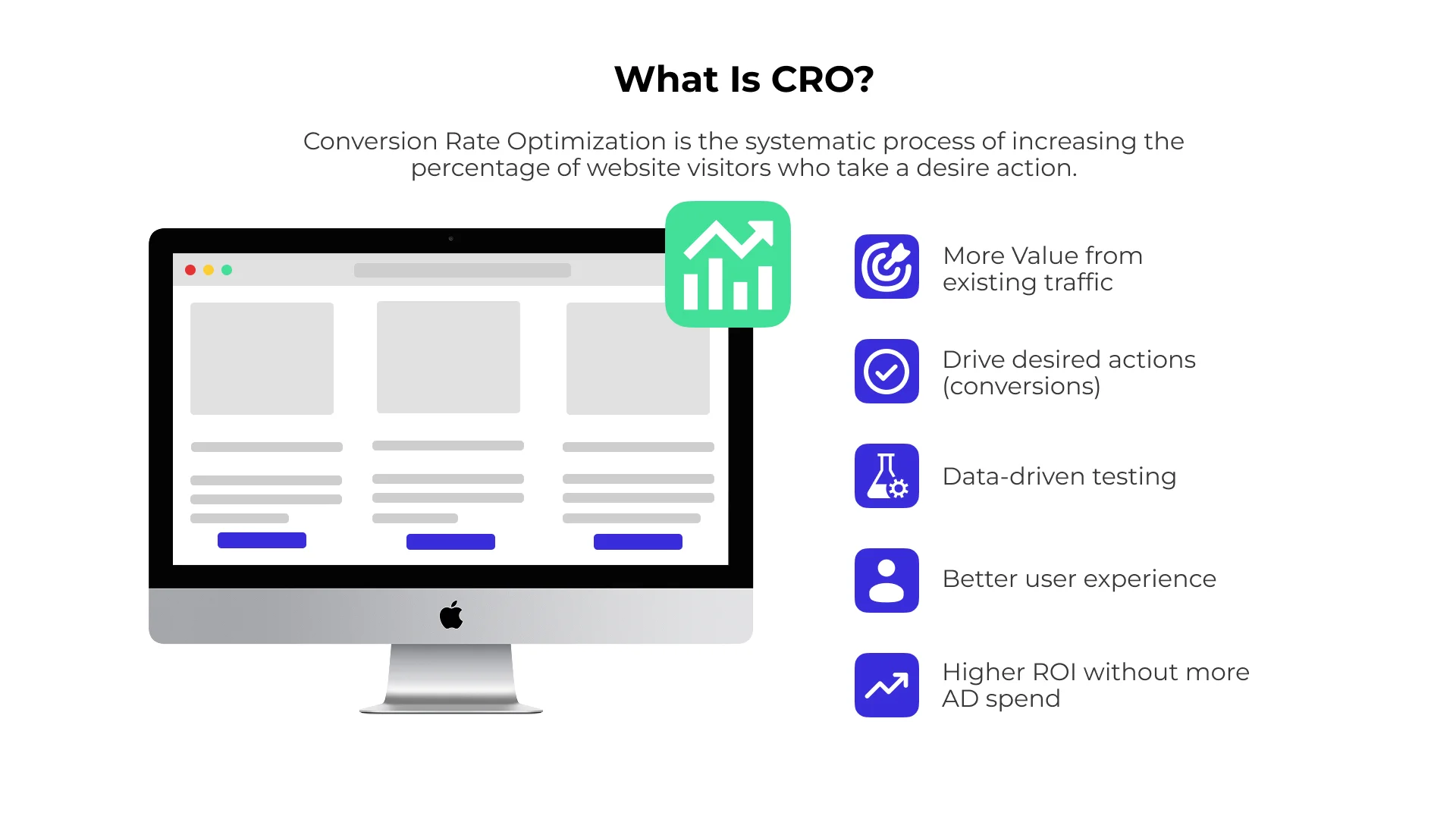
What is CRO? The answer depends on your industry. In life sciences, CRO stands for Contract Research Organization—companies that provide clinical trial services to pharmaceutical firms. In digital marketing, CRO means Conversion Rate Optimization—the systematic process of increasing the percentage of website visitors who take a desired action, like making a purchase.
Quick Answer: The Two Types of CRO
| Type | Industry | Purpose |
|---|---|---|
| Contract Research Organization | Life Sciences, Pharmaceutical | Manage clinical trials, regulatory compliance, and drug development processes |
| Conversion Rate Optimization | Digital Marketing, E-commerce | Increase website conversions through data-driven testing and user experience improvements |
If you’re a business leader with stagnant online sales, you’re interested in the second definition. A website that attracts traffic but fails to convert is like a party where guests arrive but don’t stay.
Between 70-80% of people research a company online before making a purchase. Yet many businesses pour money into driving traffic while ignoring what happens when visitors arrive. This is like filling a leaky bucket—wasteful and frustrating.
The core problem: You’re likely converting only 1-4% of your website visitors. A well-executed CRO strategy can boost that number significantly, turning existing traffic into more revenue without spending extra on advertising.
What is CRO? Unpacking the Two Meanings
The acronym “CRO” means different things depending on the context. For pharmaceutical executives, it’s one thing; for your marketing team, it’s another. Since our expertise at SiteTuners is in Conversion Rate Optimization, let’s clarify both meanings.
What is CRO in Life Sciences? (Contract Research Organization)
In the pharmaceutical and biotech world, a Contract Research Organization (CRO) is a partner that helps bring new drugs and medical devices to market, guiding them from lab concept to pharmacy shelf.
What do Contract Research Organizations do? They manage the intricate process of clinical trial management, from designing studies to recruiting patients and collecting data. They also steer the maze of regulatory affairs, ensuring submissions to the FDA or EMA meet strict compliance standards, and handle data management to maintain integrity.
Their services cover pharmaceutical development, biotechnology support, and medical device testing. CROs can complete clinical trials an average of 30 days faster than in-house teams, which translates to significant cost savings.
What is CRO (Conversion Rate Optimization) in a marketing context?
Now for the CRO that likely brought you here: Conversion Rate Optimization. So what is CRO in marketing? It’s the systematic, data-driven process of increasing the percentage of website visitors who take a desired action.
CRO helps your website guide visitors toward becoming customers. It’s about getting more value from existing traffic, not just chasing new visitors.
These desired actions—called conversions—vary by business goal. For e-commerce, it’s a purchase. For B2B, it might be a contact form or demo request. For content sites, it could be a newsletter sign-up. Even smaller actions like clicking a key call-to-action or watching a video are conversions worth optimizing.
The beauty of CRO is that it increases your website’s performance without requiring more ad spend. You’re maximizing the return on the marketing investments you’ve already made.
The discipline emerged after the dot-com bubble, when marketers realized attracting visitors wasn’t enough. With new web analytics tools, they could track, test, and improve performance, adapting direct marketing principles for the digital age. The practice has since evolved into a sophisticated field combining psychology, data analysis, UX design, and rigorous testing. To learn more, explore our insights on Conversion Rate Optimization.
Why Conversion Rate Optimization is Crucial for Your Business
I’ve seen it hundreds of times: a business owner is proud of 50,000 monthly visitors but dismayed by only 500 customers. That’s a 1% conversion rate—common, but fixable.
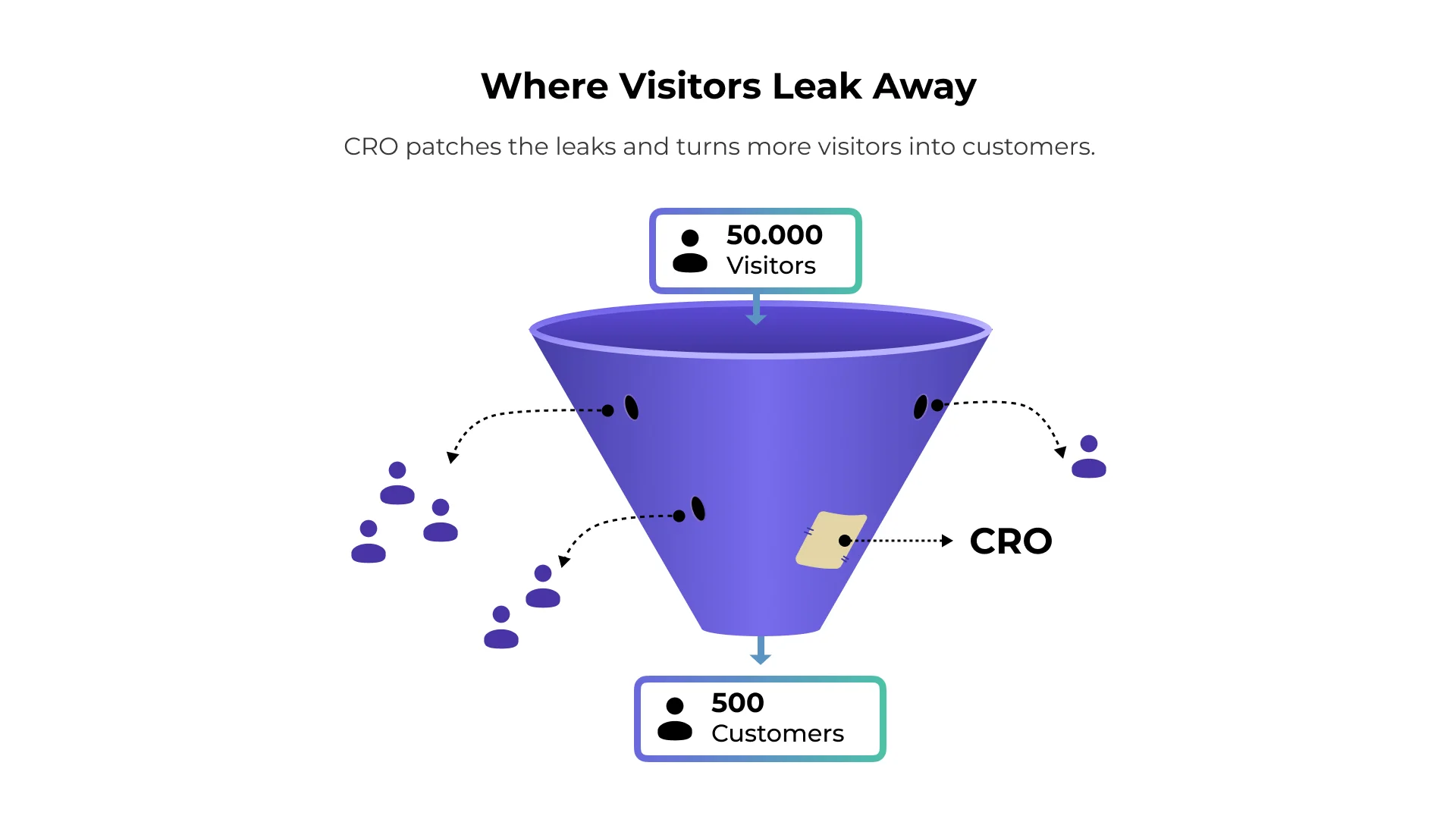
Imagine your website as a bucket. You pour money into ads and SEO to fill it with visitors. If there are holes, you’re watching potential revenue leak away. What is CRO if not the process of patching those holes?
At SiteTuners, we’ve spent over two decades helping businesses stop the leak. We focus on maximizing the value of every visitor while improving ROI, and building sustainable growth without constantly increasing ad spend.
The Core Principle: Getting More from Your Existing Traffic
The reality is, you likely have a conversion problem, not a traffic problem.
This is where CRO becomes your competitive advantage. By converting more of the people already showing up, you can double your revenue by doubling your conversion rate from 1% to 2%—without spending more on ads.
Here’s what that efficiency looks like:
Lower customer acquisition cost: If you spend $100 to get one customer from 100 visitors (1% conversion), doubling that rate to 2% cuts your acquisition cost to $50, freeing up budget and boosting profits.
Increased revenue per visitor: Each visitor becomes more valuable. A well-executed CRO strategy can boost conversions by 50% or more, directly impacting your bottom line.
Compounding returns: Small, incremental wins—a better headline, a clearer value proposition—stack up over time, compounding into meaningful business growth.
Improved marketing ROI: Your advertising dollars work harder. CRO ensures your investments in Google Ads, content marketing, and social media aren’t wasted, turning traffic into customers.
We’ve learned from over 2,100 clients that the businesses winning online aren’t just the ones with big ad budgets. They are the ones who understand Conversion Rate Optimization and Business Acceleration and apply it systematically.
Understanding Your Users to Drive Growth
Google famously tested 41 shades of blue for a link, understanding that even tiny improvements create massive value at scale. But effective CRO isn’t about blindly testing colors; it’s about deeply understanding the people visiting your website.
At SiteTuners, our user-centric approach means constantly asking: What do your visitors want? What’s confusing them? What’s stopping them?
User behavior analysis gives us the “what.” Tools like heatmaps, scroll maps, and session recordings reveal patterns you’d never spot in traditional analytics. Maybe users are clicking a non-clickable image or abandoning their cart on a specific page, pointing to a friction point.
Customer feedback provides the “why.” We use surveys and user interviews to uncover motivations, pain points, and the messages that resonate. For one client, analytics showed a high bounce rate on their pricing page. User interviews revealed confusion over plan features. A simple clarification increased conversions by 34%.
The real insight comes when we combine both data types. Quantitative data (analytics) tells us 60% of visitors leave at checkout. Qualitative data (surveys) tells us it’s due to surprise shipping costs. Now we have a clear hypothesis: show shipping costs earlier.
This is why we believe you must mix quantitative and qualitative data for reliable insights. One without the other is just guessing.
Understanding user intent is at the heart of our work. When someone lands on your site, they have a goal. Our job is to make achieving it as easy as possible. We’re constantly finding user intent data to design experiences that align with what your customers actually need. The businesses that win are those who truly understand their users and remove every obstacle to conversion.
The CRO Process: A Step-by-Step Guide to Higher Conversions
Effective Conversion Rate Optimization isn’t guesswork—it’s a step-by-step plan. When people ask what is CRO in practice, the answer is a continuous cycle of improvement where we learn, refine, and optimize based on real evidence.
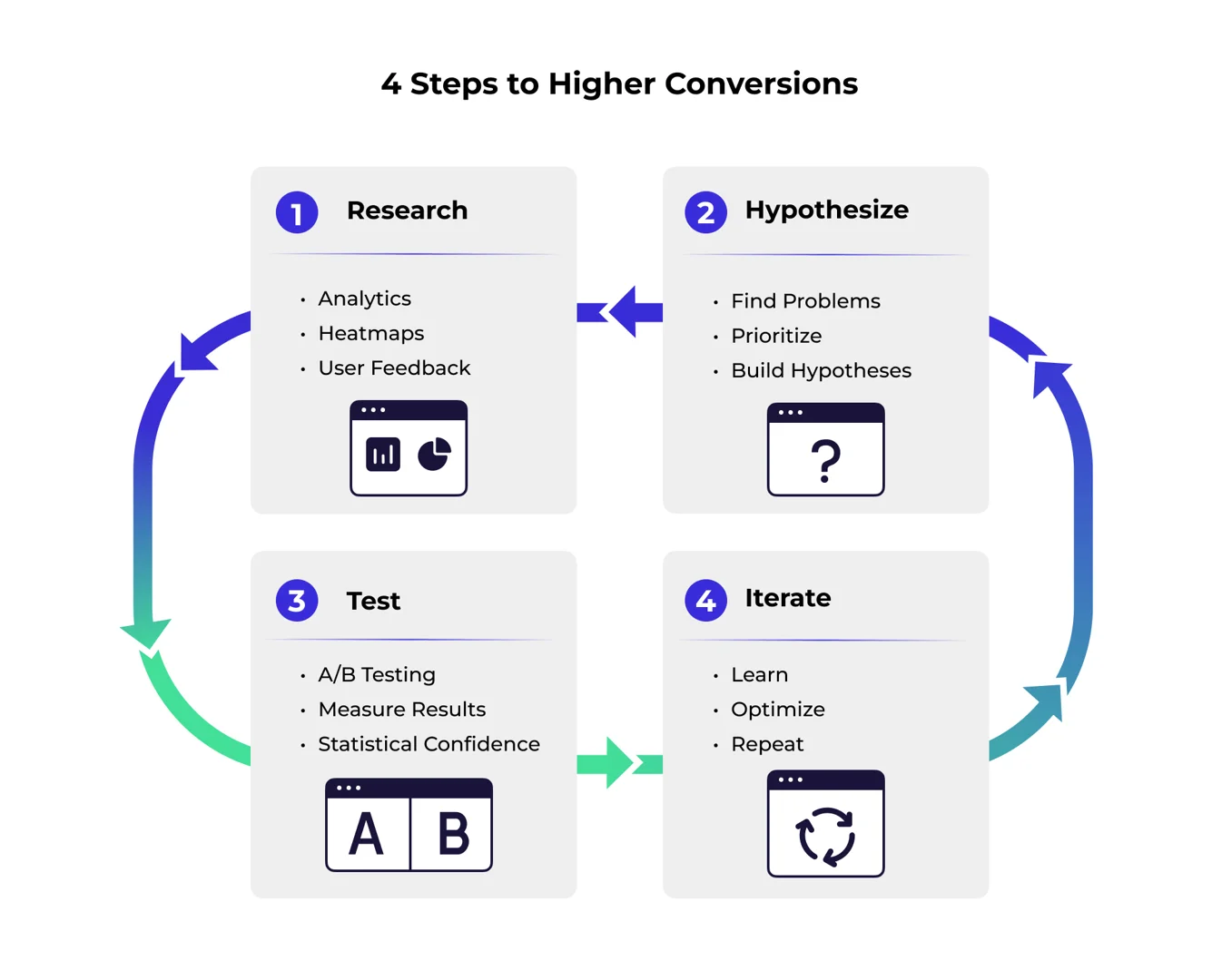
This iterative process ensures every change serves your business goals and is backed by solid reasoning. Here’s our approach:
Step 1: Research and Data Analysis
We start by gathering comprehensive data to understand website performance and user behavior. This forms the foundation of our strategy.
We begin with web analytics in platforms like Google Analytics to understand traffic sources, popular pages, and user funnels, identifying exactly where people drop off.
Next, we use user behavior tools. Heatmaps show where users click and scroll, while session recordings let us watch anonymized user journeys to spot moments of confusion or frustration that raw data misses.
We also gather surveys and user interviews to uncover the “why” behind the numbers—what motivates people, what stops them, and what needs aren’t being met.
Our team conducts a thorough expert review, reviewing your site against established usability principles and analyzing industry best practices to identify opportunities. This research phase reveals the biggest conversion barriers and growth opportunities. For a detailed look, check out our guide to CRO Audits.
Step 2: Hypothesis Formulation
This step transforms research insights into a testable action plan. We move from what is happening to why and what we can do about it.
We identify specific problems, such as “users abandon checkout when they see shipping costs,” not vague issues. For each problem, we propose testable solutions and use prioritization frameworks (like RICE) to focus on hypotheses with the highest potential impact.
Each hypothesis follows a clear “If-Then-Because” structure: “If we add trust badges near the checkout button, then cart abandonment will decrease, because surveys revealed security concerns.” This structured approach ensures every test is strategic.
Step 3: Testing and Implementation
Now we put our hypotheses to the test with real users and data.
A/B testing (or split testing) is the cornerstone of what is CRO methodology. We test two versions of a page—a control (original) and a variation (the change)—by showing them to different audience segments to compare performance objectively. For more complex scenarios, we use multivariate testing to examine multiple elements at once.
What separates professional CRO is reliable results. We ensure results are statistically valid, typically aiming for 95% confidence to rule out random luck. Even a test that doesn’t reach significance is valuable, as it tells us users were indifferent to the change.
When a test concludes with a clear, statistically significant winner, we implement that winning variation across your site, locking in the conversion gains. Our A/B Split Testing Crash Course breaks this down.
Step 4: Learning and Iteration
The process doesn’t end with a winning test; that’s where the learning begins. We analyze results to understand why one variation outperformed the other, revealing insights about user psychology and preferences.
We document every insight from all tests—winners and losers—to build a knowledge base that becomes a competitive advantage. These learnings spark new hypotheses for future experiments, creating a continuous loop of research, testing, and learning that drives sustained growth.
Over time, this process builds a sophisticated understanding of your audience, allowing for progressively more impactful optimizations. This cyclical approach is fundamental to understanding what is CRO. It’s about building a culture of continuous improvement. Explore how we integrate this in the CRO process for your company.
Common CRO Best Practices and Examples
While every site is unique, years of testing show that certain elements consistently impact conversion rates. These are high-impact areas where small changes can yield large results.
What is CRO in practice? Optimizing key website elements
When asked what is CRO in practical terms, we point to the digital touchpoints that make or break conversions.
- Calls-to-Action (CTAs): As gateways to conversion, CTAs must be visible, use action-oriented language (“Get Started” vs. “Submit”), and be placed intuitively. We test variations to find what works.
- Landing Pages: These have one job: convert. We streamline layouts, simplify forms, clarify value propositions, and ensure mobile functionality. Speed is crucial; Amazon found every 100ms of latency cost them 1% in sales. See what to fix in 7 Things You’re Doing Wrong on Your Landing Pages and How to Fix Them.
- Website Copy: Your words do heavy lifting. We craft clear, concise messages focused on benefits, not just features, to solve your visitor’s problem.
- Site Navigation: Confusing menus are conversion killers. If people can’t find what they’re looking for in seconds, they leave.
- Page Speed: A non-negotiable. A one-second page load delay can decrease conversions by 7%. We optimize images and code because every millisecond matters.
- Mobile Optimization: With over half of web traffic from mobile, your site must be responsive and easy to use with a thumb. Avoid common mistakes detailed in 7 Deadly Sins of Mobile Web Design.
- Trust Signals: Testimonials, reviews, and security badges build the confidence users need to convert. We test their placement for maximum impact.
- Personalization: Showing relevant content based on user data can increase revenue by 5-15%, making the experience feel custom.
- Urgency and Scarcity: Honest use of phrases like “Only 3 left” or “Sale ends tonight” can encourage action by tapping into the fear of missing out.
The Power of Psychology in CRO
Understanding how people think is often more powerful than understanding technology. We leverage how people naturally think not to manipulate, but to design experiences that align with natural human decision-making.
- Social Proof: Seeing that others have bought, reviewed, or trusted your brand makes new users feel safer. We test the display of testimonials, user counts, and media mentions to maximize this effect.
- Scarcity and Urgency: Limited-time offers or low-stock alerts can drive faster decisions, but they must be genuine to maintain trust.
- Authority: Endorsements from experts, certifications, or trust seals lend credibility and validate your brand.
- Loss Aversion: We are often more motivated by avoiding a loss than by an equivalent gain. “Don’t miss out” can be more compelling than “Get this benefit.”
- Framing and Anchoring: The way you present information changes its perception. Showing a higher “original price” next to a sale price creates a reference point that makes the current price more attractive.
By integrating these principles, we create persuasive experiences. Explore these techniques in Using Cognitive Biases to Improve Online Conversions and Leveraging Persuasion to Boost Conversion Rates.
Frequently Asked Questions about CRO
As we work with business leaders, certain questions about what is CRO come up repeatedly. Here are the most common ones:
What is the difference between a CRO and a sponsor in clinical trials?
This question returns us to the life sciences world. The sponsor is the entity that initiates, manages, funds, and holds ultimate responsibility for a clinical trial and its data integrity.
A Contract Research Organization (CRO) is a hired expert. The sponsor contracts them to handle specific trial-related tasks like study design, site monitoring, or data management. However, while the sponsor can delegate tasks, they cannot delegate responsibility. The sponsor remains accountable for the trial’s quality and integrity.
What is a good conversion rate?
There’s no single “good” conversion rate. While averages are often cited between 1% and 4%, this figure can be misleading because a good rate depends on several factors.
- Industry benchmarks vary widely. E-commerce selling $20 items will have different rates than a B2B company generating $50,000 leads.
- Traffic source matters. Visitors from a targeted ad are more likely to convert than those from a general social media post.
- Conversion goal changes everything. A newsletter subscription is an easier conversion than a high-ticket purchase.
The most meaningful benchmark is your own historical performance. A good conversion rate is one that consistently improves. We focus on that upward trajectory. For a deeper dive, read Why Your General Conversion Rate is Wrong.
How is Conversion Rate Optimization (CRO) different from SEO?
SEO and CRO are essential partners in a customer’s journey, but they handle different stages.
SEO (Search Engine Optimization) focuses on traffic acquisition. It makes your site visible in search results to attract potential customers to your digital doorstep.
CRO focuses on visitor conversion. Once visitors arrive, CRO guides them toward taking action with a smooth, persuasive experience.
In short: SEO fills your funnel, while CRO converts prospects at the middle and bottom of the funnel into customers.
Massive traffic from brilliant SEO is wasted without effective CRO. Conversely, a perfectly optimized site generates no revenue if no one can find it. These two disciplines are complementary forces for sustainable growth. See how they fit together in Learn about SEM, SEO, and CRO.
Conclusion
The key takeaway is that what is CRO matters to your bottom line. Conversion Rate Optimization isn’t just jargon; it’s the difference between a website that merely exists and one that actively grows your business.
You’re already investing in driving traffic. Every visitor who leaves without converting is a missed opportunity. CRO ensures you capture the value you’ve worked so hard to attract.
Throughout this guide, we’ve shown how a structured CRO approach maximizes existing traffic, reduces customer acquisition costs, and uncovers what your users truly want. Real growth comes from a continuous cycle of research, hypothesis, testing, and learning.
By understanding website elements and the psychology behind user behavior, you can create experiences that are intuitive, trustworthy, and compelling.
At SiteTuners, we’ve helped over 2,100 clients transform their digital presence since 2002. We’ve learned that sustainable growth comes from putting users first and systematically removing every barrier to conversion.
Your website has untapped potential. The question isn’t whether you can improve your conversion rates—it’s how quickly you want to start.
Ready to stop wondering what is CRO and start experiencing what it can do for you? Partner with a leading Conversion Rate Optimization Agency and let’s open up your website’s full potential together.