
Full Funnel Analytics: See What Really Drives Revenue
Definition: Full funnel analytics is the practice of tracking the full customer journey, from first contact to sale and repeat purchase, so you can see which marketing actions create revenue.
Most teams do not lose sales because they lack effort. They lose sales because they cannot see the whole path.
A paid campaign may look strong. A landing page may look busy. Sales may hit lead goals. But if those pieces are measured alone, you still may not know what creates demand, moves buyers forward, and turns interest into revenue.
That is the problem full funnel analytics fixes.
Instead of asking, “Which channel got the last click?” you can ask better questions:
- Which campaigns bring in buyers who are likely to convert?
- Where do serious prospects get stuck?
- Which pages or offers create trust?
- Which marketing spend leads to real revenue?
For SiteTuners, this matters because better visibility leads to better conversion decisions. SiteTuners has helped more than 2,100 clients identify and fix website barriers since 2002. Case study proof includes Bevilles’ 30% sales increase, Commio’s 5X increase in conversion rates, and Coastal Insurance Solutions’ 78.5% increase in landing page conversions.
I’m Jeffery Loquist, VP at SiteTuners. I’ve spent more than 18 years in e-commerce, paid media, and conversion optimization. This guide shows how to use full funnel analytics to find leaks, prove what is working, and make smarter growth decisions.
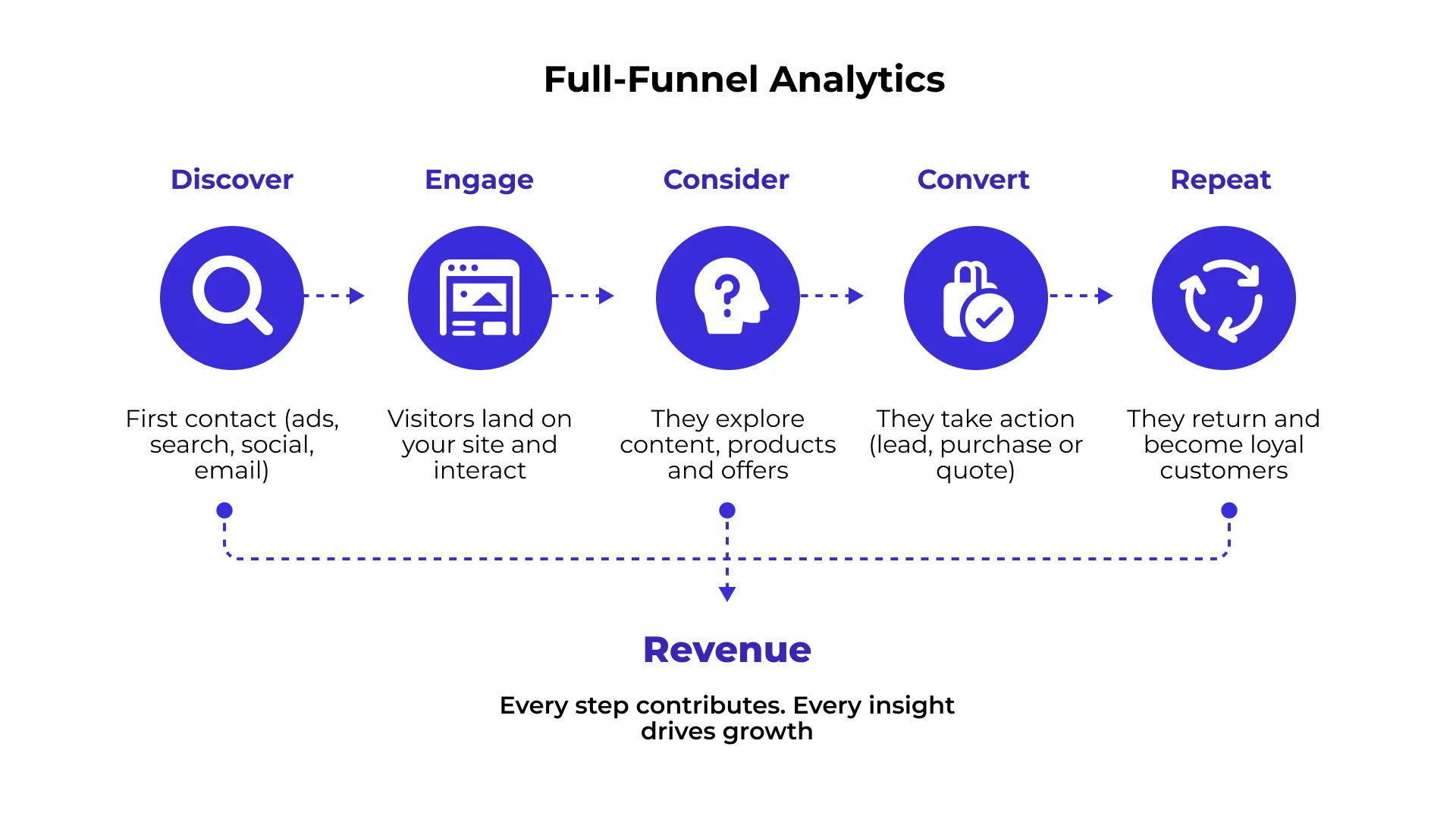
Why Full Funnel Analytics Matters at the Decision Stage
At the decision stage, buyers are comparing options, looking for proof, and deciding whether to trust you. They may read case studies, check reviews, revisit key pages, or talk with sales.
Full funnel analytics shows what brought them here and what still blocks the sale.
Many teams still give too much credit to the last click. That can make paid search, direct traffic, or retargeting look stronger than they really are.
That bias causes three problems:
- You overfund the last touch. The final channel looks more valuable than it really is.
- You underfund trust builders. Content, UX, and brand work may look weak because they do not always close the sale directly.
- You miss conversion barriers. A buyer may be ready, but a confusing page, weak offer, or unclear calls to action can stop them.
Full funnel analytics connects the whole path. It shows which touchpoints build trust, which pages create friction, and which actions predict revenue.
For e-commerce teams, this connected view is essential to improving marketing performance across every touchpoint.
What This Does for You
Full funnel analytics turns scattered data into clear action.
Here is what it helps you do:
| Business Goal | What Full Funnel Analytics Shows | What You Can Fix |
|---|---|---|
| Spend smarter | Which campaigns create serious buyers | Shift budget to higher-value paths |
| Increase conversions | Where ready buyers drop off | Improve pages, offers, forms, and checkout |
| Prove marketing value | How early touchpoints support revenue | Protect budget for demand creation |
| Improve customer value | Which sources bring repeat buyers | Focus on quality, not just lead volume |
Decision-Stage Metrics to Watch
At the decision stage, focus on metrics that show intent and friction:
- Product or service page visits
- Demo, audit, or consultation requests
- Pricing page views
- Case study views
- Form starts and form completions
- Cart abandonment
- Conversion rate
- Average order value
- Customer lifetime value
Do not stop at the overall conversion rate. A site can have enough traffic and still leak revenue at key steps.
For example, many e-commerce funnels lose most users before purchase. Product page views, add-to-cart rate, cart abandonment, and completed purchases each tell a different story. If you only look at the final sale, you miss the step that needs fixing.
After the sale, track repeat purchase rate, churn, and customer lifetime value. These show whether your marketing brings in customers who keep creating value.
Trust is a traction blocker at the decision stage. When buyers see friction at checkout, their fear of loss overrides their desire to buy.
How to Build a Full Funnel Analytics System
The biggest barrier is usually not a lack of data. It is fragmented data.
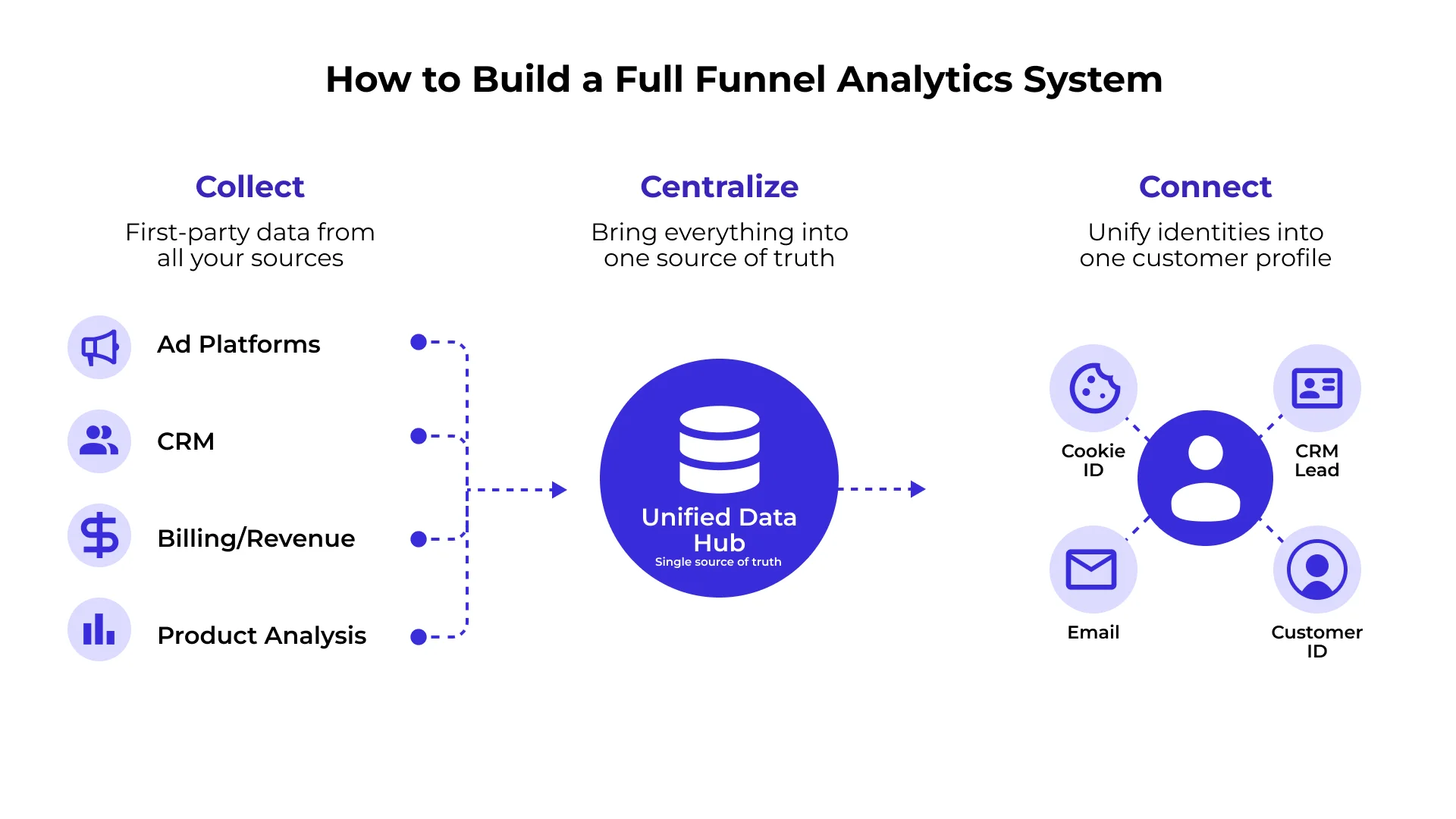
Most teams store customer and marketing data in separate systems:
- Ad platforms track costs, impressions, and clicks.
- CRMs track lead stages, pipeline value, and account details.
- Billing systems track revenue and subscriptions.
- Product analytics tools track behavior and engagement.
One person may appear as a cookie ID, an email address, a CRM lead, and a customer ID. Until those records connect, you cannot answer the most useful question: Which marketing actions create profitable customers?
Start with three steps:
- Collect first-party data. Use email sign-ups, logins, customer IDs, and consent-based tracking.
- Centralize the data. Bring ad, CRM, product, and revenue data into one source of truth, such as BigQuery.
- Connect identities. Match different identifiers to one customer profile through a CDP, SQL process, or governed data model.
Then add qualitative insight. Analytics shows what happened. User testing, surveys, heatmaps, and session recordings help explain why it happened.
A practical stack may include GA4, Google Tag Manager, BigQuery, a CRM, and attribution or data integration tools. For custom reporting, the Google Analytics Data API v1 can generate funnel reports through Google’s funnel reporting documentation. Google’s guide to [GA4] Funnel exploration also explains open and closed funnels.
How to Prove What Really Worked
No single measurement model tells the whole truth.
A stronger approach is triangulation, which means using more than one method to check performance.
Use three models together:
- Marketing Mix Modeling (MMM): Shows how media spend affects sales over time. It is useful for budget planning and privacy-safe measurement.
- Multi-Touch Attribution (MTA): Shows how digital touchpoints contribute to a conversion. It is useful for campaign and creative decisions.
- Incrementality Testing: Compares exposed and unexposed groups. It helps prove which sales your marketing actually caused.
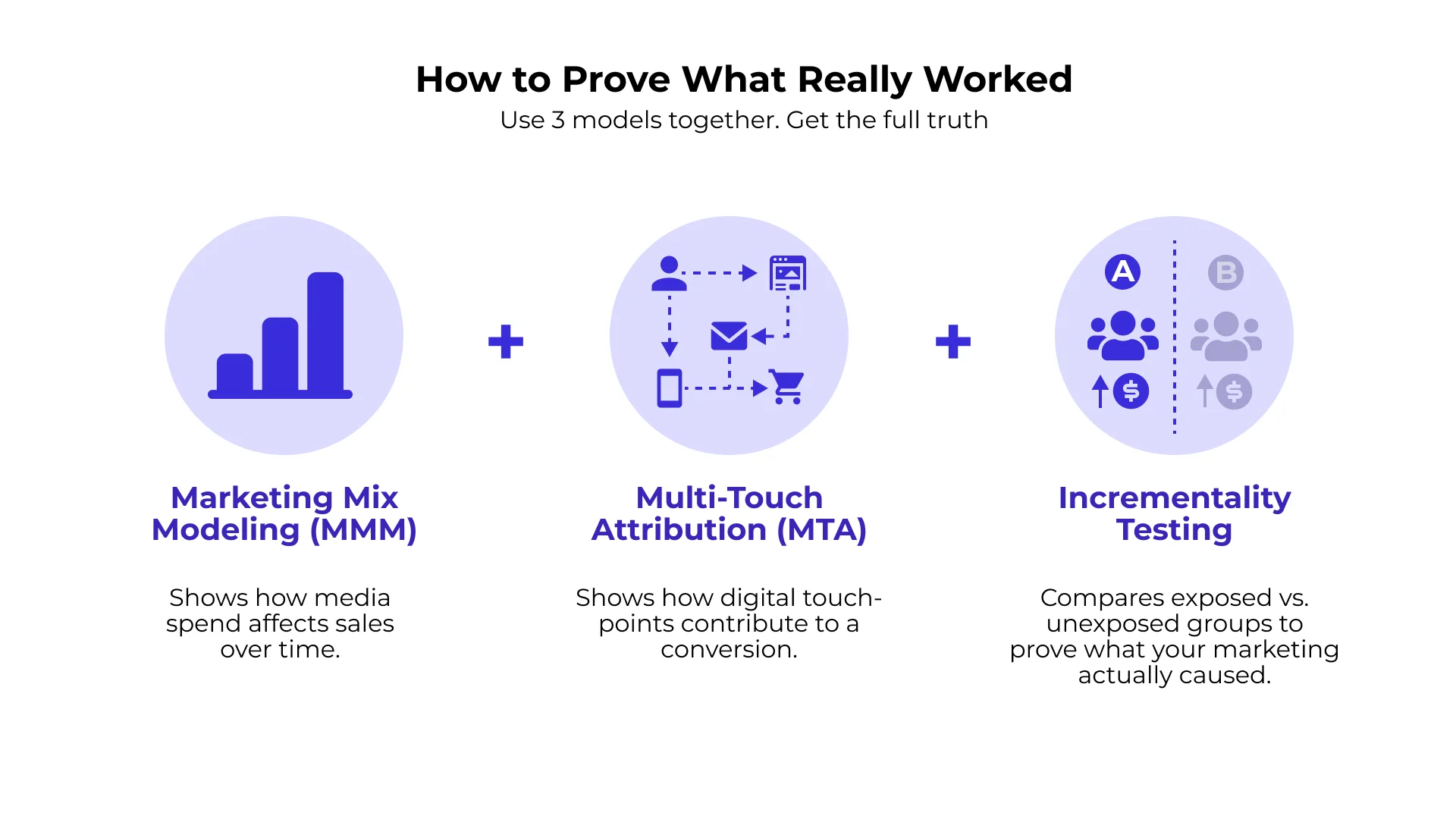
MMM gives the big picture. MTA gives day-to-day detail. Incrementality testing checks cause and effect.
Together, they help you avoid platform-reported overclaiming and invest based on real business value.
Where AI Helps
AI can make full funnel analytics faster, but it should not replace judgment.
Use AI to spot unusual changes, find drop-offs, group customer behavior, and forecast customer lifetime value. Use people to decide what the numbers mean and what to test next.
The goal is not more dashboards. The goal is faster insight, better choices, and more revenue from the traffic you already have.
Frequently Asked Questions
What is full funnel analytics?
Full funnel analytics tracks the full customer journey, from first touch to repeat purchase. It helps teams see which marketing actions create demand, build trust, and lead to revenue.
Why is full funnel analytics important?
It helps businesses avoid last-click bias, find conversion leaks, and spend marketing budget where it creates the most value.
What is the difference between open and closed funnels?
In a closed funnel, users must enter at the first step to be counted. If they skip a step or enter midway, they are excluded. In an open funnel, users can enter at any step, which better reflects real buyer behavior. GA4 supports both options.
What’s the difference between MMM and MTA?
MMM looks at the impact of marketing spend over time. MTA looks at how different touchpoints help a conversion. MMM is better for big-budget planning. MTA is better for day-to-day channel decisions.
What’s the simplest tool stack to start with?
Start with GA4, Google Tag Manager, a CRM, and one reporting layer such as BigQuery or a dashboard tool. That gives you a solid base before you add attribution, testing, or customer data tools.
Why is multi-touch attribution alone not enough?
Multi-touch attribution is useful, but it is limited by privacy rules, browser restrictions, and platform bias. It also struggles with non-click channels and does not prove which sales would have happened anyway.
How does CRO support full funnel analytics?
CRO turns funnel data into action. If analytics shows buyers are dropping off on a page, CRO helps identify and fix the reason, such as unclear messaging, weak calls to action, poor layout, or form friction.
Conclusion
Full funnel analytics is not about dashboards. It is about seeing the truth.
Most businesses have enough traffic. They do not have enough clarity. You cannot fix what you cannot see.
When you map the full journey—from the moment someone finds you to the moment they buy and come back—you spot the real friction. Maybe it is navigation. Maybe it is validation (they do not trust you). Maybe it is traction (they do not feel urgency).
These are not opinions. They are diagnoses. And they change everything.
SiteTuners has helped more than 2,100 businesses find and fix these barriers since 2002. Bevilles increased sales by 30%. Commio saw conversion rates jump 5X. Coastal Insurance Solutions increased leads by 78.5%. They did not get lucky. They got clear.
The data shows the leak. The strategy fixes it.
If something here resonates with your business, or you want an expert view of your site, speak with a conversion expert in just 30 minutes. Get a free website review built around your business.