Why the Benefits of CRO Matter for Every Website
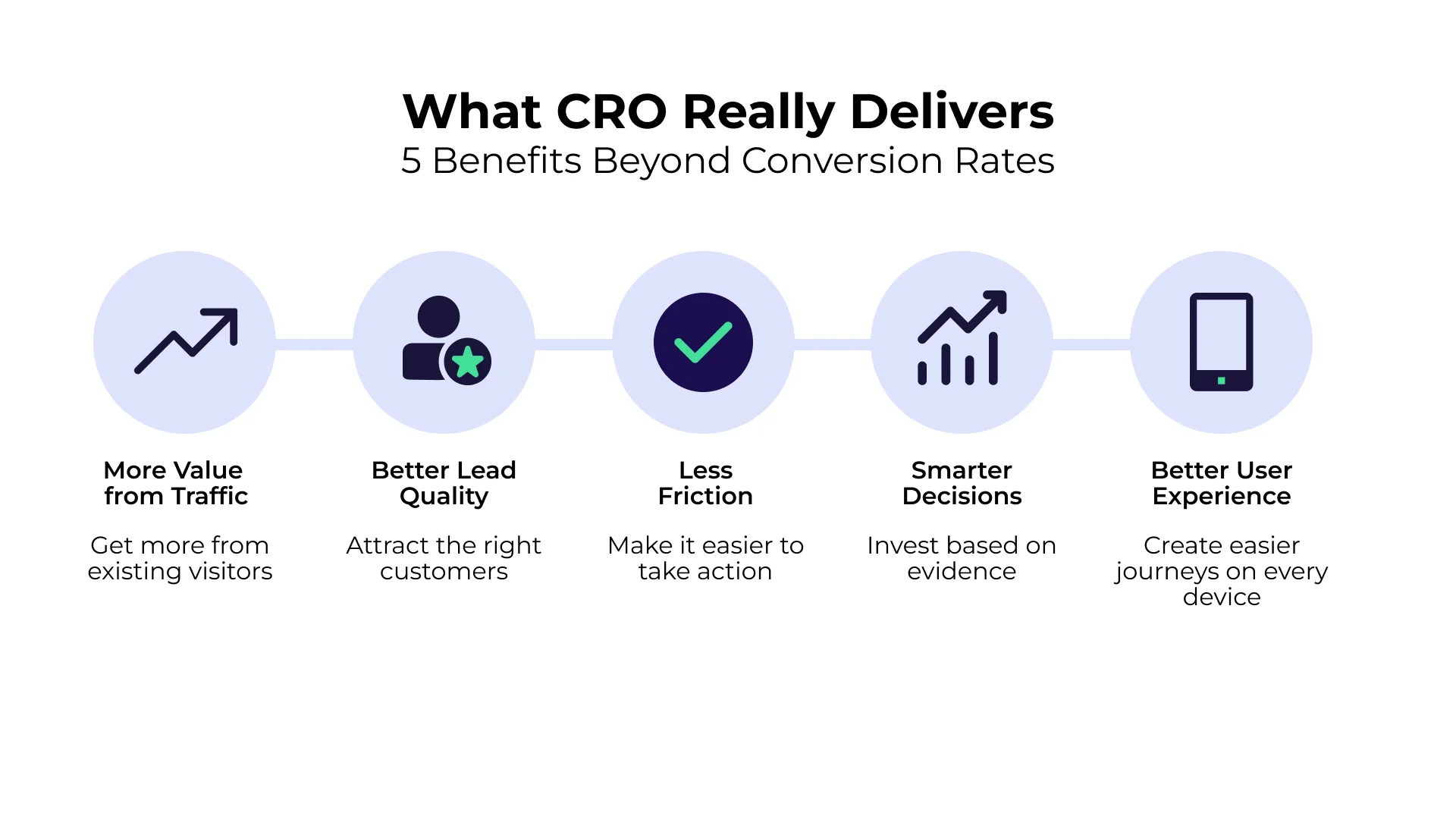
The benefits of CRO come from helping more of the people who already reach your website complete a meaningful next step. Depending on the business, that could mean more qualified leads, more completed purchases, more demo requests, or fewer prospects abandoning a form or checkout.
CRO does not create results by applying a universal template. It works when a team identifies a real barrier in the customer journey, makes a focused improvement, and measures whether that change helps the right visitors move forward. The business value is not simply a higher conversion rate; it is a clearer understanding of where revenue, leads, and customer confidence are being lost.
What this means for a business:
- More value from traffic you already earn or pay for
- Better lead or customer quality when messaging and qualification are clearer
- Fewer abandoned journeys caused by uncertainty, friction, or technical problems
- Better evidence for deciding where to invest design and development resources
- A more usable experience for customers across devices
I am Jeffery Loquist, Vice President of SiteTuners, with more than 18 years of experience across ecommerce, paid media, SEO, social media, and conversion optimization. In practice, the most useful CRO work starts with a simple question: where are motivated visitors struggling, and what would make the next step easier?
Core Financial and Strategic Benefits of CRO
CRO can improve financial performance by reducing waste between a visitor’s first click and a completed action. When high-intent visitors cannot quickly understand an offer, trust a page, find key information, or complete a form, the business may spend more on acquisition without addressing the reason those visitors leave.
The financial benefit depends on the economics. A conversion improvement is especially valuable when the additional conversions are qualified, the cost of the change is reasonable, and the business can serve the added demand. CRO is therefore as much a prioritization discipline as it is a website discipline.
| Hypothetical monthly scenario | Before improvement | After improvement | What changes |
|---|---|---|---|
| Visitors | 100,000 | 100,000 | Traffic stays the same |
| Conversion rate | 2.0% | 3.0% | 50% relative lift |
| Conversions | 2,000 | 3,000 | 1,000 additional actions |
| Acquisition cost per conversion | $50.00 | $33.33 | Lower only if spend and lead quality hold steady |
| Revenue at a $100 average order value | $200,000 | $300,000 | Illustrative increase before fulfillment and margin costs |
This is a hypothetical example, not a benchmark or promised outcome. Its purpose is to show why small changes in conversion rate can materially change the return from the same traffic.
Maximizing ROI and Lowering Customer Acquisition Costs
CRO may lower acquisition cost when it produces more qualified conversions without requiring proportional increases in media spend, sales effort, discounts, or support costs. It may not lower CAC if the change attracts poorly qualified leads, requires expensive incentives, or shifts demand away from a more profitable path.
What to look for:
- Campaign landing pages with substantial traffic but weak lead or purchase completion
- Paid traffic sources that generate volume but few sales-qualified leads
- Forms that are started often but completed rarely
- Pages where visitors repeatedly ask sales or support questions that the page should answer
Use those patterns to decide whether the next investment should be better messaging, a simpler form, stronger proof, faster performance, or a different offer.
Key Business Benefits of CRO for Landing Pages
Landing pages often reveal conversion problems quickly because they usually ask visitors to take one primary action. A focused review can show whether the page is helping people decide or making them work too hard to do so.
Common improvements include:
- Clearer value propositions: State who the offer is for, what problem it solves, and what happens after the visitor responds.
- Less cognitive load: Remove competing messages, unnecessary navigation, and distracting visual elements around the main decision.
- More usable forms: Ask only for information needed at that stage, explain why sensitive fields are required, and make errors easy to correct.
- More specific calls to action: Match the button language to the value being offered, such as “Request a CRO Review” rather than a vague “Submit.”
The goal is not to make every landing page minimal. It is to make the information needed for a confident decision easy to find.
How User Experience Powers Conversion Optimization
User experience affects whether a visitor can complete the task that brought them to a page. A page can have compelling copy and still underperform if the important details are buried, the page is difficult to use on a phone, pricing is unclear, or the next step feels risky.
CRO uses customer behavior to distinguish between a lack of interest and a problem with the experience. For example, a high exit rate after visitors reach a pricing section may signal an offer mismatch, missing proof, unexpected costs, or unanswered questions. The right response is not automatically a redesign; it is an investigation into what is preventing a decision.
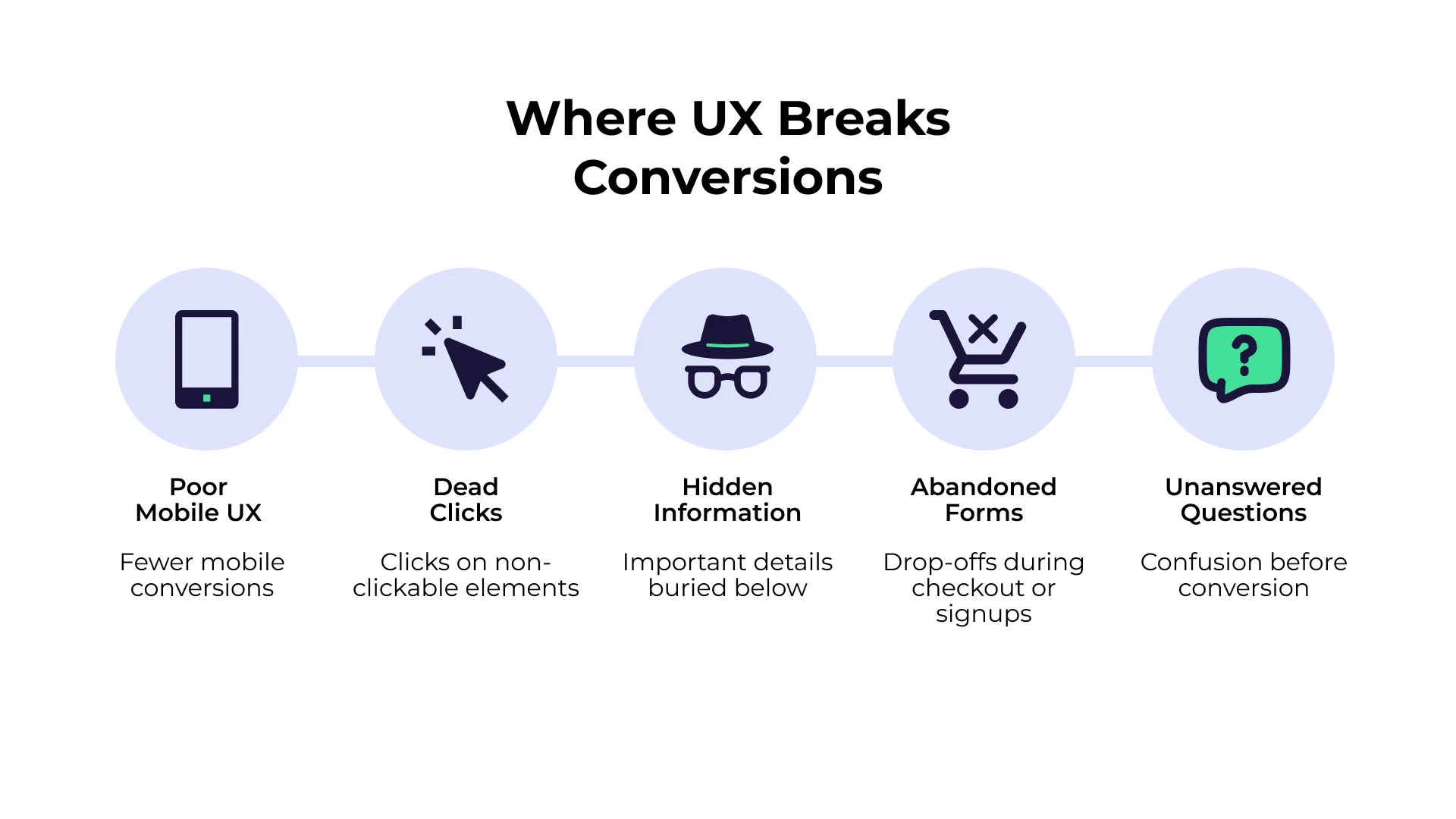
What to look for:
- Mobile users converting far less often than desktop users
- Repeated clicks on items that are not clickable
- Visitors reaching important information only after extensive scrolling
- Checkout, quote-request, or account-creation steps where abandonment spikes
- Support questions that reveal confusion before a prospect converts
Each signal should lead to a practical next step. Repeated clicks on a static image may justify making the image interactive or clarifying its purpose. A form field that causes many errors may need clearer instructions or a different format. Slow mobile pages may require a performance fix before a messaging test.
Long-Term Customer Retention Benefits of CRO
CRO can also improve the experience after an initial conversion. Clear expectations, transparent pricing, accessible help, reliable account or checkout flows, and fewer handoffs can reduce frustration and strengthen confidence in the brand.
Retention gains are not guaranteed by a more polished interface alone. They are most likely when the improved journey accurately represents the product or service and helps customers accomplish what they came to do. For that reason, post-conversion feedback, cancellation reasons, repeat-purchase behavior, and sales-quality data should inform the optimization backlog.
Essential Steps to Plan and Execute a Successful CRO Strategy
A useful CRO program is a repeatable way to choose problems worth solving. It should prevent teams from changing pages simply because a design preference is popular or a stakeholder has an opinion.
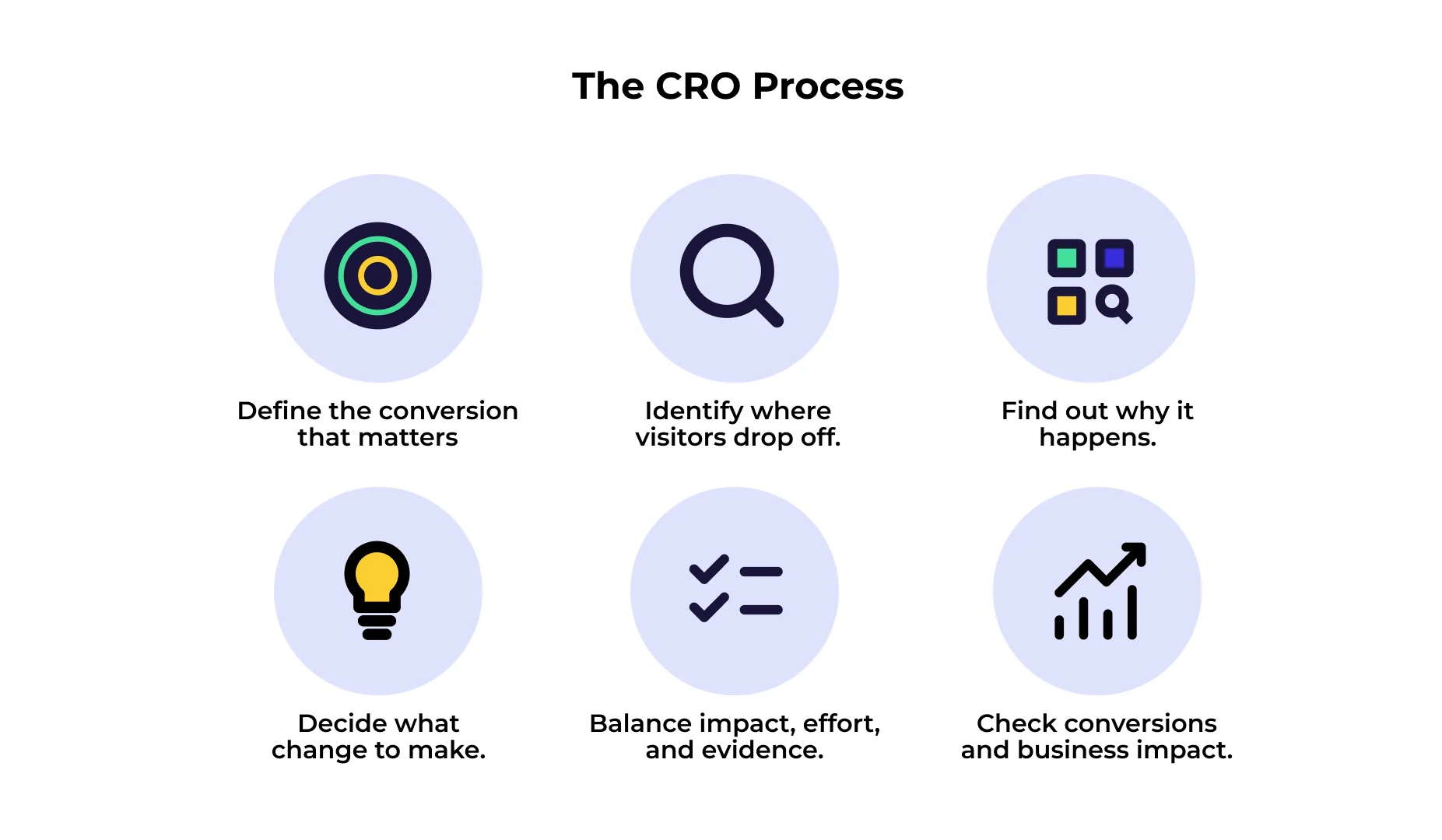
A practical sequence looks like this:
- Choose a business goal. Define the action that matters, such as a qualified inquiry, completed purchase, booked consultation, or product activation.
- Find a weak point in the journey. Start with pages or steps that receive meaningful traffic but fail to move visitors toward that goal.
- Understand the likely cause. Review analytics, page content, customer feedback, and observed behavior before deciding what to change.
- Write a focused hypothesis. For example: “Clarifying implementation timing near the form will increase qualified consultation requests because visitors currently need to ask that question before converting.”
- Prioritize the work. Favor changes with a credible expected impact, enough traffic to evaluate, and a reasonable implementation cost.
- Measure the outcome. Compare the primary conversion goal with quality indicators such as sales acceptance, refunds, cancellations, or downstream revenue.
Identifying Conversion Barriers with Behavioral Analytics
Behavioral tools are useful when they help answer a decision-making question. Heatmaps can reveal whether visitors notice a key message. Session recordings can show where people hesitate or encounter errors. Funnel reports can identify the point where abandonment is concentrated.
The important step is translating the observation into an action. If visitors scroll past a value proposition, test a clearer placement or stronger headline. If they hesitate at a form, review the number of fields, privacy language, and expected follow-up. If they abandon after selecting a product option, check whether pricing, delivery information, or comparisons are difficult to understand.
Testing and Iterating for Continuous Improvement
Testing helps a team avoid treating a plausible idea as a proven answer. It is most useful when the proposed change is meaningful, the measurement plan is clear, and the result is evaluated against the business goal rather than clicks alone.
Not every site has enough traffic for rapid A/B tests. In lower-volume situations, teams can still improve by combining customer interviews, usability sessions, form-error data, support feedback, and targeted page reviews. The standard should remain the same: make a change for a specific reason, then assess whether it improved the customer and business outcome.
Frequently Asked Questions About CRO
Which industries benefit most from implementing CRO?
Any business that relies on a website to generate revenue, leads, bookings, sign-ups, or applications can benefit from CRO. The highest-value opportunities are often found where a completed online action has meaningful business value and enough visitor volume exists to reveal patterns.
For example, ecommerce teams may focus on product pages, carts, and checkout. B2B teams may focus on service pages, case-study journeys, and lead forms. SaaS teams may focus on trial sign-ups, onboarding, and upgrade paths. Financial and insurance organizations may focus on long or high-trust application flows. The right priority depends on the customer journey and the quality of the conversions, not the industry label alone.
What are the main limitations of CRO and how can they be solved?
CRO cannot fix an offer that customers do not want, a traffic source with poor intent, or operational problems after a lead converts. It also becomes harder to measure small changes when a site has limited traffic.
Start by choosing the largest or clearest source of friction instead of testing minor visual details. Pair site data with customer interviews, sales feedback, support tickets, and usability reviews. When traffic is limited, use these findings to make evidence-based improvements and evaluate broader trends over time rather than expecting fast, statistically conclusive results from every variation.
Does CRO improve search engine optimization rankings?
CRO and SEO have different primary goals. SEO helps qualified people discover a page in search results; CRO helps those visitors understand the page and take an appropriate next step once they arrive. A higher conversion rate does not directly cause better search rankings.
The two disciplines can support each other when they improve the same customer experience. Clearer navigation, useful page structure, mobile usability, faster loading, and content that answers important questions can help visitors and strengthen the quality of a search landing page.
Conclusion
You may not need more traffic. You may need to get more value from the traffic you already have. The first step is understanding where visitors struggle, what that struggle costs the business, and why it happens before changing the page.
A strong CRO program connects website improvements to practical outcomes: more qualified leads, more completed purchases, fewer abandoned journeys, clearer investment decisions, and a better experience for customers. The results will depend on the problem being addressed, the quality of the evidence, and how well the solution fits the business and its audience.
SiteTuners has helped organizations identify and address website conversion barriers since 2002. If you want a clearer view of where your site may be losing qualified prospects, explore SiteTuners’ website optimization services or contact the team to discuss a CRO review.