The Most Important Words on Your Page
An effective call to action is the difference between a website visitor and a paying customer. It’s the prompt that transforms passive browsing into active engagement, whether that’s making a purchase, signing up for a newsletter, or downloading a resource.
Here’s what makes a call to action effective:
- Clear action verbs – Tell users exactly what to do (e.g., “Download,” “Start,” “Get”)
- Compelling value proposition – Show what’s in it for them
- Visual prominence – Stand out with contrasting colors and strategic placement
- Sense of urgency – Create motivation to act now, not later
- Simple, concise copy – Keep it short (2-5 words typically)
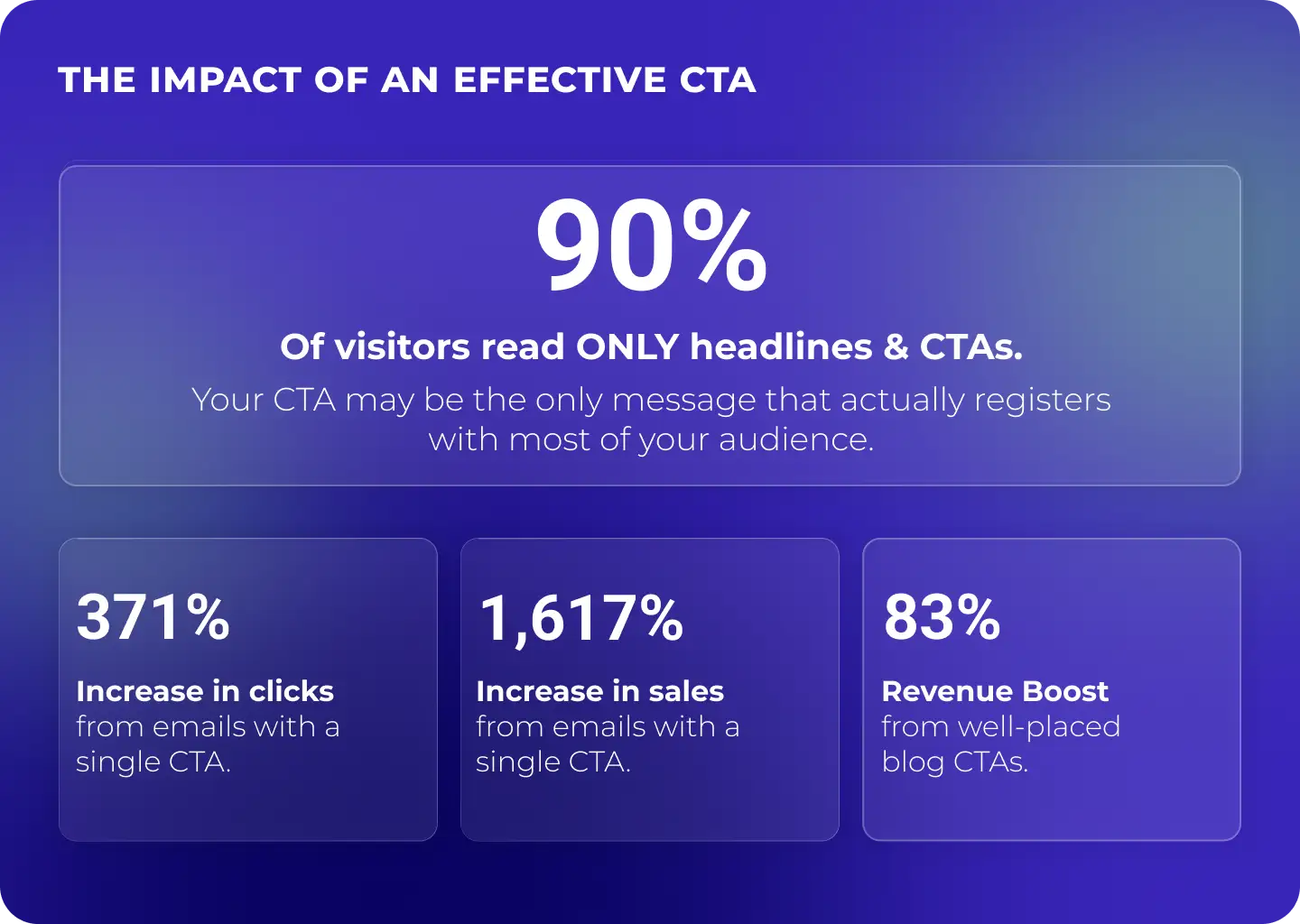
The numbers don’t lie. 90% of website visitors only read headlines and call-to-action copy. That means your CTA might be the only marketing message that actually registers with most of your audience. When done right, the impact is dramatic: emails with a single CTA increased clicks by 371% and sales by 1,617%. Adding well-placed CTAs to blog posts boosted revenue by 83%.
Yet despite their outsized influence on conversions, CTAs are often treated as an afterthought. Generic button copy like “Submit” or “Click Here” fails to motivate because it doesn’t convey any benefit. Poorly designed CTAs blend into the background. And even well-crafted CTAs can fail if they’re placed in the wrong context or don’t match where the visitor is in their journey.
This guide will show you how to craft CTAs that actually work. You’ll learn the psychological principles that drive clicks, how to tailor your messaging for different platforms and audiences, and how to test your way to higher conversion rates.
I’m Jeffery Loquist, Vice President at SiteTuners, and I’ve spent over 18 years optimizing the complete user journey and creating effective call to action strategies that turn users into customers across e-commerce, B2B, and lead generation campaigns. Let’s explore what separates CTAs that convert from those that get ignored.
Effective call to action definitions:
The Foundation: Why a Strong CTA is Your Marketing MVP
Imagine your website or marketing campaign as a captivating story. You’ve hooked your audience with an intriguing headline, painted a vivid picture with compelling content, and now they’re at a crossroads. What happens next? Without a clear, strong call to action, your story might just end there, with your audience wondering what to do next, or worse, leaving your page entirely.
At SiteTuners, we understand that an effective call to action is the true MVP of your marketing efforts. It’s not just a button; it’s a strategic marketing tool designed to elicit an immediate response, transforming passive onlookers into active participants and aligning their actions with the goals of your business or campaign.
Here’s why a strong CTA is so crucial:
- Guiding the User Journey: CTAs act as signposts, keeping prospects moving toward becoming a customer. They provide clear direction, ensuring your audience knows exactly what step to take next, preventing them from getting lost or distracted.
- Reducing Decision Friction: In a world saturated with information, decision fatigue is real. A clear, concise CTA simplifies the choice for your audience, making it easy for them to understand the desired action and its immediate benefit.
- Aligning User Actions with Business Goals: Every marketing campaign has an objective, whether it’s lead generation, sales, or increased engagement. CTAs are the direct bridge between your audience’s interest and your business objectives. They translate interest into measurable outcomes.
- Benefits of a Clear CTA: The impact of well-crafted CTAs is undeniable. They play a pivotal role in driving conversions and engagement by providing clarity, creating a sense of urgency, and emphasizing benefits. The statistics speak for themselves:
- Emails with a single CTA increased clicks by 371% and sales by 1,617%. This highlights the power of focus and clarity in guiding user action.
- Adding well-placed CTAs increased revenue from blog posts by 83%. This shows that even content-heavy pages can become conversion engines with the right prompts.
An effective call to action is the heartbeat of your digital marketing, ensuring that every piece of content, every ad, and every email serves its ultimate purpose: to drive your audience towards a meaningful interaction with your brand.
The Anatomy of an Effective Call to Action
Crafting an effective call to action is both an art and a science. It requires understanding what motivates people and how to communicate that motivation clearly and concisely. Let’s dissect the key elements that make a CTA truly compelling.
The core of any great CTA lies in its ability to be a concise prompt designed to spur immediate response. This means:
- Action-Oriented Copy: Your CTA must start with a strong verb that tells the user exactly what to do. Words like “Shop,” “Subscribe,” “Download,” or “Join” leave no room for ambiguity.
- Value Proposition: Beyond just telling them what to do, an effective call to action communicates why they should do it. It emphasizes benefits, clearly stating what the user will gain by taking the action. This could be saving time, learning something new, or getting a special offer.
- Visual Design: A CTA isn’t just words; it’s a visual element. Its design—color, shape, size, and surrounding whitespace—must make it stand out and look clickable.
- Strategic Placement: Even the most brilliant CTA will fail if no one sees it. Placement is crucial for visibility, often appearing above the fold, at the end of content, or within an email.
- Primary vs. Secondary CTAs: Not every visitor is ready for the same action. Understanding the difference between primary and secondary CTAs allows us to guide users effectively through their journey without overwhelming them.
Types of CTAs and Their Functions
CTAs come in various forms, each designed for a specific purpose and stage in the customer journey. Knowing which type to deploy ensures you’re asking the right thing at the right time.
- Lead Generation CTAs: These aim to capture contact information from potential customers, building your marketing list. They offer something valuable in exchange for an email address or other details.
- Examples: “Download Your Free Guide,” “Get a Free Consultation,” “Sign Up for Our Newsletter.”
- Direct Sales CTAs: Designed for audiences ready to make a purchase, these CTAs push for immediate transactions.
- Examples: “Shop Now,” “Buy Now,” “Add to Cart,” “Order Today.”
- Lead Nurturing CTAs: For those who aren’t quite ready to buy but want to learn more, these CTAs encourage deeper engagement and education. They help move prospects further down the sales funnel.
- Examples: “Learn More,” “Watch the Demo,” “Explore Features,” “Read the Case Study.”
- Social Sharing & Community Building CTAs: These CTAs encourage interaction on social media platforms and foster a sense of community around your brand.
- Examples: “Share with Your Network,” “Follow Us on X,” “Join Our Community,” “Repost This.”
_compressed.webp?alt=media&token=a589b4a3-c2fe-4f21-94a2-2f8d68fab5c2 "Infographic outlining four types of CTAs by customer journey stage: lead generation, direct sales, lead nurturing, and social and community engagement, with example button copy for each.")
While there are five main types of CTAs (Direct Action, Informational, Social Sharing, Feedback, and Personalized), these four categories cover the most common functions across various marketing materials.
Creating a Visual Hierarchy with Primary and Secondary CTAs
The concept of primary and secondary CTAs is vital for guiding users without causing “choice paralysis.” Imagine walking into a store and being bombarded with 50 different sales pitches simultaneously – it’s overwhelming. Your website or landing page needs a clear focus.
- Purpose of Primary CTAs: The primary CTA represents the single most important action you want a visitor to take on a given page. It should be the most prominent, visually distinct, and strategically placed element. Its goal is to achieve your main conversion objective for that page.
- Role of Secondary CTAs: Secondary CTAs offer alternative, lower-commitment actions for visitors who might not be ready for the primary ask. They act as a safety net, capturing interest from those who need more information or nurturing before committing fully. For example, if your primary CTA is “Start Free Trial,” a secondary CTA might be “Learn More” or “Watch a Demo.”
- Design Differentiation: To establish a clear hierarchy, primary CTAs should stand out significantly. This means using contrasting colors, larger sizes, and more prominent placement. Secondary CTAs, conversely, should be less visually dominant—perhaps a lighter color, an outline button, or a text link—but still clearly clickable.
- Avoiding Choice Paralysis: The going opinion is that you should minimize confusion by only asking someone to take ONE primary action. However, if the primary action won’t capture most of your leads because the “temperature” of the traffic is too hot (i.e., they’re not ready to buy), a secondary CTA can provide a valuable alternative. Just remember to keep the other click options less prominent than the primary one to avoid overwhelming your visitors with too many choices.
- Example: On a SaaS product page, a primary CTA might be “Start Free Trial.” For visitors who need more convincing, a secondary CTA like “Learn More About Features” offers a next step without the immediate commitment. This multi-layered approach caters to different user needs and stages of readiness.
The Psychology of the Click: Crafting Irresistible CTAs
At SiteTuners, we know that an effective call to action isn’t just about what you say, but how you make people feel when they read it. The most irresistible CTAs tap into fundamental psychological principles that drive human behavior.
- Action-Oriented Language: We’ve already touched on this, but it bears repeating: strong verbs are non-negotiable. They create an immediate sense of purpose and directness. Instead of passive phrases, use commanding words that instigate action.
- Emotional Triggers: Humans are emotional creatures, and good copywriting leverages this. Words that provoke emotion or enthusiasm can elicit a stronger response. This could involve tapping into aspirations, solving a pain point, or promising a positive experience.
- Psychological Principles: Understanding why certain CTAs work better than others involves diving into cognitive biases. People are motivated by gain, fear of loss, social proof, and a desire for belonging. Crafting CTAs that speak to these innate drives makes them far more compelling.
- Using Numbers and Data: Specificity sells. Incorporating numbers into your CTA copy can make it more tangible and appealing. “Get 15% Off Your First Order” is more impactful than “Get a Discount.” Or, “Join 10,000 Happy Customers” provides powerful social proof.
- Benefit-Driven Copy: Always, always, always focus on what the user gets, not just what they have to do. “Start Your Free Trial” is good, but “Open up Premium Features for Free” is even better because it highlights the benefit. The most important rule of call-to-action copy is to convey the benefit of taking the CTA in the button copy.
Leveraging Urgency and FOMO Ethically
The Fear of Missing Out (FOMO) is a powerful psychological motivator. When people think they might lose out on an opportunity that might not come around again, they’ll be mighty quick to hop on the bandwagon. This can be an incredibly effective tactic when used correctly.
- Fear of Missing Out (FOMO): This taps into our innate desire not to be left behind. When used ethically, FOMO can create a genuine reason for immediate action. The psychology behind FOMO is rooted in our social nature and desire for connection and opportunity.
- Limited-Time Offers: Phrases like “Sale Ends Monday” or “Offer Expires Soon” create a clear deadline, encouraging users to act before the opportunity disappears.
- Scarcity Tactics: Highlighting limited stock (“Only 5 Left!”) or exclusive access (“Limited Spots Available”) plays on the idea that something is valuable because it’s rare.
- Countdown Timers: Visually counting down the time remaining for an offer can be a highly effective way to amplify urgency. Applying urgency on a landing page has helped marketers increase sales by 332%.
However, it’s crucial to use these tactics ethically. Inauthentic urgency or scarcity can erode trust. We believe in transparency; if an offer is genuinely limited, communicate that clearly. If not, focus on other psychological triggers rather than misleading your audience. Our goal is to remove friction on the way to a solution, not to trick anyone.
The Power of Words: Verbs and Phrases that Convert
The words we choose for our CTAs are perhaps the most influential element on conversions. A simple test where they only changed three words led to a 104% lift in conversions. Here are some powerful action verbs and considerations to make your CTAs irresistible:
List of Powerful Action Verbs for CTAs:
- Get: Get Started, Get Your Free Ebook, Get Instant Access
- Try: Try for Free, Try Our Demo, Try It Now
- Start: Start Your Journey, Start Saving, Start Building
- Join: Join Our Community, Join Now, Join the Club
- Find: Find Your Perfect Match, Find Out More, Find Local Deals
- Shop: Shop Now, Shop the Collection, Shop Deals
- Buy: Buy Now, Buy Tickets, Buy Your Subscription
- Download: Download the App, Download Your Report, Download Free
- Subscribe: Subscribe Today, Subscribe for Updates, Subscribe to Our Channel
- Call: Call Now, Call Us Today, Call for a Quote
- Book: Book Your Appointment, Book a Demo, Book Your Stay
- Explore: Explore Products, Explore Features, Explore Our Gallery
- Claim: Claim Your Discount, Claim Your Free Gift
- Find: Find More, Find Your Potential
- Learn: Learn More, Learn How It Works
- Create: Create Your Account, Create Your Profile
- Save: Save Now, Save Money, Save Your Spot
- Watch: Watch the Video, Watch Now, Watch a Demo
- Share: Share This Post, Share Your Feedback
First-Person vs. Second-Person Copy: This is a subtle but impactful distinction. “Get My Free Plan” (first-person) can often perform better than “Get Your Free Plan” (second-person) because it makes the user feel a sense of ownership and personal connection to the action. Personalized CTAs perform 42% better than standard CTAs, and using first-person phrasing contributes to this relatability.
- Focusing on the Benefit, Not the Action: Reiterate the core principle: your CTA should tell the user what they gain, not just what they do. Instead of “Click Here,” try “Get Your Instant Quote.” Instead of “Submit,” try “Open up My Savings.” Generic labels like “Submit” do not convey any benefit to the user, offering no motivation to click.
Designing for Action: Color, Size, and Placement
An effective call to action is not just about the words; it’s also about how those words are presented. The visual design of your CTA button plays a significant role in its ability to capture attention and encourage clicks.
- Color Psychology: Colors evoke emotions and can influence user behavior. For instance, orange often initiates immediate action, while blue builds trust and security. Red and yellow can evoke excitement and optimism. Some studies even suggest that red CTAs can boost conversion rates by 21%, associating them with urgency. We recommend using a color that contrasts with your website’s background to ensure your CTA truly stands out. You can even use tools like the Canva Color Wheel to find complementary colors that pop.
- Using Contrast to Make CTAs Stand Out: Regardless of the specific color, the most effective CTA is one that contrasts nicely or stands out through color, copy, or placement. It needs to be impossible to miss. This means ensuring there’s enough visual separation from other elements on the page.
- Button vs. Text Link Performance: While text links can serve as secondary CTAs, button-based CTAs consistently outperform them. Button-based CTAs increase click-through rates by around 30% over non-styled, generic text-based CTAs. Copyblogger found that when their CTAs looked like buttons instead of plain text, they saw a conversion rate increase of 45%. Buttons are visually distinct and intuitively prompt action.
- Whitespace: Don’t crowd your CTA. Ample whitespace around a button draws the eye to it, making it feel less intimidating and more inviting to click.
- Strategic Placement: Placement is paramount. Studies tell us that visitors scan pages in patterns like “Z” and “F.” Understanding these patterns helps us place CTAs where users are most likely to see them. For example, placing a CTA in the “F-shaped pattern” reading flow can significantly improve visibility. How users scan web pages details these patterns, suggesting key areas for CTA visibility. Always place your CTA where it’s easily visible, ideally above the fold, or at the natural conclusion of a section of content.
Context is King: Tailoring CTAs for Platforms and People
An effective call to action is never a one-size-fits-all solution. Its power lies in its relevance to the user, the platform they’re on, and where they are in their journey. At SiteTuners, we emphasize that context is king.
- Audience Segmentation: Understanding your audience’s needs, preferences, and pain points is fundamental. What motivates a new visitor might be different from what motivates a returning customer. Tailoring your message to specific audience segments significantly boosts effectiveness.
- The Importance of Context: A CTA on a blog post designed to educate will differ from one on a product page aiming for a sale. The CTA must align perfectly with the surrounding content and the user’s intent at that moment.
- Mobile vs. Desktop Considerations: User behavior varies drastically between devices. While Google considers desktop and tablet as the same device for optimization purposes, mobile devices tend to have different user behavior and search intent. For instance, 80% of searches for local businesses on mobile devices convert, suggesting that mobile CTAs might prioritize immediate contact options. Therefore, customizing your CTA based on the device being used by your audience is prudent.
Adapting Your CTA for Different Stages of the Customer Journey
The customer journey is rarely linear. An effective call to action evolves with your prospects, offering the right prompt at each stage of their decision-making process.
- Awareness Stage CTAs: At the top of the funnel, users are just finding their needs or your brand. CTAs here should be low-commitment and informational, designed to educate and engage without pushing for a sale.
- Examples: “Learn More,” “Explore Features,” “Read Our Blog,” “Find Benefits.”
- Consideration Stage CTAs: Here, users are evaluating solutions and comparing options. CTAs should provide deeper insights and build trust, moving them towards a solution.
- Examples: “Download Our Guide,” “Watch a Demo,” “Get a Free Sample,” “Sign Up for a Webinar.”
- Decision Stage CTAs: These users are ready to convert. CTAs at this stage should be direct, clear, and focused on the final action.
- Examples: “Start Free Trial,” “Buy Now,” “Get a Quote,” “Contact Sales.”
By aligning your CTAs with these stages, you ensure you’re always providing a relevant next step, nurturing prospects towards conversion.
Platform-Specific Strategies for an effective call to action
Different platforms demand different CTA approaches. What works on a website might fall flat in an email or on social media.
- Website CTAs:
- Above the Fold: Always place at least one prominent CTA above the fold so users immediately know what to do.
- End of Post/Page: For longer content, repeating the CTA at the end can be highly effective, capturing users who’ve read through.
- Sticky CTAs: For very long pages, a sticky header or footer CTA can keep the option visible as users scroll.
- Floating Banners: An eCommerce website builder allows for floating banners, which are visually appealing and communicate value crisply.
- Email CTAs:
- Single, Focused Ask: Emails with a single CTA increase clicks by 371% and sales by 1,617%. Keep your email CTAs clear and singular to avoid distracting the reader.
- Visual Buttons: Use clear, contrasting buttons rather than just text links.
- Urgency & Value: Emails are excellent for limited-time offers or exclusive content.
- Social Media CTAs:
- Engagement-Focused: For organic posts, encourage likes, shares, comments, or profile visits.
- Platform-Specific Buttons: Facebook Ads, for example, offer 17 predetermined CTA options like “Shop Now,” “Learn More,” “Sign Up,” or “Download.”
- Mobile Optimization: Over 98% of active user accounts worldwide access social networks via mobile phones. Ensure your CTAs are mobile-friendly and lead to optimized landing pages.
| Platform | Best Practices for an Effective Call to Action |
|---|---|
| Website | – Place a prominent CTA above the fold. – Repeat the CTA at the end of long content. – Use sticky headers or floating banners to keep the CTA visible. |
| – Use a single, focused CTA to avoid distraction. – Design the CTA as a visually distinct button. – Emphasize value and urgency (e.g., limited-time offers). |
|
| Social Media | – Encourage engagement (likes, shares, comments). – Use platform-native CTA buttons (e.g., “Sign Up,” “Learn More”). – Ensure CTAs are mobile-friendly and lead to optimized pages. |