
Why CRO Case Studies Are Your Blueprint for Higher Conversions
_compressed.png?alt=media&token=825a1e84-5513-4b0c-b5ce-3e5569396a77 "CRO case studies - CRO case studies")
CRO case studies provide real-world proof that conversion rate optimization worksand show you exactly how to apply proven strategies to your own website. Here’s what you’ll learn from successful CRO examples:
- E-commerce sites have increased sales by 200%+ through simple checkout optimizations and urgency messaging
- SaaS companies have doubled trial sign-ups by simplifying forms and clarifying value propositions
- B2B businesses have achieved 5x increases in lead generation through strategic homepage changes
- Mobile optimizations have driven 68-125% improvements in conversion rates across industries
- Average improvements range from 15-50% for well-executed CRO programs, with some tests delivering 100%+ lifts
The median conversion rate across all industries sits at 6.6%, but top performers regularly achieve 30-60% conversion rates through systematic testing and optimization.
If you’re facing stagnant sales or poor conversion rates, you’re not alone. An alarming 82% of visitors exit websites before checkout, and 63% abandon carts when shipping costs aren’t clear upfront. The good news? Every one of these problems has been solved by businesses just like yours.
Learning from real CRO case studies beats guessing every time. As the research shows, “building on the knowledge, techniques, and strategies of folks who’ve already been there and done that is a great way to get results.” You’ll see companies that increased revenue by $1.56 million by simply reducing form fields, boosted conversions by 250% through better PPC landing pages, and achieved 18x ROI from systematic optimization programs.
The key is understanding why these tests workednot just copying what others did. Different industries face unique challenges. E-commerce sites struggle with cart abandonment. SaaS companies need to prove value before asking for credit cards. B2B buyers require trust signals and clear ROI demonstrations. Mobile users demand speed and simplicity.
Throughout this article, you’ll find specific strategies that drove measurable results across different business models. You’ll learn which tactics work for your industry, which tests to prioritize first, and how to build a sustainable optimization program that compounds results over time.
I’m Jeffery Loquist, Senior Director of Optimization at SiteTuners, and I’ve spent 18+ years optimizing conversion funnels for e-commerce and B2B companies. I’ve analyzed hundreds of CRO case studies and led optimization programs that have generated millions in additional revenue for clients.
Inspiring CRO Case Studies Across Industries
_compressed.png?alt=media&token=59607713-bc2d-4039-b71e-f29e85ce3b73 "Collage of website types - CRO case studies")
Conversion rate optimization looks different for every business. What works for an online store won’t necessarily work for a software company or a B2B enterprise. That’s why we love diving into real CRO case studies—they show you what’s actually possible when you understand your specific audience and optimize for their needs.
At SiteTuners, we’ve been doing this since 2002, working with over 2,100 clients across every industry you can imagine. We’ve learned that the best results come from identifying what’s holding your visitors back and fixing those specific barriers. Let me show you some inspiring examples of what happens when businesses get CRO right.
E-commerce Wins: Boosting Sales and Average Order Value
E-commerce is brutally competitive. You’re fighting for attention against thousands of other stores, and visitors will abandon their carts over the smallest frustrations. That’s why optimizing every step—from product find through checkout—makes such a massive difference.
Take Nyraju Skin Care, for example. They saw a 277% increase in conversions on their e-commerce landing pages. That’s not luck—it’s the result of understanding exactly where visitors were getting stuck and removing those obstacles.
Blue Bungalow achieved a 31% increase through what we call tactical changes. Sometimes the biggest wins come from seemingly small adjustments like clarifying your call-to-action, improving product photos, or making your value proposition crystal clear.
Flos USA experienced a 125% increase in checkout conversion rates, which translated to an 18X return on investment. They used behavioral analytics to find exactly where people were dropping off, then systematically fixed each problem. Bear Mattress increased revenue by 16.21% by optimizing their cross-sell flow on product pages—they simply added thumbnail images and made the copy speak directly to what visitors actually cared about, resulting in a 24.18% increase in purchases.
The desktop versus mobile question keeps coming up, and Soft Surroundings proved you need to optimize for both. They saw a 42% increase in conversion rate on desktop and a 35% increase on mobile by treating each platform’s unique user behavior seriously.
Cart abandonment haunts every e-commerce business. One of the biggest culprits? Hidden shipping costs. Our research shows that being upfront about shipping early in the checkout process dramatically reduces drop-off. One CRO case study demonstrated a 54.19% increase in purchases just by making shipping details transparent from the start.
Urgency messaging can also work wonders when done right. One e-commerce site achieved a 17% increase in conversion rate and a 4% boost in average order value by strategically adding urgency elements during checkout. The key word here is “strategically”—too much urgency feels pushy, but the right amount helps people make decisions.
These examples prove that data-driven improvements, even small ones, compound into serious revenue growth for e-commerce businesses.
SaaS & B2B Growth: Generating More Leads and Trials
SaaS and B2B companies face a different challenge. You’re not asking for an immediate purchase—you’re asking people to trust you enough to hand over their contact information or start a trial. That means your optimization focus shifts to lead generation, demo requests, and making your value proposition absolutely clear.
Commio saw a 5x increase in conversion rates through strategic website optimization. When you understand the B2B buyer’s journey—all the research, comparison, and internal approval processes they go through—you can design experiences that actually help them move forward.
Sometimes the simplest changes deliver the biggest results. We helped one B2B client achieve a 50% increase in lead generation from a simple homepage CTA change. Once you know what needs to change, the implementation can be surprisingly straightforward.
Kareo Marketing added $1.56 million in yearly revenue and improved marketing ROI by 40% by doing something counterintuitive—they reduced the number of form fields on their new doctor sign-up form. They hit a 31% conversion rate on that form, proving that less really can be more when you’re asking people for information.
POSist increased demo requests by 52% through iterative testing. They shortened their homepage scroll length and added trust signals to their contact page. This iterative approach—test, learn, improve, repeat—is what separates businesses that see steady growth from those that plateau.
Truckstop.com saw a 26% increase in demo requests by implementing a structured CRO program. They used session recordings to spot gaps, like the fact that their demo request form wasn’t prominent enough. Watching real users struggle with your site is humbling, but it’s also incredibly valuable.
HubStaff redesigned their homepage and increased visitor-to-trial conversion by 49% by reorganizing copy and visuals to highlight what actually mattered to visitors. Your homepage is often your first impression—make it count.
Thinkific has driven more than 150,000 conversions from over 700 landing pages. Their webinar landing pages hit a 50% conversion rate, showing the power of targeted, purpose-built pages. Later drove over 100,000 new leads with landing pages averaging a 60% conversion rate for gated content. The lesson? Provide real value in exchange for contact information, and people will happily trade.
Archive Social achieved a 101.68% increase in click-through rate by improving CTA visibility and streamlining their pricing page. When you make decisions easier for people, they’re more likely to take action.
These CRO case studies show that B2B and SaaS optimization is all about building trust, simplifying complex information, and creating clear pathways for engagement.
Mobile & Niche Victories: Adapting CRO for Specific Audiences
_compressed.png?alt=media&token=c34432ef-ffde-4d6b-a62a-41c033edc6c0 "round 2 - 2 (4)")
Mobile isn’t optional anymore—it’s where most of your traffic comes from. Users expect seamless experiences whether they’re on a phone, tablet, or desktop. And beyond device optimization, niche markets and emerging behaviors like voice search require their own custom approaches.
Our Credo Mobile client saw an 84% conversion rate increase by focusing specifically on mobile optimization. Understanding how people actually use their phones—quick sessions, thumb-based navigation, smaller screens—opened up massive conversion gains.
BluTv improved their mobile experience and increased sign-ups by 42% through a comprehensive redesign. They streamlined the header, featured their value proposition more prominently, and integrated pricing information where people could actually find it.
Soft Surroundings proved that mobile deserves dedicated attention by achieving a 35% increase in mobile conversion rate alongside their 42% desktop improvement. Mobile users behave differently—they’re often on the go, have less patience for clutter, and need faster load times.
New Balance Chicago saw 200% more in sales compared to past campaigns by using mobile-optimized landing pages to drive in-store traffic. This shows how digital CRO directly impacts offline revenue—something many businesses overlook.
Voice search is emerging as a significant trend in mobile shopping apps. While we’re still exploring this area, forward-thinking businesses are already considering how to optimize for voice queries and conversational search patterns.
Paltalk increased average revenue per user by 57.32% by optimizing their subscription page. They improved how options were displayed, added social proof, and incentivized higher-value purchases. Even highly specific pages can be optimized for niche user behaviors.
These mobile and niche CRO case studies demonstrate that adapting your strategy to different platforms and unique user behaviors is essential for capturing every possible conversion.
Key Takeaways from Successful CRO Case Studies
_compressed.png?alt=media&token=a3876464-6d3f-4d6d-a078-cfea3a51bfff "Lightbulb with gears - CRO case studies")
After reviewing dozens of CRO case studies, a clear pattern emerges. Success isn’t random—it follows specific principles that work across industries and business models. Whether you’re running an e-commerce store, a SaaS platform, or a B2B website, these fundamental lessons apply.
The most striking commonality? Every winning optimization started with data, not guesswork. The companies that saw 100%+ increases in conversions didn’t get there by copying what their competitors did or following the latest design trends. They dug into their own user behavior, identified specific problems, and tested solutions methodically.
The Power of Data-Driven Experimentation
Data beats intuition every single time. I’ve seen brilliant entrepreneurs with years of industry experience make wrong predictions about what their customers want. And I’ve seen simple, data-driven changes deliver results that nobody expected.
A/B testing is where the magic happens. Going ran a simple A/B test and saw a 104% month-over-month increase in premium trial start rates. That’s not luck—it’s the power of controlled experimentation.
But A/B testing only works when you know what to test. That’s where user behavior analysis comes in. HubStaff used heatmap analysis to identify exactly where visitors were getting stuck on their site. Armed with that insight, they redesigned their homepage and achieved a 49% increase in visitor-to-trial conversion. IMB Bank found through similar analysis that 37% of users were abandoning the first page of their personal loan application. Once they knew the problem, they could fix it—resulting in a 9% increase in form completion.
Session recordings are like having a window into your customers’ minds. You can watch real people navigate your site, see where they pause, where they click, and where they give up. This qualitative data adds context that numbers alone can’t provide.
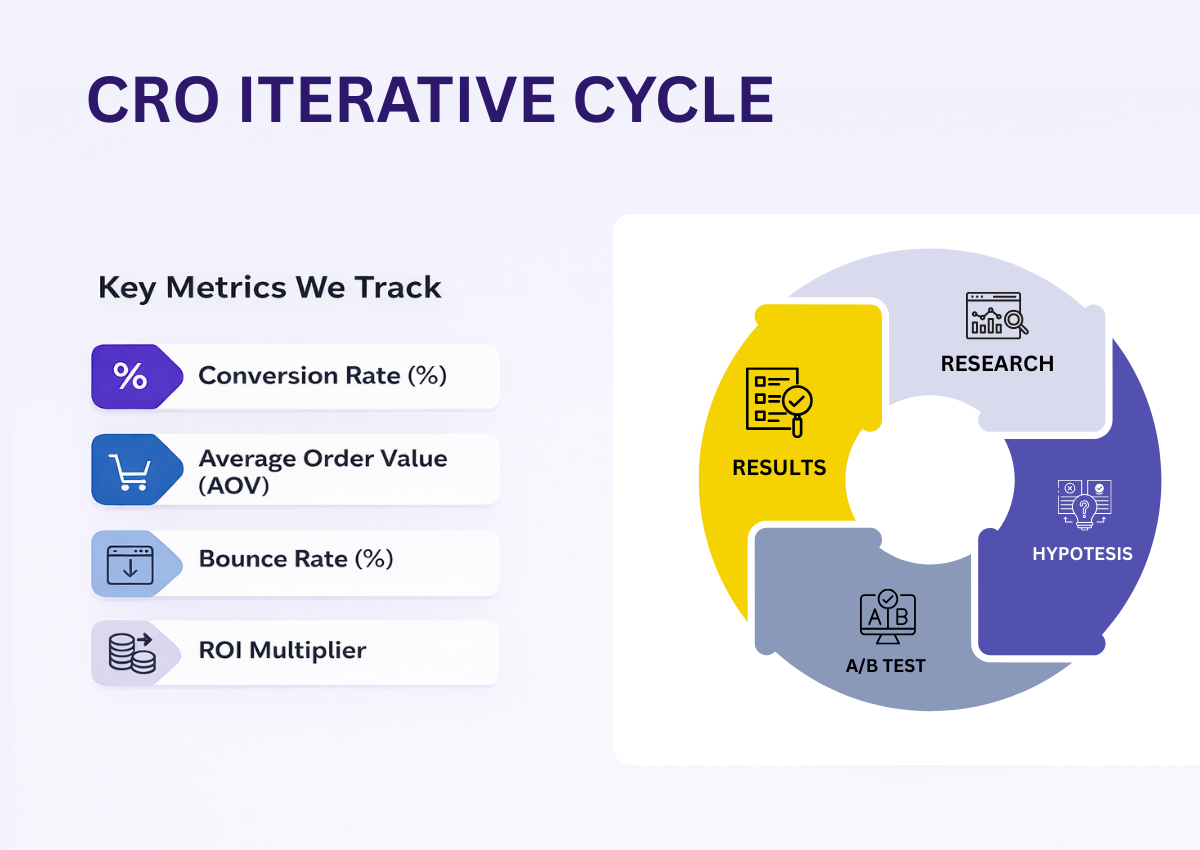
Every test should start with a data-backed hypothesis. This isn’t just a fancy way of saying “educated guess.” A proper hypothesis identifies what you’re changing, why you think it will work, and what specific metric will improve. For example: “Reducing form fields from 12 to 5 will increase form completions by at least 20% because users are abandoning due to perceived effort.”
Measuring success means tracking the metrics that actually matter to your business. Flos USA didn’t just increase their conversion rate—they calculated that their optimization efforts delivered an 18X return on investment. That’s the kind of concrete number that gets executive buy-in for ongoing CRO programs.
The beauty of this approach is that improvements compound over time. You don’t need massive traffic increases to grow revenue. Small, consistent optimizations add up to substantial gains.
Essential Tools and Technologies for Effective CRO
You can’t run a successful CRO program without the right tools. Think of them as the instruments in a diagnostic toolkit—each serves a specific purpose in understanding and improving your website’s performance.
Analytics platforms form the foundation. They track how visitors find your site, which pages they visit, where they drop off, and which paths lead to conversions. This bird’s-eye view helps identify optimization opportunities at a macro level.
A/B testing software lets you run controlled experiments with statistical rigor. These tools split traffic between different versions of your page and tell you which one wins with confidence. They handle the complex math so you can focus on creating better experiences.
User feedback tools capture the “why” behind the numbers. Surveys, polls, and feedback widgets let real customers tell you what’s confusing, what’s missing, or what convinced them to buy. This voice-of-customer insight often reveals problems you’d never spot in analytics alone.
Heatmap and session recording tools show you exactly what users do on your pages. Where do they click? How far do they scroll? Which elements do they ignore? These visual analytics tools make patterns obvious that would otherwise stay hidden in data tables.
Project management software keeps your optimization program organized. With multiple tests running simultaneously, you need a system to track hypotheses, document results, and ensure learnings get implemented. Structure prevents chaos and helps teams collaborate effectively.
The key is using these tools together, not in isolation. Analytics might show high bounce rates on your pricing page. Heatmaps reveal that nobody scrolls past the fold. Session recordings show confusion about which plan to choose. User feedback confirms that pricing isn’t clear. Now you have a complete picture and a clear direction for optimization.
Building a Sustainable Culture of Optimization
One-off CRO projects are like crash diets—they might deliver quick results, but they don’t create lasting change. The companies achieving sustained growth treat optimization as an ongoing practice, not a one-time initiative.
Organizational buy-in starts at the top. When leadership understands that CRO isn’t an expense but an investment with measurable ROI, resources flow naturally. RunScape implemented a structured CRO program with executive support and saw a 10% increase in purchases. That kind of result makes continued investment easy to justify.
But buy-in can’t stop at the executive level. Successful optimization requires collaboration between marketing, design, development, and sales teams. Everyone needs to understand that the goal isn’t to prove who’s right—it’s to let data guide decisions. When a test fails, that’s not a defeat. It’s valuable learning that prevents wasting resources on the wrong approach.
Creating a structured program means establishing a clear methodology and sticking to it. At SiteTuners, we follow a systematic process: analyze user behavior, identify barriers, form hypotheses, design tests, measure results, implement winners, and repeat. This cycle never stops because user behavior and market conditions constantly evolve.
Iterative testing is the secret to long-term success. Each test builds on previous learnings. Even “failed” tests provide insights that inform better hypotheses. As we’ve seen across countless CRO case studies, the companies that commit to continuous experimentation eventually pull ahead of competitors who optimize sporadically.
Customer insights should drive every decision. One of our Real Estate SaaS clients loved the customer interviews we conducted because they revealed motivations and objections that weren’t obvious from analytics. Understanding the psychology behind user behavior—what drives them, what worries them, what convinces them—gives you leverage that competitors miss.
The payoff for building this culture is long-term growth that doesn’t depend on constantly increasing ad spend. When your website converts better, every marketing dollar works harder. Traffic you’re already getting becomes more valuable. And as you continue optimizing, those gains compound year after year.
This is why companies that accept CRO as a core competency, rather than a side project, consistently outperform their markets. They’ve built a system that continuously improves customer experience while driving measurable business results.
Frequently Asked Questions about Conversion Rate Optimization
After walking through all these CRO case studies and success stories, you probably have some questions bouncing around in your head. Let’s address the ones we hear most often from businesses just like yours.
What is a good conversion rate?
Here’s the honest truth: asking “what’s a good conversion rate?” is a bit like asking “how long is a piece of string?” The answer always starts with “it depends.”
Your industry, business model, traffic source, and even what you’re asking visitors to do all dramatically affect what counts as “good.” The median conversion rate across all industries sits at 6.6%, but that broad average doesn’t tell the whole story.
For e-commerce landing pages, email traffic converts 5-6x better than paid traffic—same page, different source, completely different results. Entertainment landing pages typically see conversion rates around 12.3%, while SaaS companies often work with a median of 3.0%. The home improvement industry averages 3-5%, though dedicated optimization can push this to 35% conversion rates or higher.
Here’s what really matters: a 2% conversion rate for a high-value B2B software demo might be phenomenal, while 2% for a simple newsletter signup could signal serious problems. The context changes everything.
Instead of chasing some mythical “good” number, focus on beating your current performance. A 10% improvement on whatever conversion rate you have right now can transform your revenue. That’s where the real magic happens—in the steady climb upward, test by test.
How long does it take to see results from CRO?
We wish we could promise overnight results, but CRO is more marathon than sprint. That said, you won’t be waiting forever either.
Most businesses start seeing initial results within a few weeks to a few months. The timeline depends heavily on your traffic volume—websites with thousands of daily visitors can validate tests much faster than those with hundreds. More data means quicker answers.
Individual A/B tests typically run for 2-4 weeks minimum. This accounts for weekly traffic patterns and ensures you’re seeing real patterns, not just random fluctuations. We’re looking for statistical significance—proof that the changes actually work, not just lucky timing.
Some optimizations deliver what we call “quick wins.” Fix a broken form or clarify a confusing call-to-action, and you might see improvements within days. One client, Swiss Outpost, saw sales climb 50% nine months into their CRO program—a testament to how results compound over time.
The key insight? CRO isn’t a one-and-done project. Each test teaches us something new, which informs the next test, which builds momentum. Going, a SaaS company, achieved a 104% month-over-month increase in premium trial starts by simply setting up their first proper A/B test. The iterative process keeps delivering returns long after that first win.
Can CRO hurt my SEO?
This worry comes up constantly, and we totally understand why. You’ve worked hard on your search rankings—the last thing you want is to accidentally tank them while trying to improve conversions.
The good news? When done correctly, CRO actually strengthens your SEO. These two disciplines aren’t competitors; they’re teammates working toward the same goal: happy, engaged users.
Both CRO and modern SEO obsess over user experience. A website that’s easy to steer, loads quickly, and delivers relevant information keeps visitors engaged. Google notices this and rewards it. When our CRO work reduces bounce rates, increases time on page, and gets visitors clicking through to more content, search engines interpret these as positive signals that your site deserves higher rankings.
Many CRO improvements directly benefit SEO. Faster load times—a common CRO optimization—happen to be a key ranking factor. Better content clarity helps both conversions and keyword relevance. Improved mobile experiences boost rankings while capturing more mobile conversions.
As for A/B testing, Google has explicitly stated it’s perfectly fine when implemented properly. We ensure search engine bots can crawl all variations and that tests don’t create duplicate content issues or slow down your site. Following best practices keeps both your conversions and rankings climbing together.
Think of it this way: a website optimized for human visitors is almost always optimized for search engines too. They both want the same thing—a great user experience that delivers value.
Conclusion: Start Your Own CRO Success Story
We’ve explored an impressive collection of CRO case studies together—from e-commerce businesses that tripled their conversion rates to SaaS companies that generated thousands of new leads through simple homepage tweaks. The evidence is overwhelming: when you apply data-driven optimization to your website, remarkable things happen.
But here’s what matters most: these aren’t just inspiring stories. They’re proof that you don’t need a massive redesign or unlimited budget to see significant results. Sometimes a 277% increase comes from optimizing a few landing pages. Sometimes a 5x lift happens because you finally addressed that one friction point in your sign-up flow.
The common thread running through every successful CRO case study we’ve examined is a methodical, user-focused approach. The winning companies didn’t rely on gut instinct or follow the latest design trends blindly. They analyzed real user behavior, formed data-backed hypotheses, tested their ideas rigorously, and let the results guide their decisions. They understood that optimization isn’t a destination—it’s a continuous journey of learning and improvement.
Your website is either making you money or costing you opportunities. Every day you delay optimization is another day of leaving revenue on the table. The good news? You don’t have to figure this out alone.
At SiteTuners, we’ve been helping businesses identify and fix website conversion barriers since 2002. We’ve worked with over 2,100 clients across industries, and we’ve seen how the right optimization strategy transforms performance. Our team knows which tests to prioritize, how to interpret user behavior data, and how to build a sustainable optimization program that delivers compound results over time.
The real question isn’t whether CRO works—these case studies prove it does. The question is: when will you start writing your own success story?
Your competitors are already optimizing. Your potential customers are already making decisions about whether to buy from you based on their website experience. The time to act is now.
Start improving your conversion rates today and let’s create the next great CRO case study together—yours.