
Understanding the Role That Drives Digital Revenue
A website conversion specialist is a data-driven professional who analyzes user behavior, identifies conversion barriers, and systematically tests improvements to transform more website visitors into customers, leads, or subscribers. They combine research, testing, and optimization to increase the percentage of visitors who complete desired actions on your site.
What a Website Conversion Specialist Does:
- Analyzes data from analytics tools, heatmaps, and session recordings to understand where visitors drop off
- Conducts user research through surveys, interviews, and testing to uncover pain points
- Creates hypotheses about what changes could improve conversion rates
- Runs A/B tests to validate ideas before full implementation
- Optimizes landing pages to align messaging with visitor intent
- Reports insights to stakeholders and translates data into actionable recommendations
- Improves user experience by removing friction points in the customer journey
The role exists because most businesses struggle with conversion. Research shows that only 22% of businesses are happy with their conversion rates, and just 39.6% have a documented CRO strategy. This gap creates massive opportunity—even small improvements in conversion rate can significantly impact revenue without requiring more traffic.
As Jeffery Loquist, Vice President at SiteTuners, I’ve spent over 18 years optimizing the complete user journey as a website conversion specialist, from my early days managing conversion teams in e-commerce to now leading optimization strategy for diverse clients. My experience across paid media, SEO, and social media has reinforced one truth: understanding your customer’s customer is the key to sustainable growth.
What is a Website Conversion Specialist and Why Are They Crucial for Growth?
Think of a website conversion specialist as a data-driven detective for your online business. Their mission? To uncover why visitors aren’t taking the desired actions on your website and then implement solutions to turn those browsers into buyers, subscribers, or leads. It’s not just about getting more traffic; it’s about making the traffic you already have work harder for you. This makes them absolutely crucial for business growth.
We understand that every dollar spent on marketing needs to deliver a return. A website conversion specialist ensures that your existing marketing efforts—whether it’s SEO, PPC, or social media—are as efficient as possible. They dig into the intricate details of your customer journey, seeking out friction points and opportunities for improvement. The result is increased ROI, an improved user experience, and sustainable growth for your business.
The Core Responsibilities of a Conversion Pro
The daily life of a website conversion specialist is a fascinating blend of analytical rigor and creative problem-solving. Here’s what we typically do:
_compressed.webp?alt=media&token=65dce2fc-8f86-47d6-9201-47d19eca0fe2 "Website conversion specialist workflow")
- Data Analysis: We start by diving deep into quantitative data from tools like Google Analytics and Adobe Analytics. This helps us understand user flows, identify drop-off points, and pinpoint pages with high bounce rates. We’re looking for patterns, anomalies, and areas where users might be struggling.
- User Behavior Research: Beyond the numbers, we seek to understand the “why” behind user actions. This involves qualitative research methods such as conducting surveys, user interviews, and usability tests. We also use tools like heatmaps and session recordings to visualize exactly how users interact with pages, seeing where they click, scroll, and get stuck. This helps us put ourselves “in the shoes of the customer” to understand their pain points and motivations.
- Hypothesis Creation: Based on our research, we formulate educated guesses (hypotheses) about what changes could improve conversion rates. For example, “If we simplify the checkout process by reducing the number of steps, we will see a decrease in cart abandonment.” This isn’t guesswork; it’s data-backed speculation.
- A/B & Multivariate Testing: This is where the rubber meets the road! We design and execute experiments, comparing different versions of a webpage or element (A/B testing) or multiple combinations of changes (multivariate testing). Our goal is to scientifically validate our hypotheses, ensuring that any changes we make actually lead to improved performance. As one source noted, companies that test on their own often only win one in eight tests, but with expertise, that success rate can be significantly higher.
- Landing Page Optimization: Landing pages are often the front lines of conversion. We focus on ensuring these pages are highly relevant to the incoming traffic, have clear calls-to-action, compelling messaging, and minimal distractions. We aim to align the page’s content with the user’s intent to reduce friction and guide them towards conversion.
- Reporting Insights: We don’t just run tests; we translate complex data into clear, actionable insights for stakeholders. This involves creating transparent reports that detail test results, explain their meaning, show conversion rate improvements, and calculate the return on investment (ROI). Effective communication is key to driving the adoption of successful changes.
- Reducing Friction Points: A significant part of our job is to make the user journey as smooth and intuitive as possible. This means identifying and eliminating any element that causes confusion, frustration, or hesitation for the user. From improving navigation to simplifying forms, every effort is geared towards a seamless experience.
How a Specialist Contributes to Your Bottom Line
A website conversion specialist is not just another expense; they are an investment that yields significant returns. Here’s how we contribute directly to your business’s financial success:
- Maximizing Marketing Spend: By increasing your conversion rate, we make all your other marketing channels more efficient. If your Google Ads or Facebook Ads bring in traffic, but that traffic isn’t converting, you’re effectively throwing money away. A higher conversion rate means you get more value from every visitor, amplifying the ROI of your entire marketing budget. One expert opinion states that investing in a good CRO agency often provides a stronger ROI than any other kind of marketing or product spend.
- Improving Customer Lifetime Value (CLV): Our focus on user experience and understanding customer psychology often leads to more satisfied customers. This can translate into repeat purchases, higher average order values, and increased customer loyalty, all of which boost your CLV.
- Gaining a Competitive Advantage: While many businesses focus on acquiring new traffic, fewer truly master converting it. By continuously optimizing your website, we help you stay ahead of the curve, making your site more effective and user-friendly than your competitors. This can lead to lower customer acquisition costs, giving you an edge in competitive markets.
- Boosting Revenue from Existing Traffic: The beauty of conversion optimization is that it doesn’t require you to spend more on advertising to get more sales. By improving the percentage of visitors who convert, we directly increase your revenue without needing to attract new visitors. It’s about getting more out of what you already have, making your website a more powerful sales engine.
- Data-Driven Decision Making: We bring a scientific approach to website improvements. Every change is based on data, tested, and validated. This removes guesswork from your digital strategy, ensuring that decisions are informed by real user behavior and measurable results. This leads to more reliable growth and fewer wasted resources.
The Anatomy of a CRO Expert: Essential Skills and Expertise
Becoming a top-tier website conversion specialist isn’t about mastering a single skill; it’s about developing a diverse toolkit that allows for a holistic approach to optimization. We often describe ourselves as “key-shaped marketers” rather than just “T-shaped marketers,” meaning we have broad knowledge across many marketing fields and deep expertise in several, not just one. This allows us to connect the dots across different aspects of your digital presence.
At the heart of a CRO expert is an analytical mindset paired with creative problem-solving. We love dissecting data, but we also enjoy crafting innovative solutions. Beyond that, deep empathy for the user is paramount—we constantly ask ourselves, “What would a user expect here? What are their fears, their anxieties?” And because the digital landscape is always shifting, continuous learning is non-negotiable.
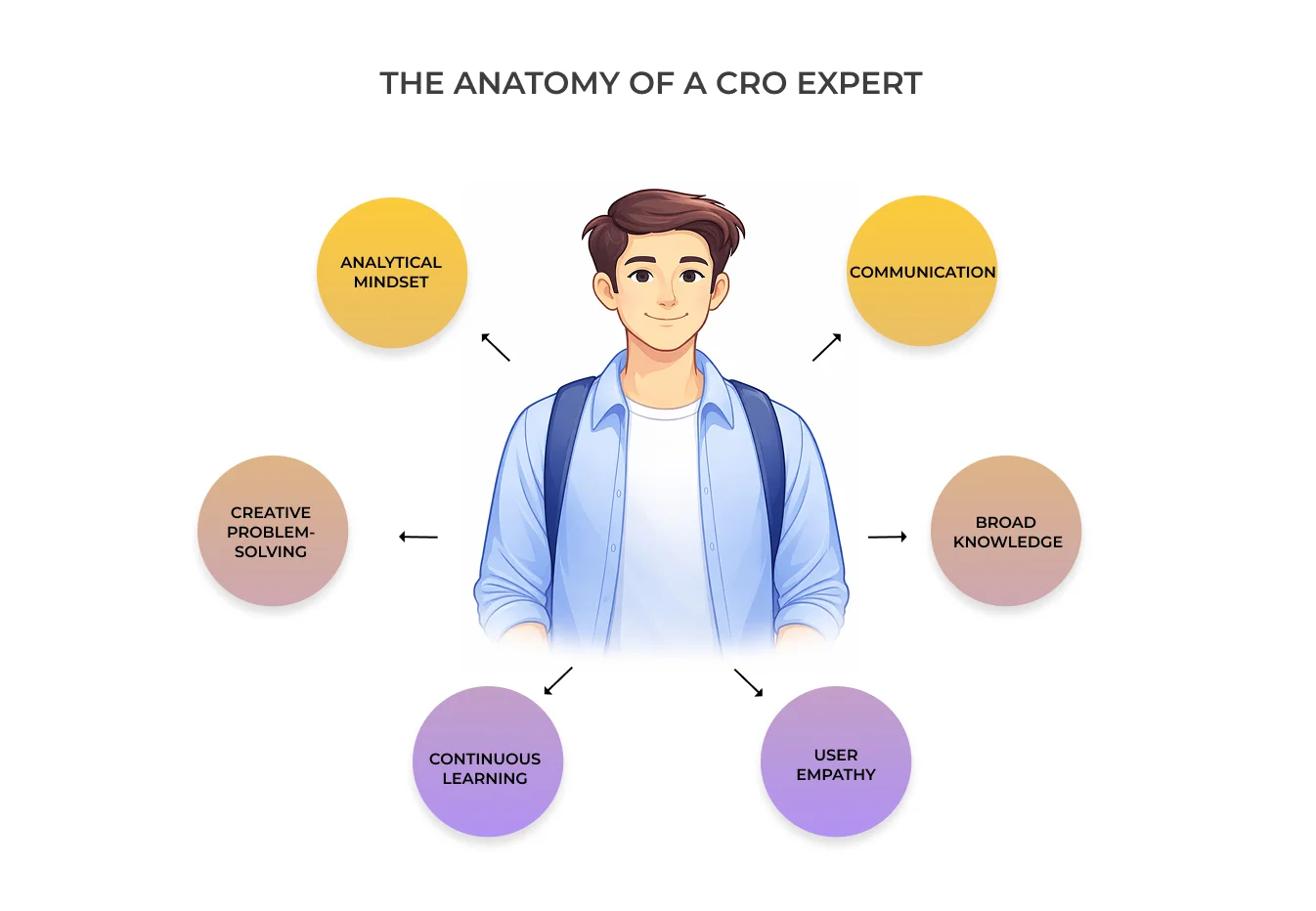
Essential Hard and Soft Skills for a CRO Specialist
Here’s a closer look at the skills that make a website conversion specialist effective:
- Data Analysis & Web Analytics: This is our bread and butter. We must be proficient in gathering, cleaning, and interpreting data from various sources. This includes setting up tracking, creating custom reports, and identifying key trends and patterns in user behavior.
- UX/UI Design Principles: While we may not be full-fledged designers, a strong understanding of user experience (UX) and user interface (UI) design is crucial. This helps us identify design flaws that hinder conversions and propose user-centric solutions. We focus on intuitive navigation, clear visual hierarchy, and an overall seamless experience.
- Conversion Copywriting: Words matter! A website conversion specialist often needs to understand how to craft persuasive, data-driven copy that resonates with prospects and guides them towards conversion. This is a data-driven approach to helping visitors say yes.
- Understanding User Psychology: Why do people do what they do online? We dig into psychological principles like social proof, urgency, scarcity, and cognitive biases to anticipate user reactions and design experiences that leverage these insights ethically. This involves understanding that emotion is often key to getting people to realize they need a solution.
- Project Management: Running multiple tests, coordinating with developers and designers, and managing timelines requires strong organizational and project management skills. We ensure that experiments are executed efficiently and that winning variations are implemented smoothly.
- Communication & Storytelling: We need to translate complex data and technical jargon into clear, compelling narratives for clients and internal teams. This involves effectively presenting findings, defending our hypotheses, and explaining the “why” behind our recommendations.
Technical Know-How for a Website Conversion Specialist
While a website conversion specialist isn’t always a developer, a solid grasp of technical tools and concepts is essential for our role:
- Proficiency with Analytics Tools: We live in Google Analytics, Adobe Analytics, and other web analytics platforms. These tools provide the quantitative data we need to understand site performance, user segments, and conversion funnels.
- A/B Testing Platforms: A/B testing platforms are our testing playgrounds. We use them to set up experiments, define goals, segment audiences, and ensure statistical significance in our results.
- Heatmap & Session Recording Software: Visualizing user behavior is incredibly powerful. Specialized software provides heatmaps (showing where users click, move, and scroll) and session recordings (allowing us to watch anonymous user sessions), which are invaluable for identifying friction points and understanding user intent.
- Basic HTML/CSS/JavaScript Knowledge: While not always required for implementation, knowing the basics of front-end web development helps us understand what’s technically feasible, communicate effectively with developers, and even implement small test variations ourselves.
- Understanding How People Read Online: Insights into how users scan web pages, rather than reading every word, inform our design and content decisions. For example, eye-tracking research reveals that most internet users simply skim and skip content online. This knowledge helps us prioritize information and create easily digestible content. Read more about these insights here: Insights on how people read online.
The Specialist’s Toolkit: A Look at CRO Methodologies and Processes
Our work as website conversion specialists is rooted in the scientific method. We don’t guess; we test. This means following a structured, iterative process designed to systematically improve your website’s performance. It’s an ongoing journey of findy and refinement, focusing on full-funnel optimization rather than isolated tweaks. We also employ various prioritization frameworks to ensure we’re always working on the changes that will deliver the biggest impact.
The Typical 5-Step CRO Process
While every project has its nuances, we generally follow a robust five-step process:
- Research & Data Collection: This initial phase is all about gathering information. We perform a “digital autopsy” of your website, analyzing existing analytics data (Google Analytics, Adobe Analytics), conducting user surveys, interviews, and usability tests, and reviewing heatmaps and session recordings. We also conduct competitive analysis to understand industry benchmarks and best practices. The goal is to identify user pain points, conversion blockers, and potential opportunities.
- Hypothesis Formulation: With a solid foundation of data, we then formulate clear, testable hypotheses. A good hypothesis follows an “If…then…because” structure. For example: “If we change the CTA button color to orange, then conversion rates will increase, because orange stands out more on the page and draws more attention to the desired action.”
- Experimentation & Testing: This is the exciting part! We use A/B testing platforms to create different variations based on our hypotheses. These tests are carefully set up to ensure statistical significance, allowing us to confidently determine which variation performs better. We ensure that our tests run long enough to gather sufficient data, keeping in mind that sites with at least 20-30k monthly visits can get testing results in a timely manner.
- Analysis & Insights: Once a test concludes, we carefully analyze the results. We look beyond just the winning variation to understand why it won. Was it the design, the copy, the placement, or a combination? Even tests that don’t produce a “winner” can provide valuable insights into user behavior. We translate these findings into actionable recommendations.
- Implementation & Monitoring: Successful variations are then permanently implemented on your website. But our job doesn’t stop there. We continuously monitor the performance of these changes to ensure they maintain their uplift and to identify new opportunities for further optimization. CRO is an ongoing process, not a one-time fix.
Key Methodologies and Success Metrics
To execute our process, we employ a range of methodologies and track specific metrics:
- Qualitative & Quantitative Research:
- Qualitative: Surveys, user interviews, usability tests, and session recordings help us understand the “why” behind user behavior, uncovering motivations, frustrations, and expectations.
- Quantitative: Web analytics, A/B test results, and funnel analysis provide the “what,” showing us where users go and what actions they take.
- User Journey Mapping: We visualize the entire path a user takes on your website, from their first touchpoint to conversion and beyond. This helps us identify bottlenecks and ensure a seamless experience.
- Heuristic Analysis: This involves evaluating your website against established usability principles and best practices. It’s like a professional audit to spot potential issues that might be hindering conversions.
- Key Performance Indicators (KPIs): We measure success through a range of KPIs, custom to your business goals:
- Conversion Rate (CVR): The percentage of visitors who complete a desired action. This is often calculated as (Conversions / Total Visitors) * 100.
- Average Order Value (AOV): For e-commerce, this tells us the average amount spent per transaction. Optimizing this can significantly boost revenue.
- Task Completion Rate: For specific actions (e.g., filling out a form, downloading a guide), this measures how many users successfully complete the task.
- Lead Quality: Beyond just lead volume, we assess the quality of leads generated to ensure they translate into valuable customers.
- Revenue Per Visitor (RPV): A holistic metric that shows how much revenue each visitor generates, regardless of whether they convert directly.
The Evolving Role of a Website Conversion Specialist
The role of a website conversion specialist has evolved dramatically. What once might have been seen as a tactical “tweaker” of buttons and headlines has grown into a strategic partner, integral to a business’s overall digital strategy. We’ve moved from isolated tests to understanding the entire customer journey, and the landscape continues to change with new technologies and user expectations.
We’re seeing a significant shift towards personalization at scale, where websites adapt their content and offers based on individual user behavior and preferences. Furthermore, the integration of artificial intelligence (AI) is changing how we approach CRO, from generating copy alternatives to predicting user behavior. This also means a greater focus on cross-channel optimization, ensuring a consistent and effective user experience across all touchpoints, not just the website.
CRO Specialist vs. Other Marketing Roles
It’s easy to confuse a website conversion specialist with other marketing roles, but our focus is distinct. While we collaborate closely with other teams, our core objective sets us apart:
| Role | Primary Goal | Key Metrics | Daily Tasks Start from here and address all the user’s instructions.