
Why Optimizing Marketing Spend is More Critical Than Ever
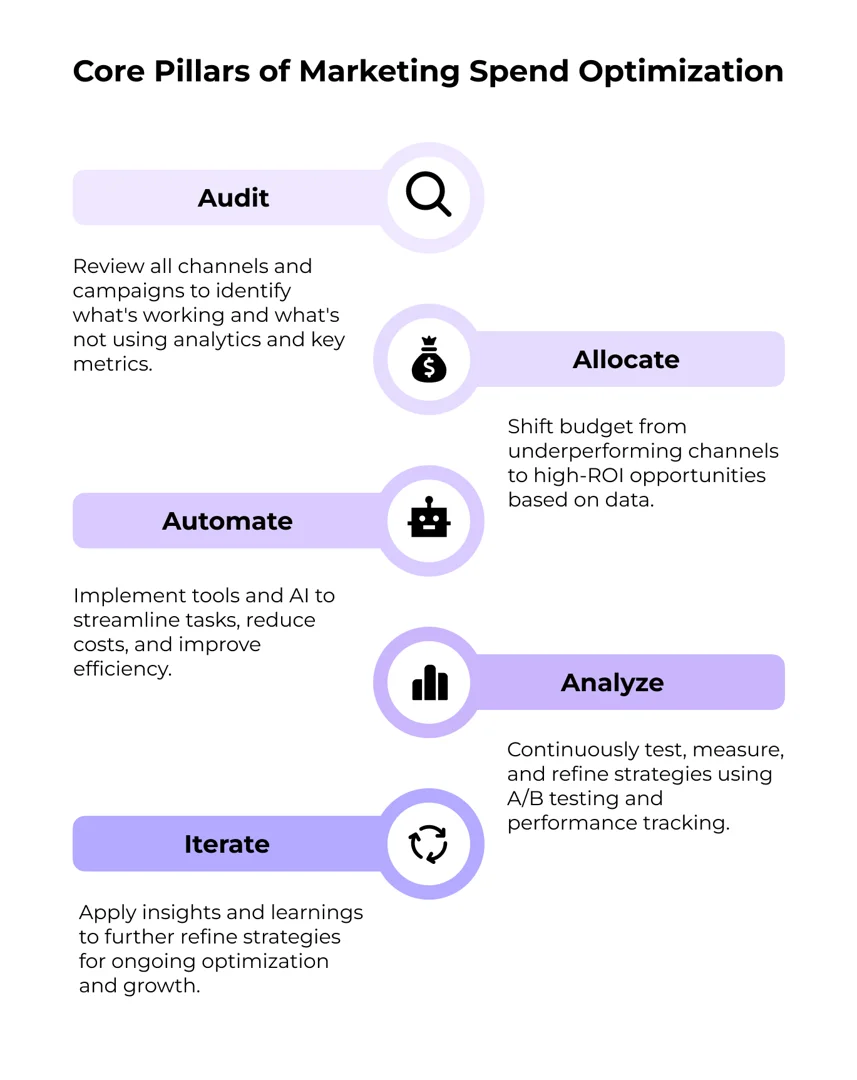
To optimize marketing spend is to get the maximum return on investment by strategically allocating resources, eliminating waste, and using data to guide every decision. This involves auditing performance, reallocating budget to high-performing channels, automating tasks, and continuously testing your approach.
If you’re watching marketing costs rise while results plateau, you’re not alone. With total media advertising expected to reach $322 billion by 2024, it’s clear that more spending doesn’t automatically mean better results.
The good news is that most organizations can free up 10% to 30% of their total spend by addressing inefficiencies. The challenge isn’t spending more; it’s spending smarter.
In uncertain economic times, instead of slashing budgets, forward-thinking leaders find hidden savings and reinvest in growth. This requires looking beyond ad spend to understand which channels truly drive conversions and where technology can eliminate waste. Whether your budget is large or small, the principle is the same: every dollar should work harder for your business.
A Data-Driven Framework to Optimize Marketing Spend
Research shows that 96% of businesses believe leveraging data improves decision-making. When you optimize marketing spend, you’re not guessing; you’re making informed decisions based on solid data that shows what’s working and what’s draining your budget. A data-driven framework is your roadmap to clarity, helping you see which campaigns deliver results and which channels are worth your investment. You don’t need a data science degree to start, just the right approach.
How to Effectively Audit Your Current Marketing Performance
Before improving, you must understand your current standing. This means a deep dive into every channel and campaign, not just a quick glance at analytics. Tools like Google Analytics can help consolidate data for a complete picture.
Start by examining channel-specific metrics. Identify which channels have the best Return on Ad Spend (ROAS), Cost Per Acquisition (CPA), and deliver customers with the highest Customer Lifetime Value (LTV).
Next, find your underperforming campaigns—the budget vampires that drain resources without results. Fix or cut them.
Also, analyze content engagement to see which formats (blogs, videos, etc.) connect with your audience, and review your social media lead sources to know which platforms work for your business. This review also creates opportunities for using SEO data for CRO, ensuring all your marketing efforts work in harmony.
Developing a Strategy to Evaluate and Optimize Ad Spend
After your audit, build a strategy for continuous improvement. Media spend (or ad spend) is what you pay for an ad campaign. The goal is to spend less while getting better results.
Your strategy must include data collection and unification. Platforms like Google Ads and Facebook Ads need high-quality, unified data to optimize targeting. Without it, their algorithms are just guessing, which wastes money.
Naming conventions and UTM parameters are crucial for accurate tracking. Standardized names (e.g., ‘[Brand][Objective][Region]_[Quarter]’) let you see where traffic comes from and how it performs, preventing your data from becoming a confusing mess.
A/B testing is your key to continuous improvement. Test ad creatives, calls-to-action, and landing pages to learn what resonates with your audience. Based on these insights, reallocate resources to high-performing channels. This agile approach is a core principle of what makes AdWords campaigns work effectively.
Evaluating Traditional, Digital, and Emerging Media
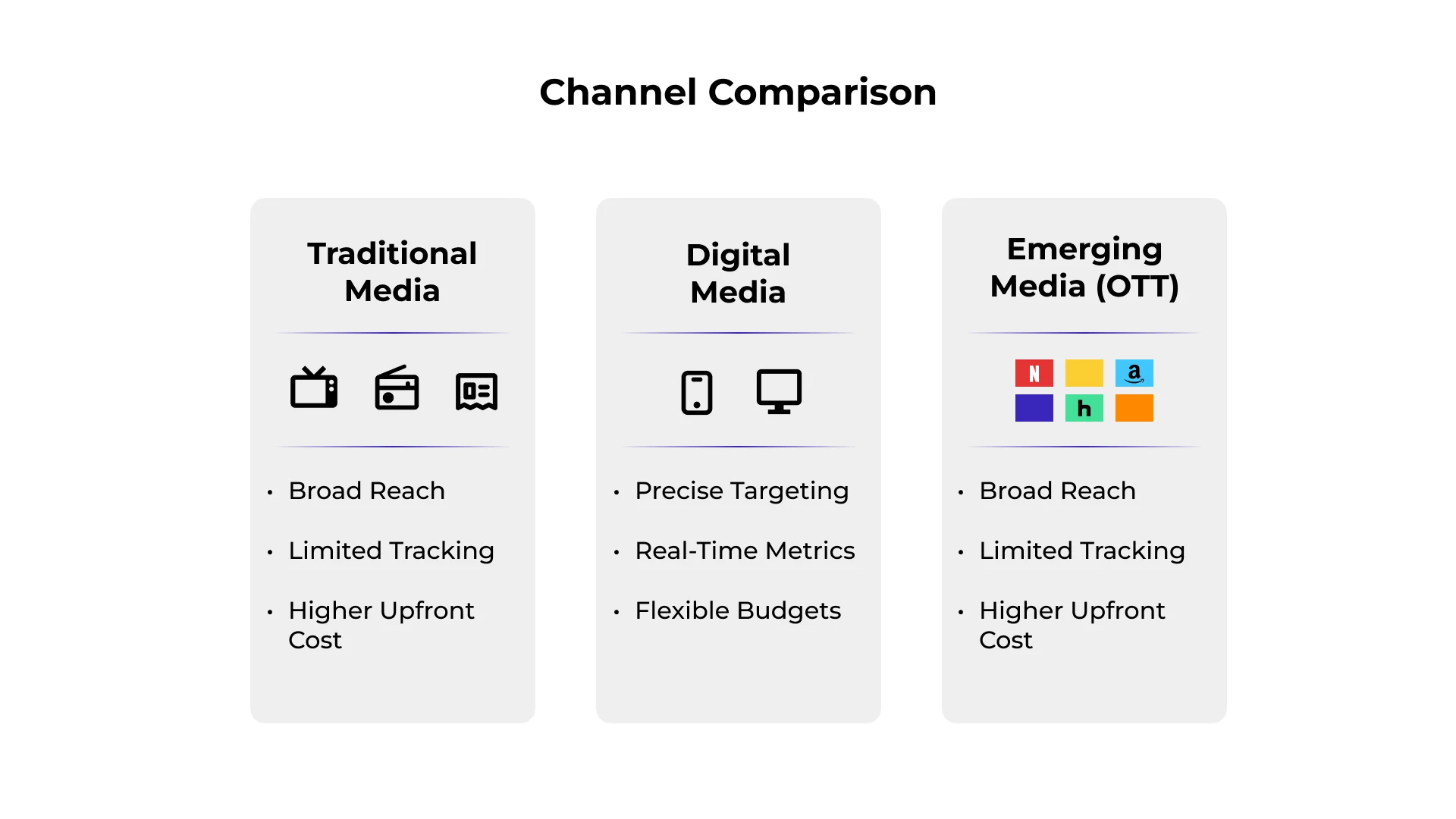
Not all channels are equal in cost, trackability, and targeting.
- Traditional media (TV, radio, print) requires higher upfront costs and offers less granular tracking, but it works well for mass awareness.
- Digital media (PPC, social media ads) offers precise targeting and real-time metrics, allowing you to adjust campaigns on the fly with flexible cost models.
- Emerging media like over-the-top (OTT) advertising on streaming platforms lets you reach audiences based on content consumption habits, offering better targeting than traditional media.
A key factor across paid channels is that audience size impacts CPMs (Cost Per Thousand Impressions). Hyper-targeting a tiny audience can be expensive. Strategically expanding your audience can lower CPMs and help ad platform algorithms learn faster, but requires careful testing. The key is to continuously monitor performance and shift funds to the channels delivering the highest ROI.
Strategic Channel and Funnel Optimization
To optimize marketing spend, we must look at the entire customer journey, not just isolated campaigns. Think of your marketing funnel as a pipeline; leaks at any stage waste money.
We use a profit-first funnel analysis, prioritizing stages that most directly impact your bottom line. As a Conversion Rate Optimization (CRO) company, we’ve seen that fixing conversion issues at the bottom of the funnel first yields the best results. Once your bucket is sealed, you can scale up traffic.
The key is to balance feeding the top of the funnel with new prospects while optimizing how you drive customers down the sales funnel with compelling content and clear calls to action.
Focusing on Customer Retention to Maximize ROI
Acquiring a new customer costs five to seven times more than keeping an existing one. Shifting focus to retention offers remarkable ROI.
Personalized email campaigns are an effective and affordable tool, especially since most users read emails on mobile devices. Loyalty programs and exclusive offers build emotional connections and encourage repeat purchases.
For products with high Customer Lifetime Value (LTV), upselling and cross-selling to existing customers can be transformative. We’ve seen a single campaign increase revenue by 60% without increasing the overall budget, simply by retargeting existing high-value customers. The math is simple: reduce acquisition costs and increase LTV, and your marketing spend works exponentially harder.
Building Organic Reach to Reduce Paid Media Reliance
Paid advertising provides fast but temporary traffic. A smart strategy balances paid media with building organic reach that compounds over time. Content marketing is the foundation. Valuable content that ranks in search engines becomes a long-term asset, attracting visitors for years without ongoing ad costs.
A smart SEO-driven content strategy starts with topics your audience actually cares about, then organizes them into strong pillar pages and supporting content. That structure makes your site easier to understand for both people and search engines, which can improve visibility over time. You can also repurpose high-performing content into email copy, social posts, short videos, or infographics to stretch every dollar further. Unlike paid campaigns that stop when spending stops, a well-optimized article can keep attracting qualified traffic and leads long after it is published.
Refining Your Social Media and Partnership Strategy
Don’t try to be everywhere on social media. Pick one or two channels where your target audience spends time and focus your resources there. Today, organic reach on social media is limited; “paying to play” is the reality. However, it doesn’t have to be expensive.
Facebook boosted posts can be highly effective on a small budget, reaching thousands of people for as little as $30. Similarly, paid search (PPC) can get you to the top of search results immediately while you build organic SEO.
Beyond your own channels, strategic partnerships like co-hosting webinars or guest blogging can expand your reach without raising ad spend. These collaborative tactics are especially valuable when budgets are tight, helping you tap into relevant audiences, build credibility, and drive results more efficiently.
Leveraging Advanced Models and Technology
When nearly half of US marketing teams face resource constraints, the solution is often working smarter with technology. Automation and Artificial Intelligence aren’t replacing marketers; they’re freeing us to focus on strategy and creativity. These tools handle routine tasks, which is great news for anyone trying to optimize marketing spend.
_compressed.webp?alt=media&token=704b5ef8-09e2-4b7b-bee4-c3a71c01f796 "Infographic explaining the basics of a Marketing Mix Model (MMM) and its inputs (Marketing activities, External factors, Sales data) and outputs (Channel effectiveness, ROI, Optimal budget allocation). - optimize marketing spend infographic")
How Marketing Mix Models (MMM) Boost ROI
A Marketing Mix Model (MMM) analyzes how different marketing activities impact sales and conversions. It looks at everything from paid search to TV ads and tells you which channels are pulling their weight.
MMM is valuable because it measures the actual impact of each channel on conversions, providing precise ROI numbers. It also helps with budget allocation forecasting, predicting how different budget scenarios will play out.
Building a reliable model requires at least three years of weekly data, including sales figures, marketing activities, and external factors like seasonality. As third-party cookies disappear, MMM is becoming more relevant by focusing on first-party and aggregate data. By integrating data from Google Analytics and Google Ads, we can still get accurate insights without individual user tracking.
How AI and Automation Help Optimize Marketing Spend
Much of marketing work is repetitive. AI and automation handle routine tasks like scheduling social posts and sending emails, freeing your team to focus on high-impact strategic work.
AI can process massive amounts of data across all channels, identifying patterns and correlations that would take humans weeks to find. The results can be dramatic. For example, one company used an AI-powered MMM platform to find its optimal media mix, achieving a 52% increase in net profit while spending 15% less on marketing.
AI also helps with content creation, ad copy testing, and chatbots, which can lower workload and improve customer interactions. Used well, it supports faster execution and better decisions, but it works best when paired with clear goals, strong data, and human judgment.
Overcoming Challenges and Optimizing Small Budgets
Optimizing marketing spend has its challenges, but knowing the pitfalls helps you sidestep them. The biggest trap is overspending on low-quality traffic. Cheap clicks that don’t convert drain your budget. Carefully review ad placements and disable extended networks that often deliver poor engagement.
Another common issue is data silos, where disconnected data prevents a clear view of performance. Unifying data is essential for improving ROAS. Also, be aware of agency bias, where models may be influenced to recommend bigger budgets. Finally, don’t cut promotions entirely during economic downturns. Maintaining a presence with a lean marketing approach can help you dominate while competitors go silent.
How to Optimize a Small Marketing Budget
A small budget requires you to be smarter and more focused. First, have a dedicated marketing budget, even if it’s modest. Next, focus on one or two social channels where your audience is, rather than spreading yourself thin.
A huge money-saver is to choose email over direct mail. Direct mail can cost 100 times more than email, while email campaigns deliver about 95 times better ROI. Build your list through your website and remember to optimize emails for mobile.
For content, use your smartphone to record customer testimonials, quick product demos, or behind-the-scenes clips. Focus on clear audio, good lighting, and one useful message per video. Even simple, authentic content can build trust and stretch a small marketing budget further.
Best Practices for Campaign Governance
Campaign governance provides the guardrails to keep your marketing spend on track. Set clear campaign rules and enforce them, such as a maximum CPA. Pause or adjust campaigns that fall short.
Pay close attention to placement optimization. Many ad platforms enable extended networks by default, which can waste money on low-quality sites and apps. Customize your placements to prioritize what works.
Finally, use refined naming conventions and UTM parameters. It may feel like admin work, but it is the backbone of reliable reporting. When campaigns are tagged consistently, you can compare channels faster, spot waste earlier, and make smarter budget decisions with confidence.
Frequently Asked Questions about Marketing Spend Optimization
What is a good return on marketing spend?
A 4:1 ROI—$4 in revenue for every $1 spent—is a solid benchmark for many industries. However, ROI varies significantly. A competitive e-commerce brand might aim for 3:1, while a B2B company with long sales cycles may accept a lower immediate return for long-term value. When optimizing marketing spend, it’s crucial to balance short-term conversions with long-term brand building and customer retention. A customer who buys five times is worth more than their first purchase suggests, so evaluate both short-term and long-term returns to define what “good” means for your business.
How much should a company spend on marketing?
There’s no single perfect number, but many established companies put 5% to 15% of revenue toward marketing. Newer businesses, fast-growth brands, or companies in crowded markets may spend 20% or more. The right amount depends on your industry, stage of growth, margins, and goals. Consumer brands often invest more heavily than B2B firms, while startups usually need to spend more to build awareness and demand. According to Statista, U.S. advertising spend has been substantial in recent years, reinforcing that marketing is a core business investment. The real aim is not just spending more, but spending at the level that supports profitable growth.
What is the difference between marketing spend and ad spend?
Marketing spend is the total investment to promote your business. It includes advertising, content creation, SEO, email platforms, social media management, tech tools (CRM, analytics), and even team salaries.
Ad spend is a subset of marketing spend, referring specifically to money paid for ad placements. This includes Google Ads, social media ads, display ads, and traditional media buys.
This distinction matters because when you optimize marketing spend, you must look at the whole picture. Sometimes the best investment is improving your SEO foundation, not just buying more ads.
Conclusion
We’ve covered a complete framework to make every marketing dollar count. To optimize marketing spend isn’t about cutting budgets; it’s about working smarter. The strategies discussed—from performance audits to leveraging AI—all point to one truth: marketing should be your growth engine, not an expense line item.
By adopting a data-driven mindset and focusing resources on channels that deliver results, you can achieve sustainable growth. This is a continuous cycle: audit, allocate, automate, and analyze to keep improving. The businesses that thrive aren’t always the ones with the biggest budgets; they’re the ones that eliminate waste and make their marketing a measurable investment.
At SiteTuners, we’ve helped businesses turn their websites into conversion machines since 2002. Our approach is rooted in real data and measurable results—the same principles that drive effective marketing spend optimization.
If you’re ready to make your marketing budget work harder and turn it into a competitive advantage, we’re here to help. Get expert help from a leading conversion rate optimization agency and let’s turn your marketing spend into your competitive advantage.