
Understanding Multivariate Testing Services and Methodologies
Multivariate testing services help businesses find the best combination of webpage elements — like headlines, images, and calls-to-action — to maximize conversions and revenue.
Here’s what you need to know at a glance:
| Question | Quick Answer |
|---|---|
| What is it? | Testing multiple page elements simultaneously to find the best-performing combination |
| Who needs it? | Businesses with high-traffic pages and stagnant conversion rates |
| How is it different from A/B testing? | A/B tests one element at a time; multivariate tests many elements and their interactions at once |
| What does it require? | Significant traffic volume and a clear hypothesis |
| Key benefit | Reveals how elements interact — insights A/B testing alone can’t provide |
If your website is getting traffic but not converting, the problem might not be one thing — it might be how your page elements work together. A weak headline paired with the wrong image and a vague CTA can quietly kill conversions, and a single A/B test won’t tell you which combination is dragging results down.
That’s exactly where multivariate testing becomes powerful.
Only about 12% of test ideas are proven winners. That means the ability to test multiple combinations quickly — and learn from every result, win or lose — is a serious competitive advantage. Businesses that build a systematic testing practice don’t just improve their pages; they build compounding knowledge about what their customers actually respond to.
I’m Jeffery Loquist, Vice President at SiteTuners, and with over 18 years of experience in digital marketing — including leading conversion, content, and traffic acquisition strategies — I’ve seen how multivariate testing services can turn underperforming pages into consistent revenue drivers. In this guide, I’ll walk you through everything you need to know to run smarter, higher-impact experiments.
_compressed.webp?alt=media&token=8f949c99-5a60-453c-9cee-1905d710685d "user-inserted")
When we talk about multivariate testing services, we are describing a sophisticated way to “read the room” of your digital audience. Unlike a simple A/B test, which might just ask, “Do users prefer a red button or a blue button?”, multivariate testing (MVT) asks, “How does the combination of this specific headline, this hero image, and this button color affect the user’s decision to buy?”
The core value of MVT lies in detecting interaction effects. Sometimes, a headline performs brilliantly on its own, but when paired with a specific image, the conversion rate unexpectedly drops. This is because page elements don’t exist in a vacuum; they work together to form a cohesive user experience. By utilizing website testing services, we can stop guessing which combinations work and start relying on parametric data.
Interestingly, the roots of MVT go back further than the internet. In the 1700s, a British surgeon conducted what is widely considered the first multivariate experiment to cure scurvy, testing combinations of citrus fruits, fresh air, and sleep. Today, we apply those same principles of experimental design to digital interfaces. While we often focus on marketing, these methodologies are also vital in technical fields, such as multivariate analysis for manufacturing, where multiple variables must be optimized simultaneously to ensure product quality.
How Multivariate Testing Services Differ from A/B Testing
The most common question we hear is: “Why not just run three A/B tests in a row?”
While A/B testing is excellent for A/B testing vs split testing comparisons and isolating the impact of a single major change, it fails to capture the “compound interest” of multiple small changes working together.
- A/B Testing: Isolates one variable. It’s a boxing match between Version A and Version B.
- Multivariate Testing: Evaluates the interaction between multiple variables. It’s more like a chemistry experiment where we want to find the perfect reaction between several ingredients.
MVT provides much more granular insights. It allows us to see the “conversion lift” generated by each individual element and how those elements influence one another. This holistic view is essential for high-traffic pages where even a 1% improvement in engagement can lead to a massive increase in ROI.
Full Factorial vs. Fractional Factorial Methods
In multivariate testing services, there are two primary ways to construct a test:
- Full Factorial: This method tests every possible combination of every variable. For example, if you have 3 different headlines and 3 different images, a full factorial test will create 9 unique versions (3×3=9) and distribute traffic equally among them. This is the “gold standard” for data accuracy but requires the most traffic.
- Fractional Factorial (The Taguchi Method): This is a more “traffic efficient” approach. Instead of testing every single combination, we test a specific subset of combinations and use statistical modeling to deduce how the other combinations would have performed.
Effective multivariate test construction requires choosing the right method based on your available traffic. While full factorial gives you the clearest picture, fractional factorial allows you to gain insights faster when you don’t have millions of visitors to spare.
When to Choose Multivariate Optimization Over Other Methods
Choosing the right testing method is about matching your strategy to your resources. We typically recommend multivariate testing services for high-traffic pages—think homepages, major landing pages, or checkout flows—where “speed to insight” is critical.
If you are just starting out, A/B testing basics might be more appropriate to validate big, bold ideas. However, once you have a functional layout and want to fine-tune the “persuasion architecture” of the page, MVT is the way to go.
It’s also worth noting that testing isn’t just for marketing; it’s a vital part of the development lifecycle. Many organizations utilize software testing services to ensure that structural changes don’t just “work” from a coding perspective, but also perform from a user experience perspective.
Ideal Elements for Multivariate Testing Services
Not every element on your page is worth testing. To get the best results, we focus on elements that have a high “psychological weight.” These include:
- Headlines and Sub-headlines: These are usually the first things a visitor reads.
- Hero Images or Videos: Visuals set the emotional tone of the page.
- Call-to-Action (CTA) Buttons: Testing the color, placement, and copy (e.g., “Buy Now” vs. “Get Started”).
- Value Propositions: How you describe the benefit of your product.
- Form Fields: Reducing friction by testing the number and layout of fields.
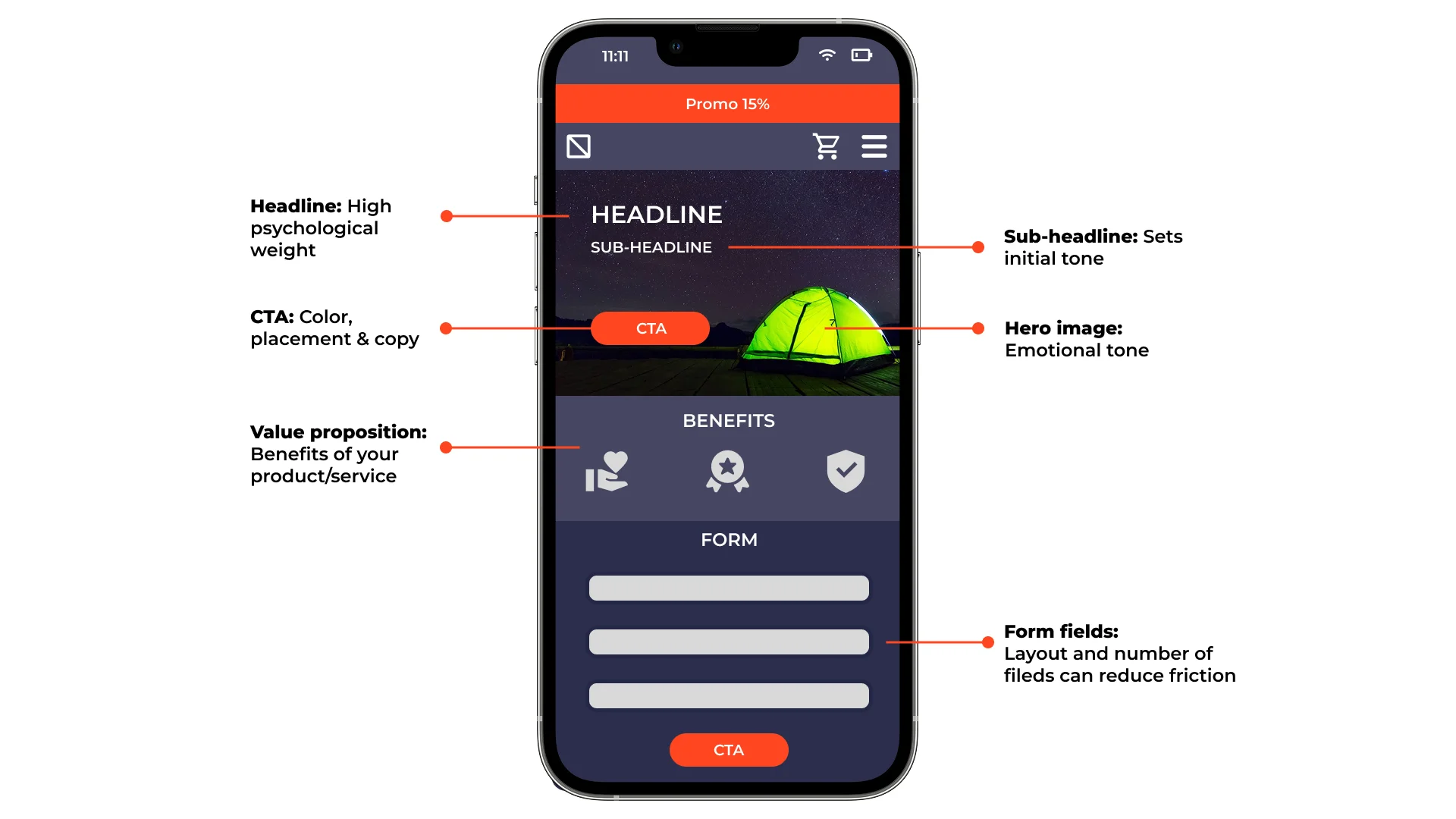
When fixing your site and determining what to test, we look for elements that directly impact the user’s “mental model” of your offer.
Traffic Requirements and Statistical Significance
This is the “reality check” of multivariate testing. Because MVT splits your traffic into many different “buckets” (one for each combination), you need a lot of visitors to reach statistical significance.
For example, if you have 30,000 daily visitors and a 5% conversion rate, a test with 3 variations might take 11 days to reach a 95% confidence level. However, if you only have 5,000 daily visitors and a 2% conversion rate, that same test could take over 400 days!
This is why data collection in multivariate testing is so crucial. We use power analysis to determine the required sample size before the test even begins. If the traffic isn’t there, we pivot to A/B testing to ensure we get actionable results in a reasonable timeframe.
Overcoming Challenges: Complexity and Performance
One of the biggest hurdles in modern optimization is “page flicker.” This happens when the original version of a page loads for a split second before the testing tool swaps it out for a variation. Not only is this annoying for users, but it can also skew your data.
To solve this, enterprise-grade multivariate testing services often use proxy architecture or server-side execution. These methods ensure that the variation is delivered at the “edge,” meaning the user sees the right version immediately without any latency.
Reducing latency and automating your A/B test processing allows for high-confidence results without sacrificing site speed.
A Comparison of Testing Methods
| Feature | A/B Testing | Split URL Testing | Multivariate Testing |
|---|---|---|---|
| Complexity | Low | Medium | High |
| Traffic Needed | Low to Medium | Medium | High |
| Best For | Major changes/redesigns | Structural/backend changes | Fine-tuning/interactions |
| Setup Time | Fast | Medium | Slow |
Client-Side vs. Server-Side Implementation
How you deploy your tests matters as much as what you test.
- Client-Side: Uses a visual editor and JavaScript to make changes in the visitor’s browser. It’s great for marketing teams who need to move fast without developer help.
- Server-Side: Changes are made on the server before the page is sent to the browser. This is more secure, flicker-free, and allows for testing complex features like search algorithms or pricing models.
When reviewing your website testing checklist, consider whether your team has the developer resources for server-side testing or if a client-side visual editor is more practical for your workflow.
The Role of AI in Modern Optimization
AI is changing the game for multivariate testing services. Modern tools now use “Multi-Armed Bandits”—an AI-driven approach that automatically shifts traffic toward winning variations in real-time. This means you don’t have to wait for a test to “finish” to start seeing a boost in revenue.
AI can also improve how you choose what to test. Using ideas from ecommerce conversion psychology, AI can spot patterns in user behavior and suggest headlines, images, or offers that may better match visitor motivations. That helps teams focus on higher-potential variations and make multivariate tests more strategic.
Best Practices for High-Impact Multivariate Experiments
Success in MVT isn’t about running the most tests; it’s about running the right tests. We always start with a strong hypothesis: “If we change [Variable X], we expect [Outcome Y] because of [Reason Z].”
To find these variables, we often start with CRO audits. By combining quantitative data (from your analytics) with qualitative insights (from heatmaps and user recordings), we can identify the specific friction points where users are getting stuck.
Following best practices for implementing CRO ensures that every experiment you run is tied to a measurable business goal.
Building a Testing Culture and Team
Testing shouldn’t be a one-off project; it should be part of your company’s DNA. This requires a cross-functional team that includes:
- Strategists: To form hypotheses and plan the roadmap.
- Designers: To create visually compelling variations.
- Developers: To handle technical implementation and server-side logic.
- Analysts: To interpret the data and find the “why” behind the results.
When you prioritize your tests for impact, you ensure that your team is always working on the experiments that have the highest potential for ROI.
Analyzing Results and Reporting
Once a test reaches statistical significance, the real work begins. We don’t just look at the “winning” combination; we look at the individual performance of every element.
Key metrics to track include:
- Conversion Rate Lift: The percentage increase in your primary goal.
- Revenue Per Visit (RPV): This is often more important than conversion rate alone.
- Bounce Rate: To see if certain combinations are driving people away.
- Segment Performance: Did the winner for mobile users differ from the winner for desktop users?
By blending quantitative and qualitative insights, we can turn raw data into a narrative that explains exactly how your customers think.
Frequently Asked Questions about Multivariate Testing
How much traffic is required for a multivariate test?
As a general rule, you should have at least 10,000 to 15,000 monthly conversions (not just visitors) to run a complex multivariate test effectively. If your traffic is lower, you are better off sticking to A/B testing or using a fractional factorial design to reduce the number of combinations.
Can multivariate testing be used for mobile apps?
Absolutely. Modern multivariate testing services offer SDK integrations that allow you to test in-app elements like onboarding flows, menu layouts, and push notification copy. This is essential for improving user engagement and retention in the competitive app market.
What is the main advantage of MVT over successive A/B tests?
The main advantage is the measurement of interaction effects. Successive A/B tests might tell you that “Headline A” is better than “Headline B” and “Image 1” is better than “Image 2.” However, they won’t tell you if “Headline B” and “Image 1” actually work better together than any other combination. MVT finds the “compound winner” that successive A/B tests might miss.
Conclusion
At SiteTuners, we believe that every click is a conversation. If your website isn’t converting, it’s because that conversation has hit a barrier. Multivariate testing services are the most efficient way to identify and remove those barriers by finding the perfect synergy between your page elements.
Since 2002, we have helped over 2,100 clients—from small businesses to global enterprises—achieve measurable results through user-centric optimization. Whether it’s a 290% increase in ROI from paid leads or a 37% boost in website engagement, our approach is always backed by data and driven by human psychology.
Don’t let your conversion rates remain stagnant. It’s time to stop guessing and start testing for triumph. Start your conversion rate optimization journey with us today and let’s build a website that doesn’t just look good, but performs flawlessly.